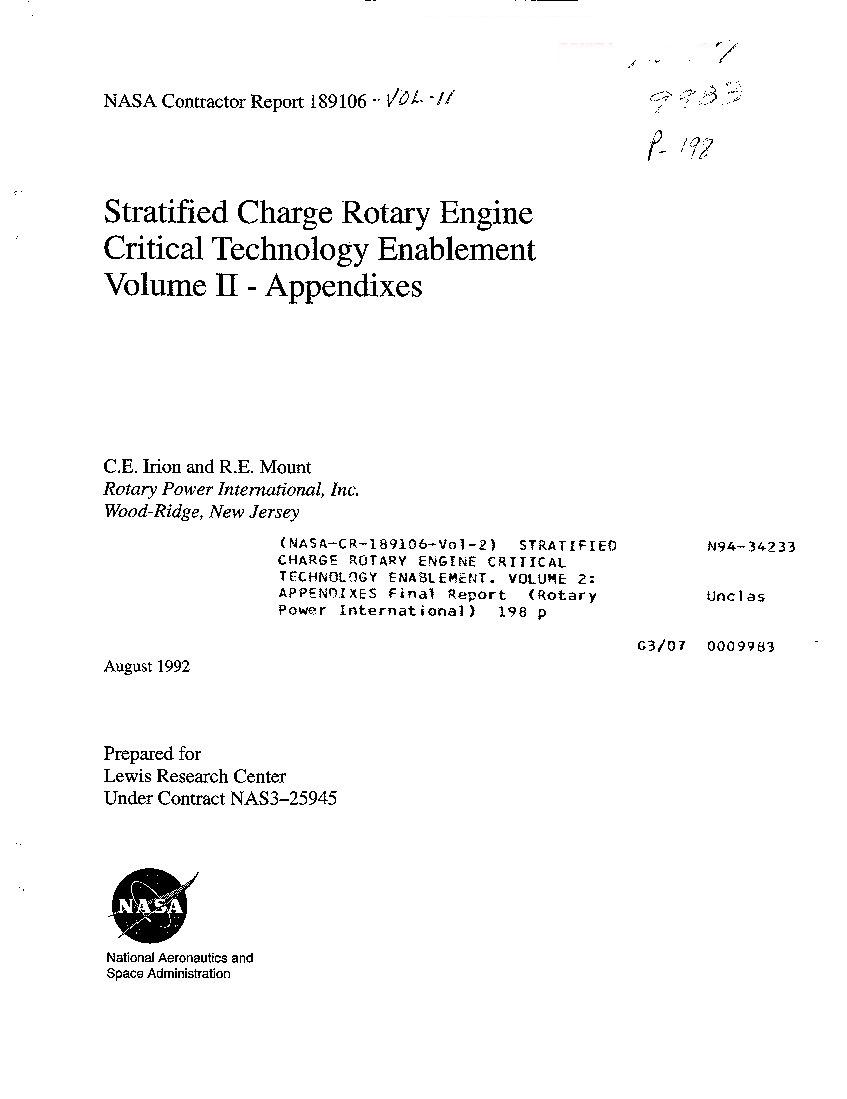
Stratified Charge Rotary Engine Critical Technology Enablement Volume II - Appendixes
C.E. Irion and R.E. Mount
Rotary Power International, Inc.
Wood-Ridge, New Jersey
(NASA-CR-I89106-Vol-2) STRATIFIED CHARGE ROTARY ENGINE CRITICAL TECHNOLOGY ENABlEMENT.
VOLUME 2:
APPENDIXES Final Report (Rotary Power International) 198 p
N94-34233
Unclas
G3/01
0009983
August 1992
Prepared for Lewis Research Center Under Contract NAS3-25945
National Aeronautics and Space Administration
This was not easy to find. In fact I defy anybody to find it now.
I think NASA removed it from the data base and reclassified it top secret :)
Paper study. Garbage in garbage out?
Paul
Paul
1992. Too bad this was just verbiage garbage?. Interesting that they
proposed a similar way to do it I thought of last year with the gearbox.
Unfortunately unlike us their thought process seemed to stop there. Gee
what a bunch of rhetoric. Did they actually get paid for this stuff? It
looks like documents were quickly whipped together and summited to make a
paper trail for claiming research grant money. Don't ask me how I know:)
And I thought we talked a lot:)
I'll print it out and sift through it when I have time.
Doug Fir
It was an appendix on a much larger pdf file. I was just lucky
to run across it. If you searched the NASA data base for "turbo compound"
it would not have appeared. I had to separate the appendix from the
larger pdf to get it small enough to email it to you, Gordon and Steve.
It is a real crime against humanity they stopped short of building the hardware
and getting some real data.
-------------------------------------------------------------------------
"The NASA Lewis Research Center contracted with John Deere Technologies
International, Inc. (JDTI), under the Stratified Charge Rotary Engine
Critical Technologies Enablement (SCRECTE) program, to demonstrate a
competitive general aviation engine. The demonstrator was based on previous
JDT! designs but required significant development in fuel economy and power
density at cruise altitude. The engine specification required 40 percent
thermal efficiency (brake specific fuel consumption, BSFC, of 0.34 lbs/hp/hr
on Jet-A fuel) at cruise conditions and specified full power to be available
from sea level to 25,000 feet altitude and 75 percent power for cruise up to
33,000 feet. In order to meet the power requirement at altitude, intake port
air density needed to be as high as previously demonstrated at sea level.
The compressor could not use shaft power, because this would increase BSFC,
which needed to be lowered. The source of energy available to improve the
BSFC and provide intake pressurization is the engine exhaust. The flow
rates, pressures, and temperatures involved strongly suggest the use of
turbomachines for these processes. JDT! employed Sundstrand to analyze the
turbomachinery system for the engine.
Sundstrand originally planned, in a multiphase program, to provide system
analysis, including component sizing and performance predictions; to design
the turbomachinery and ancillary equipment; to procure, assemble, and test
the turbomachinery system; and, fmally, to support engine testing with the
turbomachinery system. The program was subsequently descoped due to
alterations in the contractual agreements between JDTI ana:. NASA, and the
Sundstrand effort was terminated before the design hardware effort was
begun."
-------------------------------------------------------------
NASA had to shoot off five hundred million dollars every other month into
space in the form of the space shuttle and was running out of money.
NASA needs to get their priorities corrected.
--
Paul Lamar ...No rotor no motor.
The Rotary Engine NewsLetter. Powered by Linux.
ACRE NL web site.
http://www.rotaryeng.net
Copyright 1998-2006 All world wide rights reserved.