I finally got time to get my failed 13b apart. The rear rotor was
missing one apex seal, the other 2 were intact but jammed due to
the
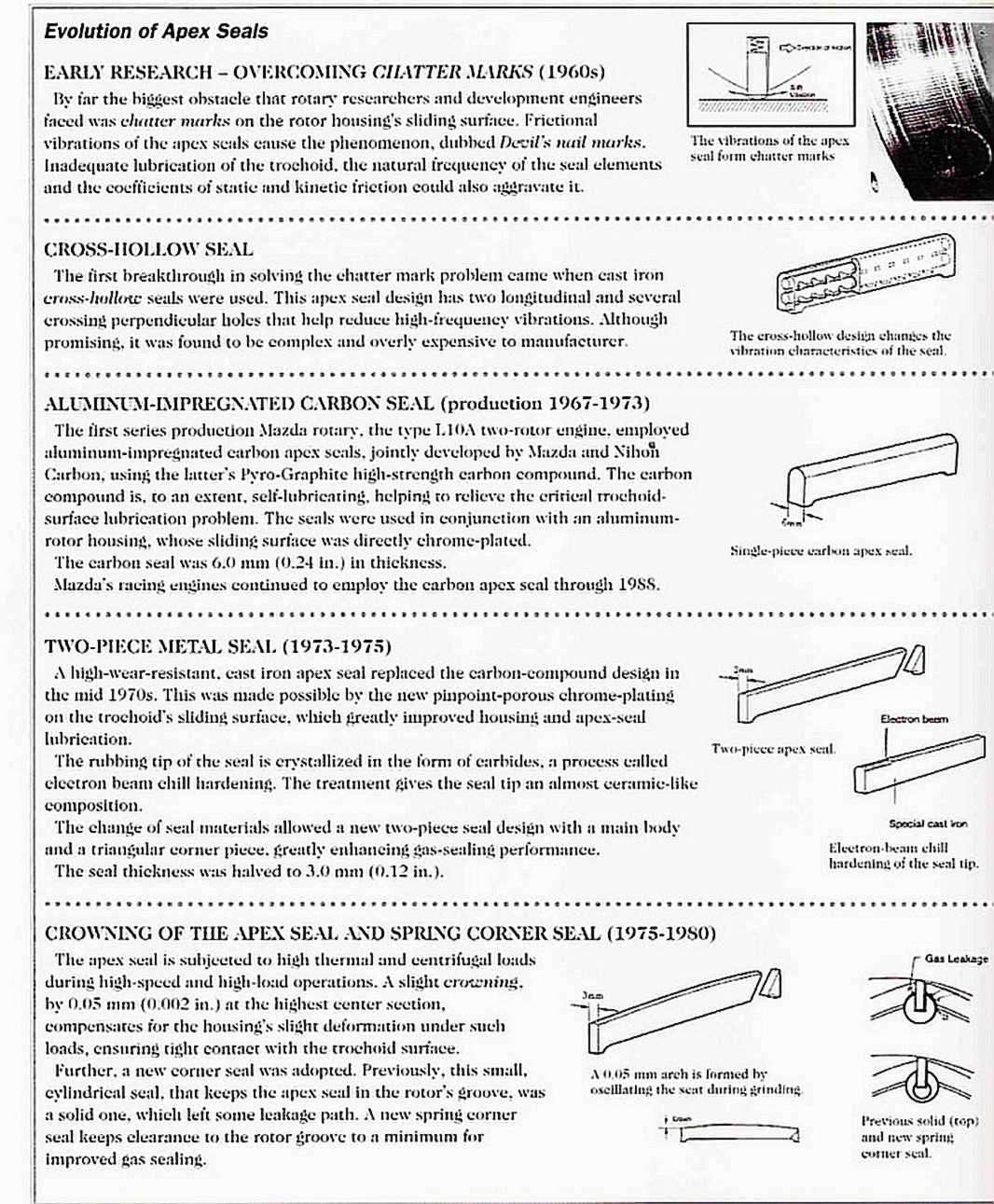
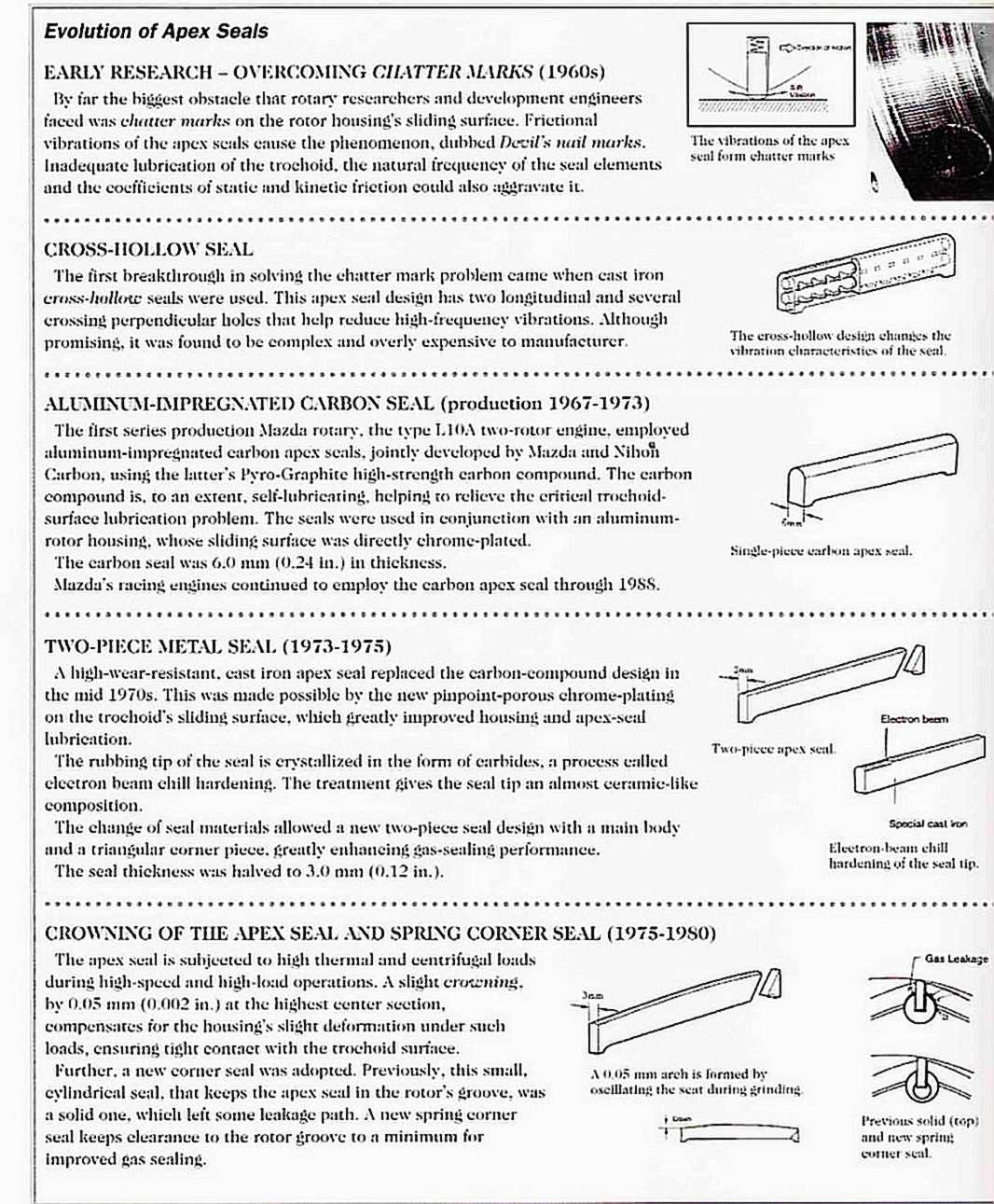
fragments of the broken one. The rotor housing has the classic
chatter
marks all around. Doing a Google of "13B apex seal chatter" results
in
plenty of examples of this failure mode. Apparently the chatter is
from
the natural resonant frequency of the seal, it eventually fatigues
the
seal causing failure.
The front rotor was in good shape, but the housing had the same
chatter
marks, but not as severe as the rear rotor. The front rotor housing
was
brand new 150 hours ago when I rebuilt this motor after the Grand
Canyon
forced landing. At that time the good rotor housing had slight
chatter
marks but I reused it. The front rotor was destroyed at that time
due to
foreign object entering the rotor.
Both rotors were missing the corner seal rubber plugs on the side
with
the short apex seal segment. Perhaps the small segment vibrated
more,
disintegrating the rubber seals?
The first 260 hours of flying my rotary bird was with stock 3-piece
seals, and I never saw any chatter marks. The last 250 hours has
been
flown with 2 piece seals and now I have chatter marks .
I now have Tracy's 2 piece apex seals and I wonder how they will
perform, it appears that the heavier weight of the 2 piece seals
puts
the resonant frequency in the cruising range of 6000RPM?
Chuck Dunlap
RV6 13B
----------------------------------------------------------------
Couple of things Chuck. Are you mixing two cycle oil with the fuel?
If so what kind of oil? What brand of seals did you have in there?
Recently I have seen some chatter marks on Dave Leonard's engine
too.
I asked Dave what the brand of the apex seals were and he did not
tell me.
He kind of changed the subject or he did not know. Years have gone
by and
we have not heard of or seen chatter marks. Lately several
companies
are
claiming they are making their own apex seals.
Seal chatter has a lot to do with the exact material they are made
from.
Mazda uses a special cast iron alloy that is heated with
a laser and chilled in liquid nitrogen. They would not do this
unless it
was necessary as it is costly. I'll send some more data on this
shortly.
Mazda has spent millions on seal research so I would not buy
anything
other than Mazda apex seals. Mazda have a new two piece seal that
will
fit in your engine. Many kinds of steel alloys have been
tried and they are known not to work including tool steel.
Silicon nitride ceramic apex seals by Ianettie are known to
work well as the density is much less than steel so too is the
weight
This raises the resonant frequency. They are diamond ground to
super smoothness to cut the friction which is also a factor
in apex seal chatter.
Apex seal chatter also has a lot to do with the spring
pressure. The right springs must be used and tailored to the
material the apex seal is made from.
Paul Lamar ...No rotor no motor.
Paul, I definitely told you what kind of seals I was using, Tracy Crooks
for the last engine, and stock 3-piece seals for the first engine. I
have never had any problem with apex seals. The first engine lost a
side seal, while cooling was obviously the downfall in the other.
The other thing we need to consider as a factor in the chatter is the
apex seal springs. As you have told me, the springs tend to get weak
over time. Weaker springs could contribute to the chatter, or even
cause it.
Chuck, did you replace the springs with your last re-build?
Dave Leonard
LCDR William Leonard
Mobile FRSS
C HSC HQ
Unit 42135
FPO AP 96426-1235
Follow the Iraq blog at:
http://leonardiniraq.blogspot.com
Turbo Rotary RV-6 N4VY
My other websites at:
http://members.aol.com/_ht_a/rotaryroster/index.html
<http://members.aol.com/_ht_a/rotaryroster/index.html>
http://members.aol.com/_ht_a/vp4skydoc/index.html
------------------------
I am really happy you are getting the newsletter in Iraq Dave. How is it
going?
Here is a picture of your rotor housing out of your last engine. Sure
looks like chatter to me :)
Paul Lamar ...No rotor no motor.
Paul, I am mixing Wal-Mart 2stroke oil 100:1
The seals were 2 piece on both rotors, I think they were Hurley seals
from a group buy in mid-2002, but one rotor that I replaced after the
2003 Grand canyon incident I used a set of seals MTX112N326 from
Mazdatrix. I don't know if there is a difference between those seals.
Dave, I replaced the springs when I first built the motor in mid 2002,
but I reused them when I replaced the rotor in 2003. Is there a way to
test the springs, other than the free height measurement shown in the
Mazda manual, which I always check when building a motor.
Chuck
Emon Hurley is a great guy but he does not have the apex seal
technology Mazda has. Years ago I used to think these seals
were as good as Mazda seals but in the last couple of years or
so I have come to realize there is a huge difference.
I think Mazdatrix sells only ferrous factory
seals or Ianetti ceramic seals. As I recall that is what Dave
Lemon told me. When Dave measures the compression on a recently over
hauled engine he can tell whether they are factory seals or not.
Factory seals have higher compression.
Well it is possible that the heat treat on the springs could go
away but it is unlikely to happen without also reducing the free height
of the spring. Go with the free height measurement spec in the
Mazda overhaul manuals. That is not to say they could not permanently relax
in operation due to over heated oil or not enough apex seal
oil to cool them. The center of the apex seal is a hot spot (500 F) in
the rotary engine and is affected by the temperature of the
sump oil among other things. Also the steel alloy the spring is
made of can affect the exact operating temperature that causes
a reduction in yield strength. (A permanent relaxation of the spring.)
Something like Inconel springs would probably be the best.
--
Paul Lamar ...No rotor no motor.
The Rotary Engine NewsLetter. Powered by Linux.
ACRE NL web site.
http://www.rotaryeng.net
Copyright 1998-2006 All world wide rights reserved.