Paul,
Steve is a good friend and retired from Honda. I know you've said that
you don't want to involve yourself with anything that doesn't have a
rotor, but I thought you would at least want to know about this engine.
jd
Begin forwarded message:
> *From: *"Steve Loizeaux"
>
> John,
>
> I've pitched the engine from LIM Technology in previous emails,
> but now that it's had common-rail fuel injection installed and
> been tested (the too-long report is attached), the inventor, Jeff
> Klein, is even more intent on finding a development partner. Do
> /you/ know anyone in (or outside!) the industry who' might be
> willing to evaluate the Simple Cycle engine, and consider
> investing/participating in its further development?
>
> I've been to LIM Technology twice and seen prototype engines run.
> This is not something an eccentric inventor did in his mother's
> garage. And, frankly, it's way ahead of Bruce Crower's six-stroke
> water injection setup described in my recent email! The Simple
> Cycle engine has no conventional valve train, runs cooler than
> engines that route exhaust thru the head, and would weigh
> less, have greater power density, get better fuel mileage, and
> cost less to build than a conventional engine of similar
> size/output. One application for it would be a diesel-electric
> hybrid, best choice for the near future according to MIT.
>
> LIM has a rep in Europe who's pitched the LIM valve and the Simple
> Cycle engine to major EU auto and parts makers. Some (like
> Peugeot) have responded, asking about the valve technology. The
> only concrete response so far is a "letter of interest" from
> Dassault (I thought they only built jet fighters!)
>
> This IS a serious project. From a conceptual perspective
> alone---combining the new valve design with a unique rearrangement
> of conventional diesel engine components---the engine's
> considerable potential should be obvious to any mechanical engineer.
> LIM Technology L.L.C.
>
> 150 Blades Lane, Suite E
> Glen Burnie, MD 21060
> ceo@Limtechnology.com <mailto:ceo@Limtechnology.com>
> (410) 760-8801
>
>
>
> February 26, 2006
>
>
> When a Maryland start-up company announces a major improvement in
> the field of internal combustion, it sounds like the wrong topic
> in the wrong place. Today, politicians advocate hybrid cars, fuel
> cells, and fuel from corn, and the president touts hydrogen as
> the fuel of the future. But wouldn't a new engine technology which
> is very fuel-efficient and inexpensive to build be worth a closer
> look? LIM Technology holds exclusive rights to patents on such
> technology, four in the U.S., three of them internationally.
>
> The LIM technology team includes four mechanical engineers, two
> with PhD degrees: Mark McVea, a consultant based in Camillus, NY
> who teaches SAE seminars on engine and transmission technology,
> and Douglas M. Baker of TECAT Engineering, based just outside
> Detroit. Our chief engineer, Konstantin Mikhailov, has a masters
> degree, and works in the Maryland headquarters.
>
>
>
> We've built three working prototype diesel engines in our Maryland
> machine shop. The latest was shipped to Detroit where it underwent
> operational testing and analysis, and computerized modeling
> of theoretical performance. The results showed a very competitive
> ratio of power output to fuel consumption over its entire
> operating range, easy starting in cold weather, low idle speed,
> and a high, flat torque curve.
>
> The LIM Simple Cycle engine is designed to take better advantage
> of the laws of physics than conventional engines. It relies on the
> same principles developed and widely adopted after the first
> four-stroke engine was patented (in 1875), but our unique
> application of those principles makes it “simpler, smaller, smarter”
.
>
> If you're qualified to invest in a start-up venture, you may want
> to read the /first draft/ of Dr. Baker’s report [attached]. While
> not a business plan or prospectus, it /is/ a scientific assessment
> of the Simple Cycle engine's potential based on operational tests,
> and analysis of the resulting data.
>
> Our prototype 2.8 liter (159 cu. Inch) three-cylinder engine was
> able to idle at 180 rpm. Dr. Baker’s studies indicate it
> would idle for over seven hours on less than a gallon of fuel. A
> conventional engine would idle at around 800 rpm---and probably
> die at less than 600---so if you let it idle seven hours, it
> would likely consume over /two/ gallons of fuel. Based on test
> data from our prototype, power density, and fuel economy---even at
> full power, are projected to be better than a
> conventional engine. One of Dr. Baker's areas of expertise is the
> design and application of modern diesel fuel injection. We believe
> this combination of best intake-air and exhaust management (*LIM*)
> and best fuel management (*TECAT*) will result in an
> industry-leading product, likely to produce industry-leading
> profitability.
>
> Profitability doesn't require a large market share because in the
> global market more than 100 million multi-cylinder engines are
> produced every year. The Wankel rotary engine, for example,
> another pioneer technology, but not nearly as fuel-efficient as
> ours, is today found mainly in Mazda sports cars which
> command far less than 1% of the world market. However, adjusted
> for inflation, the Mazda engine development group earned more than
> a billion dollars.
>
> Today, the market is much larger, our Simple Cycle technology is
> far more fuel-efficient, and our engine is highly likely to do
> better. The purpose of this letter is to motivate you and others
> to join this dedicated group; to help bring to market new
> technology which will extend the useful life of our petroleum
> reserves and reduce the costs of commercial and personal
> transportation.
>
>
>
> Based on the discounted value of anticipated future net income, we
> think a current high-risk valuation of LIM should be $30
> million. We think no more than $3 million in new investment will
> be needed to get us to commercialization.
>
> Two of our three prototypes are still in Glen Burnie, and can be
> demonstrated on short notice. The most advanced prototype, with
> common-rail fuel injection, is in Livonia, Michigan, at McLaren
> Engines, where a great many engines and transmissions are tested
> and analyzed. To see a demo of this latest engine, contact Dr.
Baker.
>
>
> *Contacts:*
>
> LIM: Jeffrey Klein, (410) 760-8801, Glen Burnie,
> MD www.limtechnology.com <http://www.limtechnology.com>
>
>
>
>
> TECAT: Douglas M. Baker, (248) 615-9862 Livonia, MI
> www.tecatengineering.com <http://www.tecatengineering.com>
>
>
>
> Douglas Baker, PhD, operates TECAT Engineering, his own consulting
> business. He has proposed forming a company owned jointly by LIM
> Technology and TECAT to cross-license the existing technologies of
> both companies, and add to the new company any technology
> that either company develops in the future. This would ultimately
> diversify our proposed product line. Dr. Baker’s skills in digital
> simulation and fuel injection design are essential to LIM's
> success. And LIM's patented valves are important to Dr. Baker's
> success: he plans to include them in an engine design he's been
> working on for years. We're obligated by agreement not to disclose
> any details, but his "NexTier" technology and "Revolation" engine
> will have great high-end value for military users and others who
> need exceptional power from a small package, good fuel
> consumption, and low emissions.
------------------------------------------------------------
Its a diesel engine. Too heavy for aircraft use and they tend to destroy
propellers because of a sharp power pulse. The .37 BSFC is nice but a good
power to weight ratio is not among their strong points. Been there and
done that since 1932 :) Never really caught on. Also the .37 BSFC tends
to be at about 50% power. At higher power levels the BSFC of a diesel
approaches that of a gasoline engine. From the looks of it
it is not exactly compact either.
BTW I just bought a Honda Odyssey. Great minivan.
--
Paul Lamar ...No rotor no motor.
Paul and others - this looks like simply the old GMC two stroke Diesel with
the exhaust and scavenging
ends swapped nothing to support claims of great perf increase - low cost -
simplification nor
light weight.
Incidently I hear that an Audi Diesel ALMP2 won the 12 hour race overall
Vance
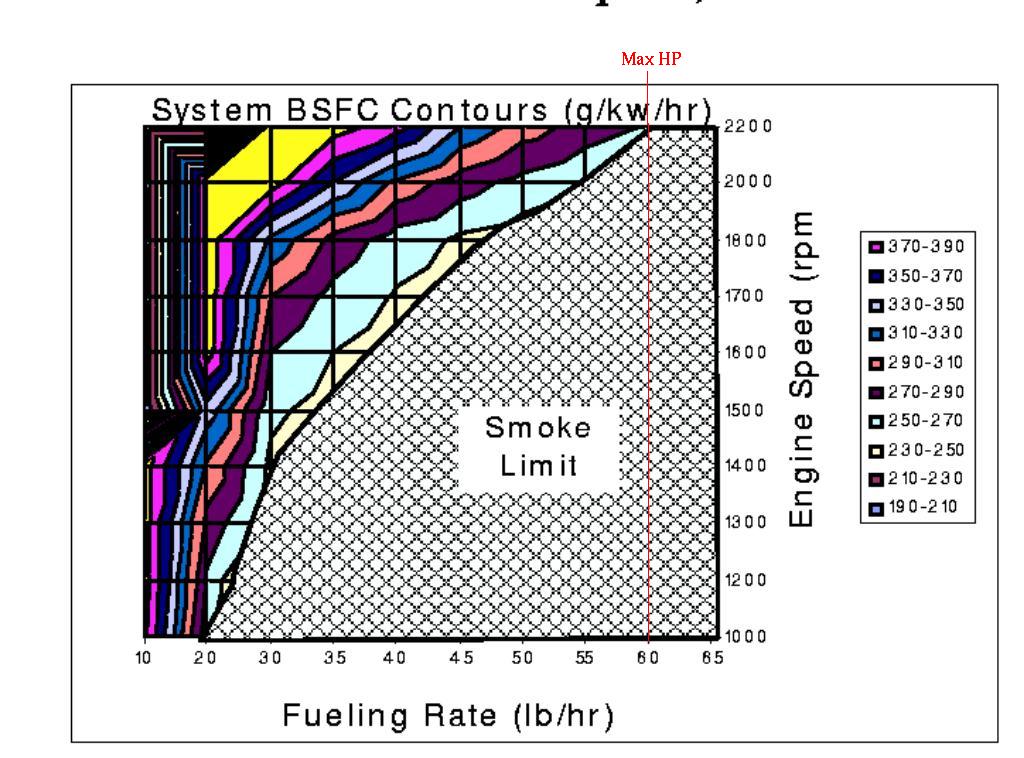
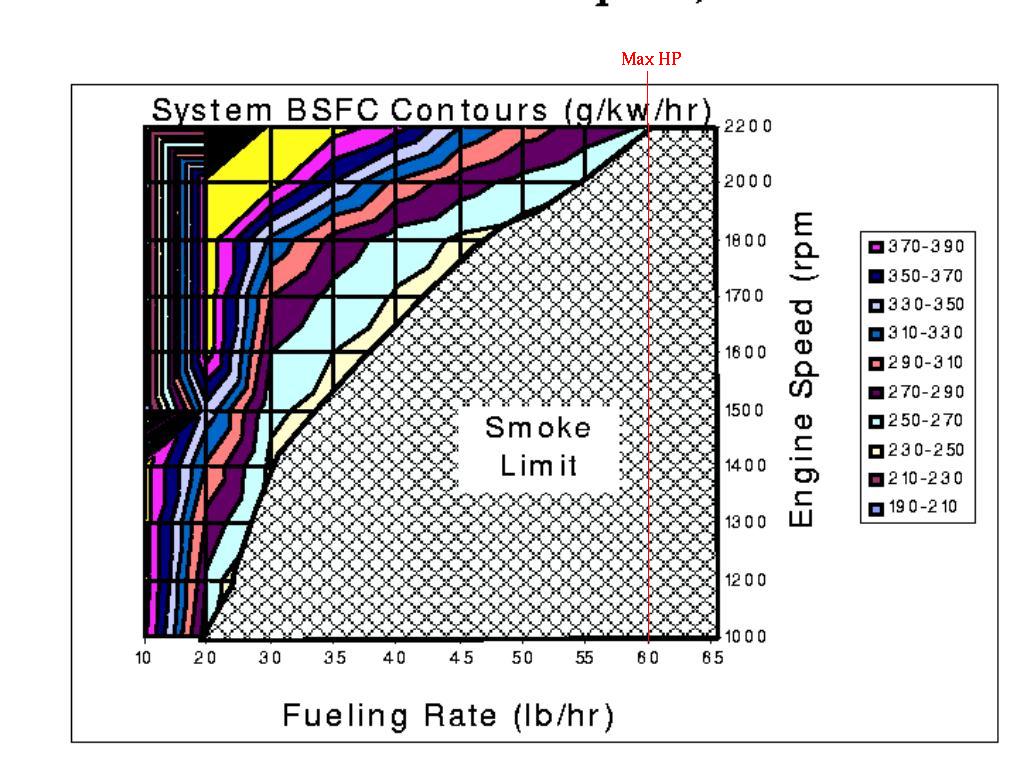
Here is a chart from that pdf that John sent me. Apparently best BSFC is
a long way from max HP.
They have a strange way of plotting a BSFC map. Hard to compare with
a traditional BSFC map. I have added a couple of comments to try to make
sense out of it.
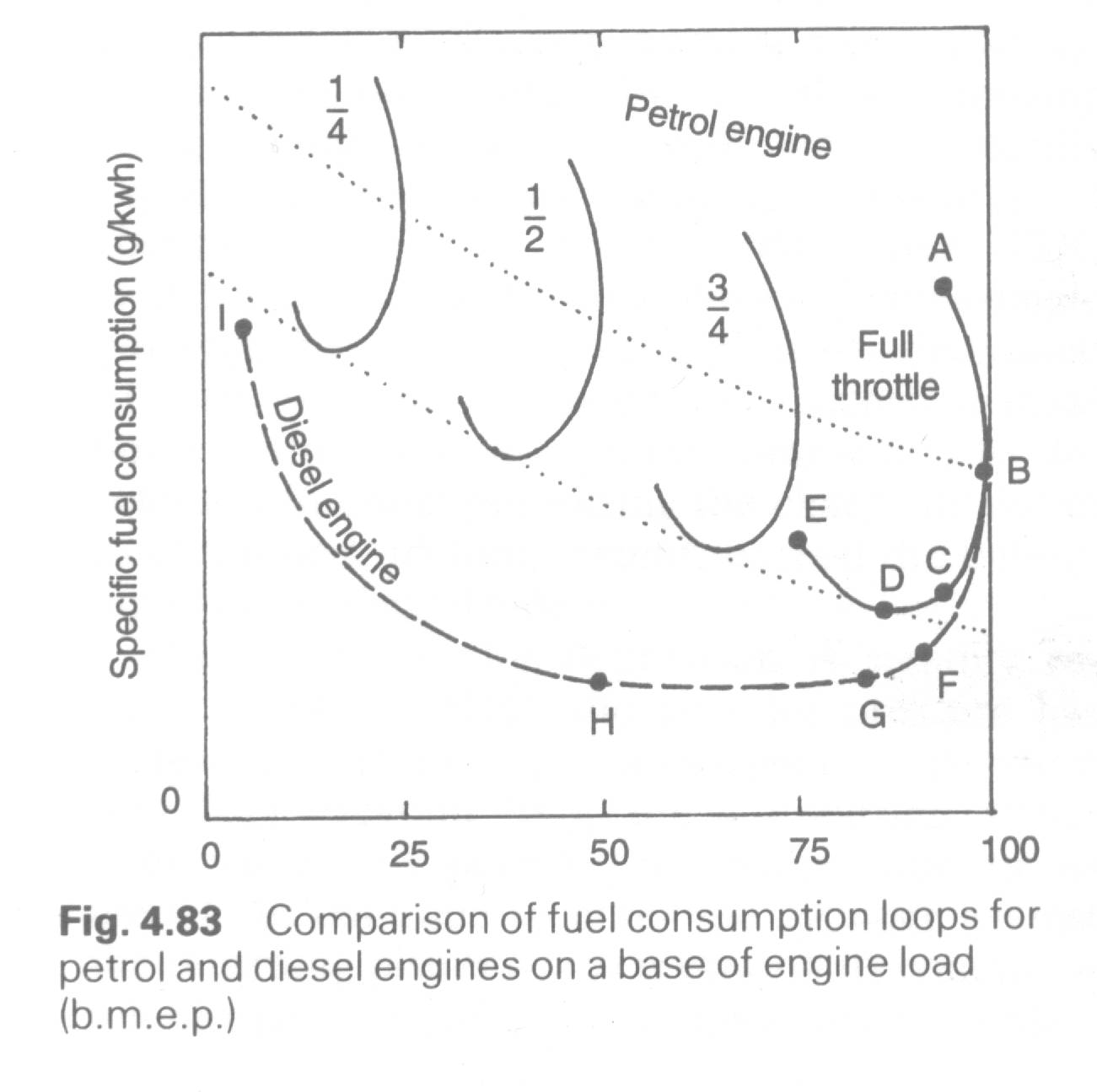
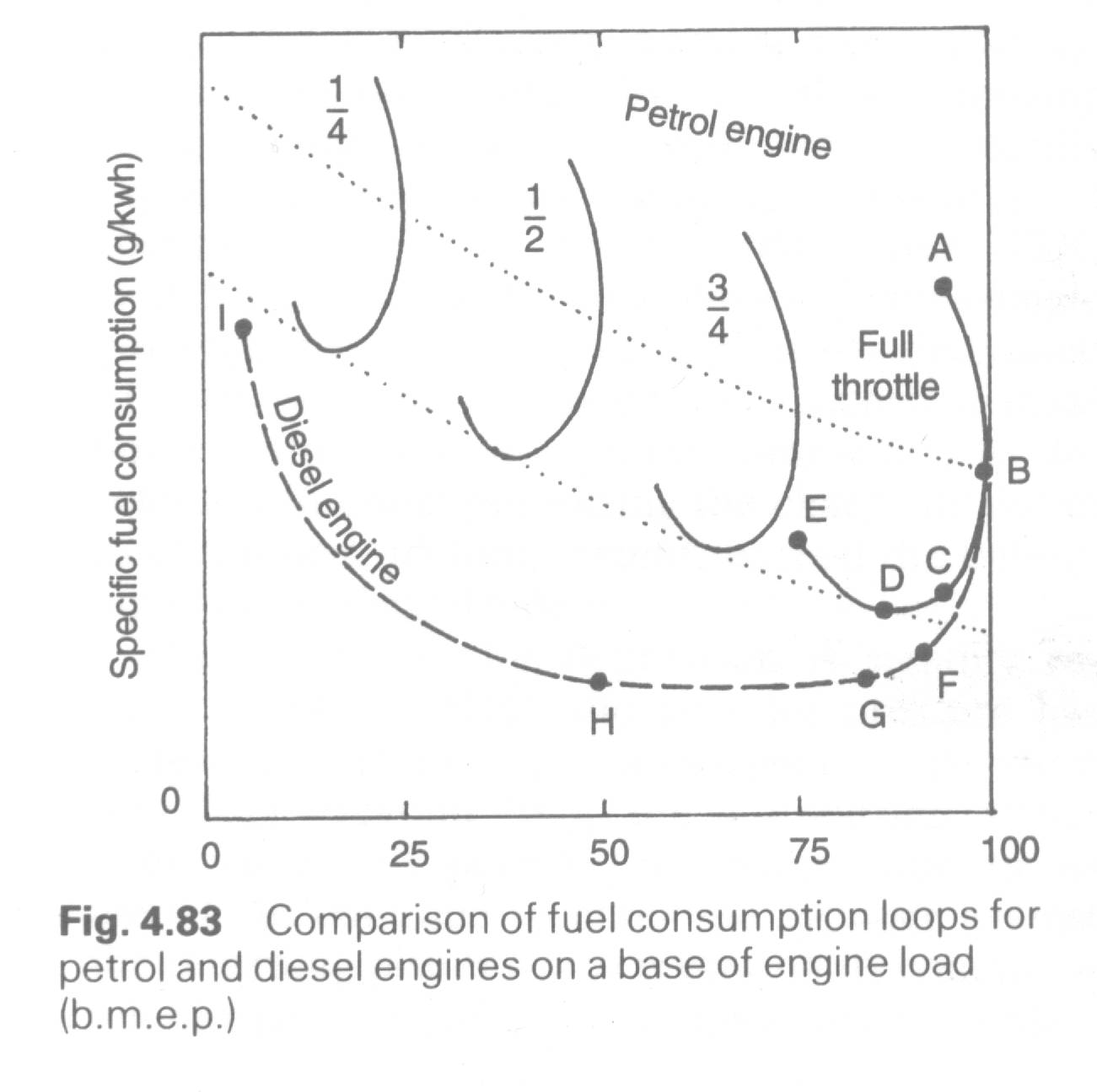
Here is a conventional diesel traditional BSFC map for comparison.
This would make a poor aircraft engine as it is likely to be very heavy
as it is a low speed diesel. High compression ratios are good for efficiceny
but bad for weight. The advantage to the turbo compound is you get
high efficiency with light weight.
Paul Lamar ...No rotor no motor.
The Rotary Engine NewsLetter. Powered by Linux.
ACRE NL web site.
http://www.rotaryeng.net
Copyright 1998-2006 All world wide rights reserved.