Yes Paul: I do have a copy of the SAE report on the McCulloch turbo
compound. I will have to search for it. When I find it I will scan it
into my other computer and send it to you.
Bob YoungApple Valley, CA
Thanks Bob.
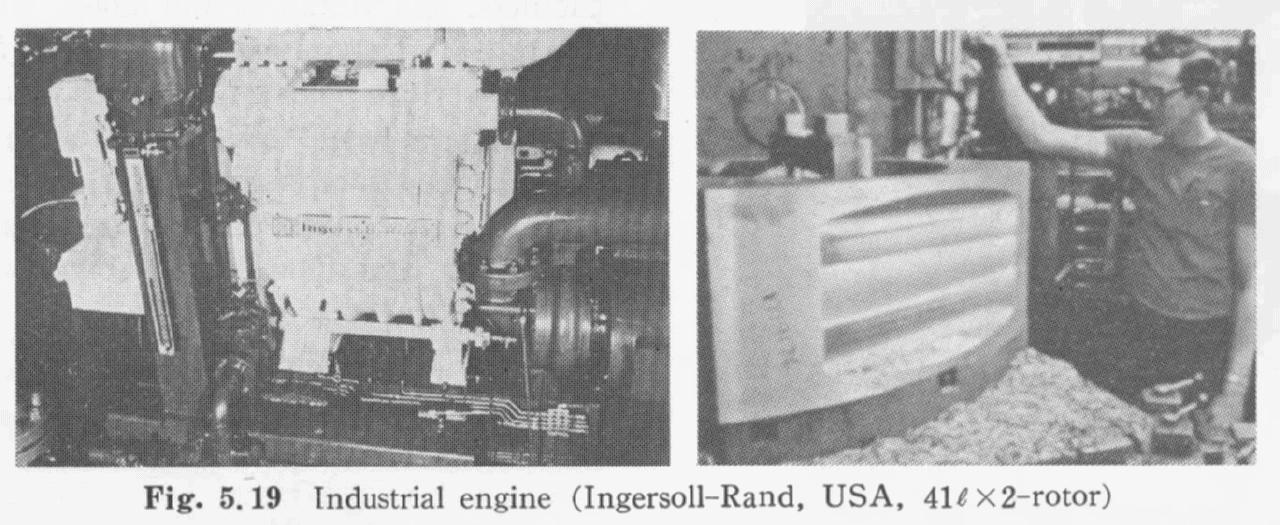
It never ceases to amaze me how many turbo compounds engines were out
there when you start looking for them. Hopefully the rotary turbo compound
will
stick because of the high price of fuel.
--
Paul Lamar ...No rotor no motor.
Paul:
I'm not sure a rotary is a good match for some of the heavier vehicles, but
I heard on the news today that the administration is planning on jacking up
the average mileage minimums on trucks and SUV's. You would think that
turbo-compounding would be well worth a second look for those applications.
George Wright
---------------------------------
Depends on the size of the rotary engine :)
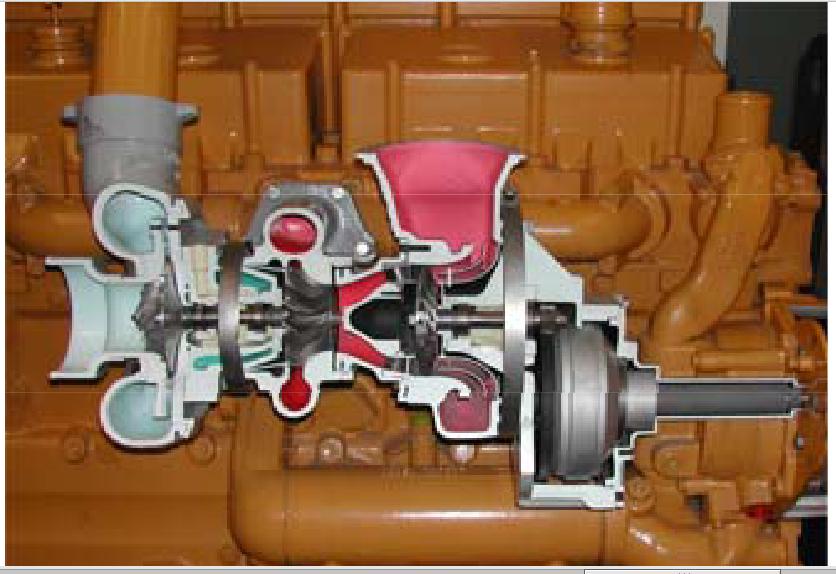
Both Caterpillar and Scani have built turbo compound diesels.
Diesels are so much more efficient than gasoline engines for trucks
it is hardly worth the expense. Even truck diesel don't operate
at 100% power as they need excess power for acceleration and
climbing hills. That is why you see trucks creeping up the grapevine.
Diesels do well at part power as far as BSFC is concerned.
What Scania and Catapillar failed to do is attempt to broaden
the HP range over which turbo compounding is optimized. They basically
both used the R3350 TC type of a constant gear reduction between
turbine and engine RPM. There may be a little bit more to be had
out of a turbo compound diesel with a variable ratio gear box between
turbine and engine shaft. The other thing they did wrong IMHO is use
two turbines when one will work. That implies additional unnecessary heat
loss.
Quote:
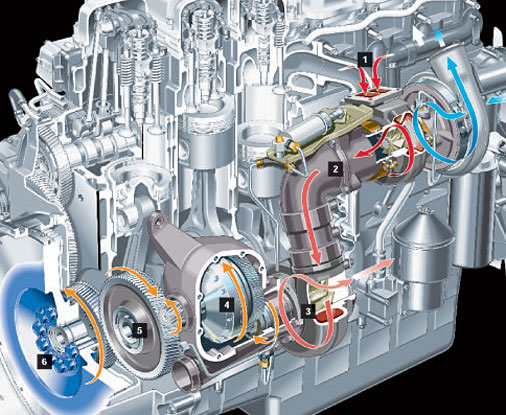
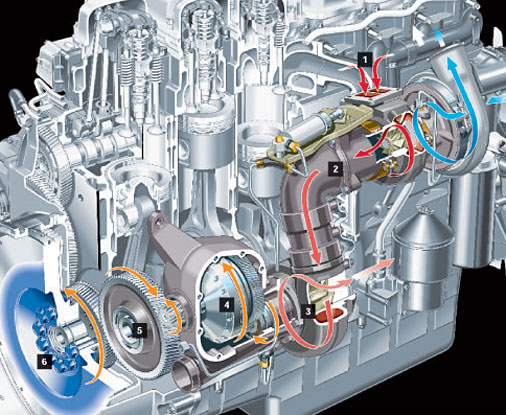
"Scania turbo compound;
Turbo compounding creates extra power by converting "wasted" energy.
Turbo compounding seems to defeat the laws of physics by creating energy out
of nothing. It works by recovering energy that would otherwise be lost, or
wasted. It is a classic example of recycling. Instead of expelling "wasted
energy" via the exhaust pipe, more heat is extracted from the exhaust gases
by a second exhaust turbine downstream from the turbocharger.
The second turbo (the turbo compound turbine) spins at 55,000 r/min. This
motion is passed through turbine gears and a hydraulic coupling, then
through the timing gears to the crankshaft. Stepping down the revs produces
a useful boost in torque, which when reaching the flywheel adds momentum.
You get this extra driving force without increasing expenditure on fuel.
The economical green band on the rev counter provides a wide range of
economical engine speeds, making life easy for the driver. The engine
exhibitsXgreat flexibility. The rotation of the crankshaft benefits from the
constant extra drive coming from the turbo compounding process, helping to
even out the rhythmic pressures induced by combustion. So the engine runs
more smoothly."
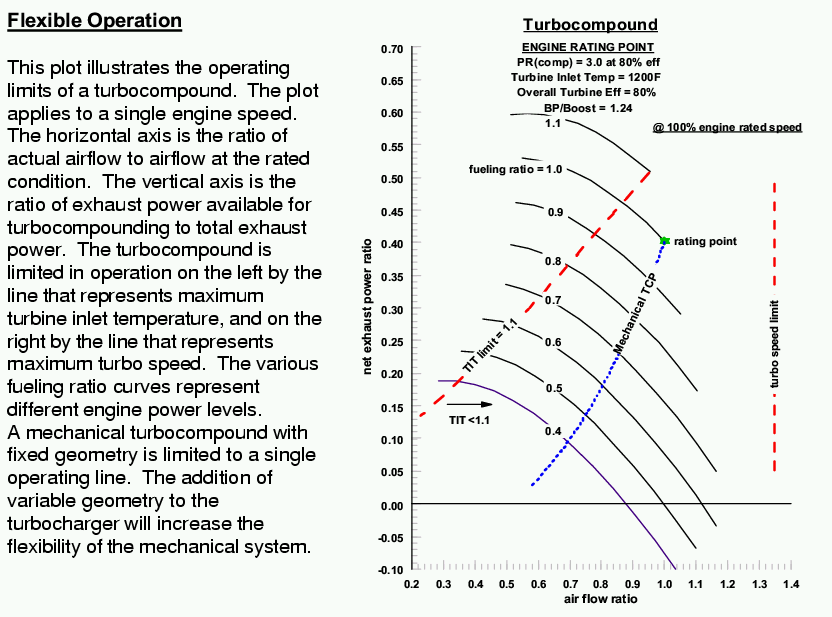
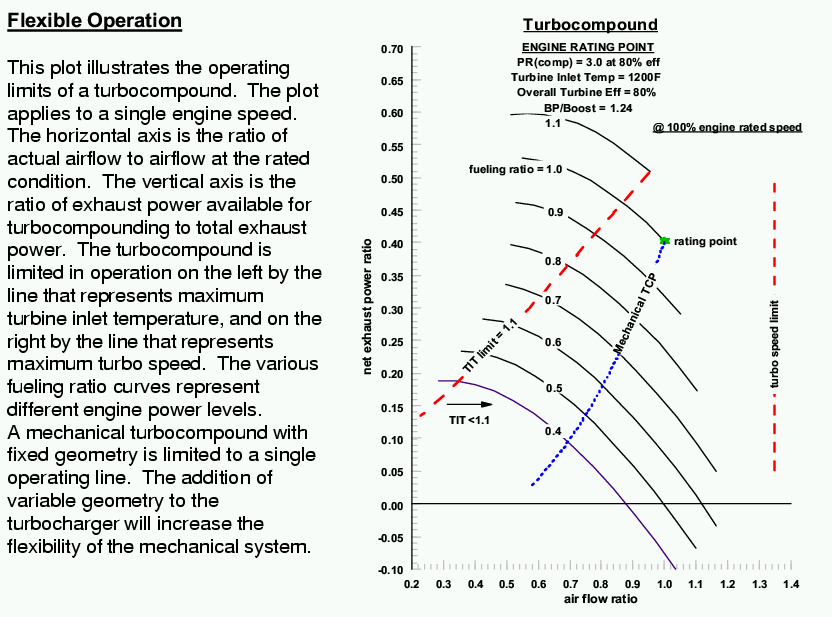
I like the chart from Catapillar as it clearly shows how the turbine RPM
and turbine inlet temperature converges to limit the power obtainable
from an exhaust turbine.
Paul Lamar ...No rotor no motor.
The Rotary Engine NewsLetter. Powered by Linux.
ACRE NL web site.
http://www.rotaryeng.net
Copyright 1998-2006 All world wide rights reserved.