Paul,
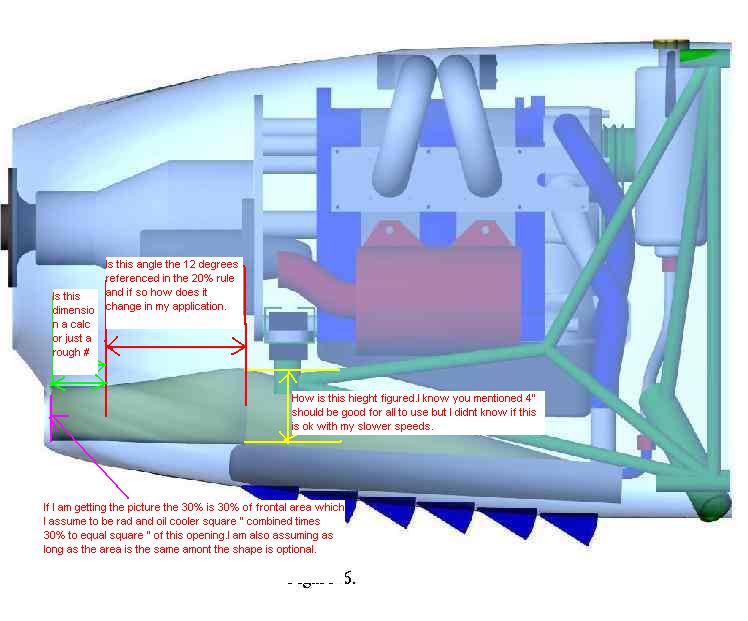
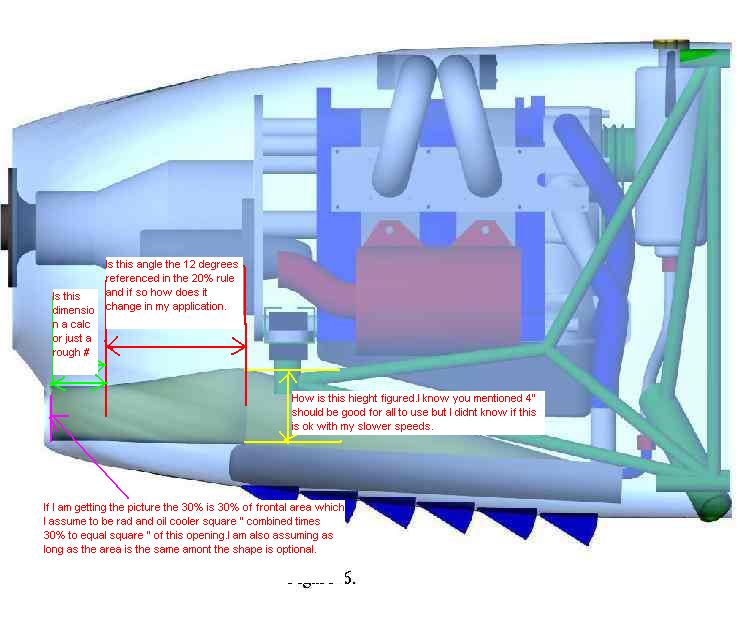
Pic 1 is proposed scoop shape
Pics 2,3 are std. install with 9" from back of prop to front of rad.
Pics 4,5 are rotated 90 deg. to get more distance from prop flange but
also increases width of difusser.
Im not sure which is more important
I will build cowl flaps and one advantage of pics 4,5 install is option
of separately controlled cowl flap for oil cooler
My climb out speed is more like 65 to 80 with top speed of 155
Thanks again for your time,
Geir
Pic 4 & 5 is the way to go as the oil cooler can be mounted side
by side and it is a two pass rad with inlet and outlet at the back.
You might want to use 30% opening area because of the slow
climb speed.
BTW what are the dimensions of the rad core?
I love the idea of separate cowl flaps for oil and water with a common
diffuser.
Not only are the flaps individually adjustable but the air pressure
one or the other core gets depends on the individual flap settings
if you get my drift. If you close the water flap the oil cooler
gets max air pressure and vice versa to look at the extreme case.
This is a great idea and will work extremely well.
You are doing a great job on this airplane Geir.
Paul Lamar ...No rotor no motor.
Paul,
Sorry for splitting the questions on re: 20% and re: elite.My intent was
to reference the 20% rule and try to understand the math and apply it to
my install.The rad dim. is 18" between tanks by 13"
Thanks,
Geir
----------------------------------------------------------------------------------------------------------------------------------------
To cool the engine takes a given mass of air raised to a certain temperature.
The mass of air taken in is a function of the forward speed.
Volume of air in cubic feet per second equals area of opening in square
feet times the velocity in feet per second.
Rule of thumb base line for 20% is 105 MPH
So at 70 MPH you need a 50% bigger opening.
Rough guess is 30% of core area instead of 20% of core area.
There are tons of other factors so this is just a rough guide line.
OK so your core volume is about 468 cubic inches given two inches thick.
I think that will be enough assuming the wedge diffuser is well sealed to the
rad and the scoop opening and you have some good cowl flaps on there.
Paul Lamar ...No rotor no motor.
Paul,
Forgive my ignorance but I am not understanding the calcs to size the
diffuser correctly.I tried the math using your 20% email and dimensions
you gave but for some reason I dont come up with the same answers .I am
going to use 30% as you suggested but I am not understanding the
process. My dimensions were 18" wide by 18" deep by 2" thick(rad and
oil cooler combined). I have 5" of height below schertz beam and 12"
from back of prop to front of oil cooler/ rad assembly.Thanks for your
patience with my lack of knowledge.
Geir
The 20% rule is based on the assumption the rad is 2 inches thick.
The 20% refers to the scoop opening area relative to that of the
"frontal area" (F.A.) of the core. You have two cores. The core F.A. is
18 by 18 or 324 square inches. 20% of that is 64.8 square inches
3 inches high by 20 inches wide or 4 inches high by 16 inches wide.
30% would be 97 square inches or 24 inches wide by 4 inches high.
the scoop can take a smiley face form if you wish but keep it as far from
the prop shaft as practical.
The section of duct between the scoop and the wedged shaped diffuser
in theory should be of constant area but some variation in area probably
would not be noticed. The length is optional. The entrance into the wedged
shaped diffuser should also be 20 to 30% of the core F.A.
Since the stock oil cooler is 5 inches wide and and the water core is 13
inches wide you have 18 inches wide total. You have 5 inches below the beam to the core
so that works out to 90 square inches. Pretty good for 30% of the frontal area of
the cores. If you can slide the rad cores forward a bit due to the wedge shape
of the diffuser you can get a bit more opening area.
Now every body knows why the position of the beam is critical to your cooling
effectiveness. :)
BTW Geir please forward quote so people can follow the thread.
Paul Lamar ...No rotor no motor.
The Rotary Engine NewsLetter. Powered by Linux.
ACRE NL web site.
http://www.rotaryeng.net
Copyright 1998-2006 All world wide rights reserved.