Hi Paul & all,
"Subject: More comments from Paul Lamar
As back ground info on the rotary. The bare engine block weighs about
190 pounds with cast iron end housings. About 140 pounds with aluminum
end housings."
Anyone flying with these aluminum end housings? Any links to more info?
(Please excuse my ignorance if these are well known or previously
discussed items)
Thanks,
Hennie
---------------------------------------------------------
Never a problem on previously discussed items.
That is why we are here.
Not that I know of now. Allan Tolle probably flew an Everett Hatch
all aluminum engine ten years ago or so.
They are rather expensive. At about $1200 to $1500 USD
from Racing Beat. The rear and two rotor intermediate housings
in this 3 rotor engine picture are aluminum.
There is some question about the wear surface process and durability.
Racing Beat would not tell me what the wear surface process was so I
doubt it
was detonation gun coated. If I were building all aluminum end housings
I would brag about using proven, expensive detonation gun coatings.
IMHO the ONLY reliable way of doing an all aluminum end housing IMHO.
If the wear surface does not hold up on these Racing Beat aluminum
end housing you could always have them detonation gun re coated
with silicon carbide and diamond reground.
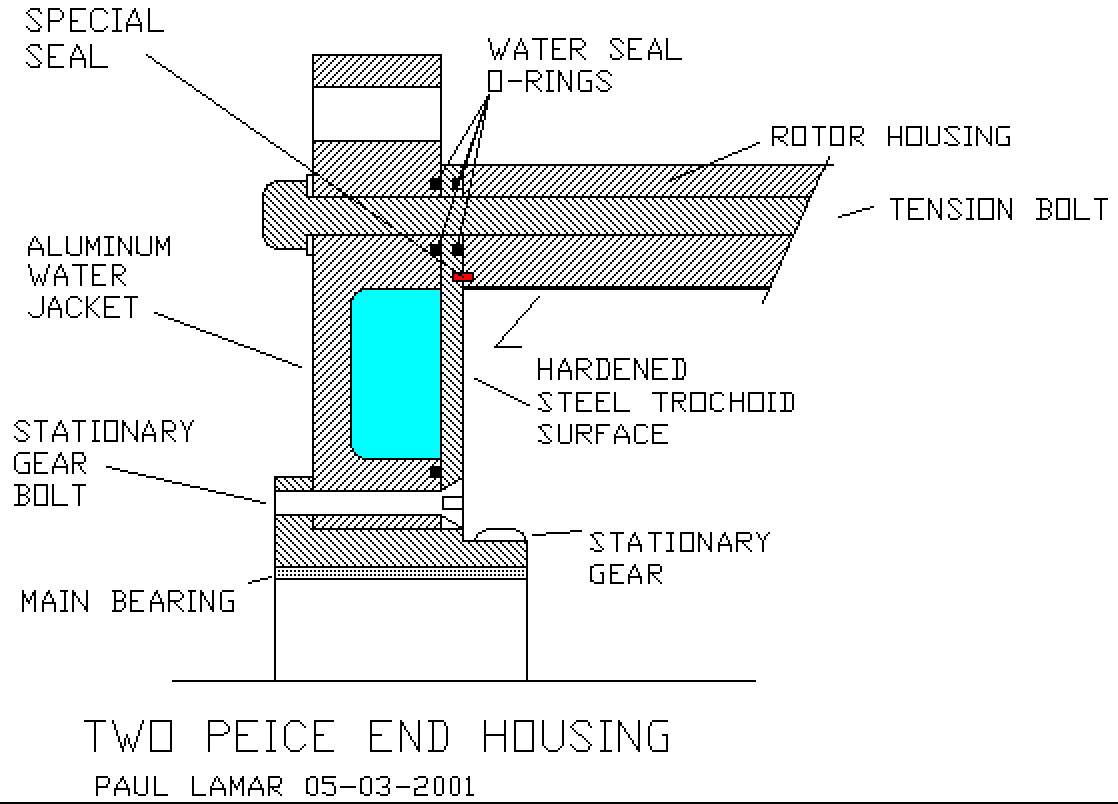
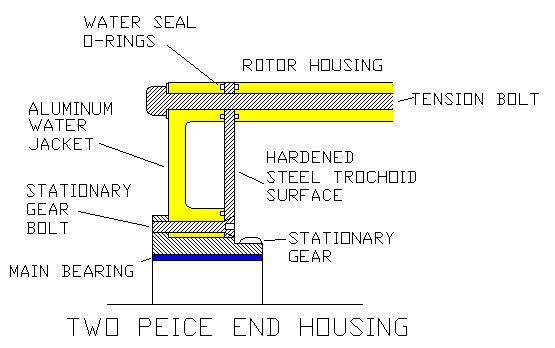
Richard Sohn is also developing a two piece end housing with
cast iron wear surface. <unicorn@gdsys.net>
Paul Lamar ...No rotor no motor.
Paul,
Have you heard anything good about the process called Electrochemical
Metallizing? I got this off the Swain web site
(http://www.swaintech.com/weld.html).
<snip>
Electrochemical Metallizing
Metallizing is often used to describe wire flame spr-
aying. The flame spraying process, however, should not be confused with
electro chemical metallizing, an out-of-tank plating process for adding
a metal coating to a metal substrate.
Electrochemical metallizing is a technological br-
eakthrough, an improvement over a process originally termed "brush
plating". Thin (0.0001 in. to 0.01 in.) metallic coatings are applied at
low temperature. A dc power pack has two flexible leads. One goes to the
workpiece and the other connects to one of a number of working tools or
styli. Anodes of different sizes and shapes are connected to the end of
the stylus and wr-
apped with an absorbent material. The covered anodes are dipped into the
plating solutions, or the solutions are pumped to the anodes when the
areas to be coated are large.
The positive lead from the dc power pack is connected to the work tool
and the negative lead is connected to the workpiece. An electrical
circuit is completed when the wrapped tool and workpiece are brought
close to one another, resulting in metal being deposited from the liquid
solution onto the metal base.
More than 100 primary metals and alloys can be deposited by this method,
including nickel, copper, tungsten, cobalt, gold, silver, tin, zinc,
Babbit, cad-
mium, lead, and nickel-tungsten.
Electrochemical metallizing applications include repairing damaged
printed circuit boards, dented molds, scored or pitted hydraulic rams,
damaged pr-
inting press rolls, and dented or cracked extrusion dies, and resizing
pins or gates. Electrochemical met-
allizing is also used for military repairs, as it meets many military
specifications for wear, corrosion, and resizing
<snip>
Years ago we used to use an oxy-acetylene torch setup to spray powdered
metal onto construction equipment wear surfaces such as backhoe buckets.
It was subjected to extraordinary conditions and survived. I haven't
done anything along those lines since then. According to Swain Tech,
the process has advanced considerably. I was wondering if this could be
an economical solution to the aluminum end housings?
Mark Steitle
One thou (.001) is not very thick.
It might be but the big problem is different materials on aluminum.
There is a temperature expansion difference to contend with.
Detonation gun coating actually embeds the wear surface particles into the
aluminum as they impact the aluminum at super sonic velocities.
The particle size can be varied to optimize the results. In a way it is
similar, (on a microscopic level) to the SIP process Mazda uses for
rotor housings. There is a mechanical lock between the steel liner
and the aluminum. It has been proven to work on aluminum end housings by
Mazda and others. Why risk anything else unless you are General Motors,
Ford, Mazda, Toyoto etc. etc. ? I don't know of anybody with the $$$$$
resources to
test 500 engines for 500 hours each to see if something new works.
Paul: It has been many a year ago; but, when using aluminum pump plates in
some transmissions, which, as I am sure you can guess didn't hold up too
well once a little metal got into the fluid, I solved the problem by having
thin steel plates cut to fit. Why couldn't you do that with aluminum end
plates, especially in this day of cnc stuff?
jofarr, soddy tn
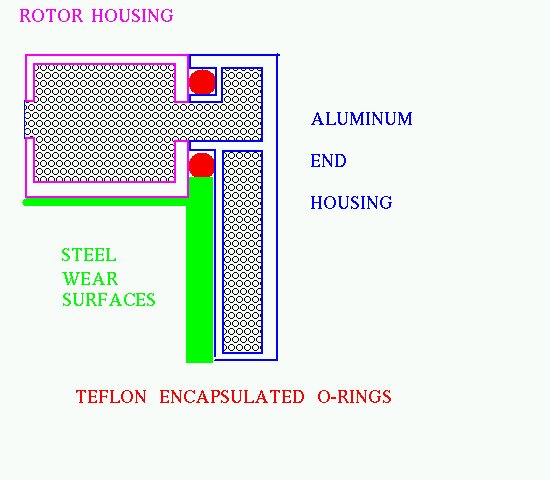
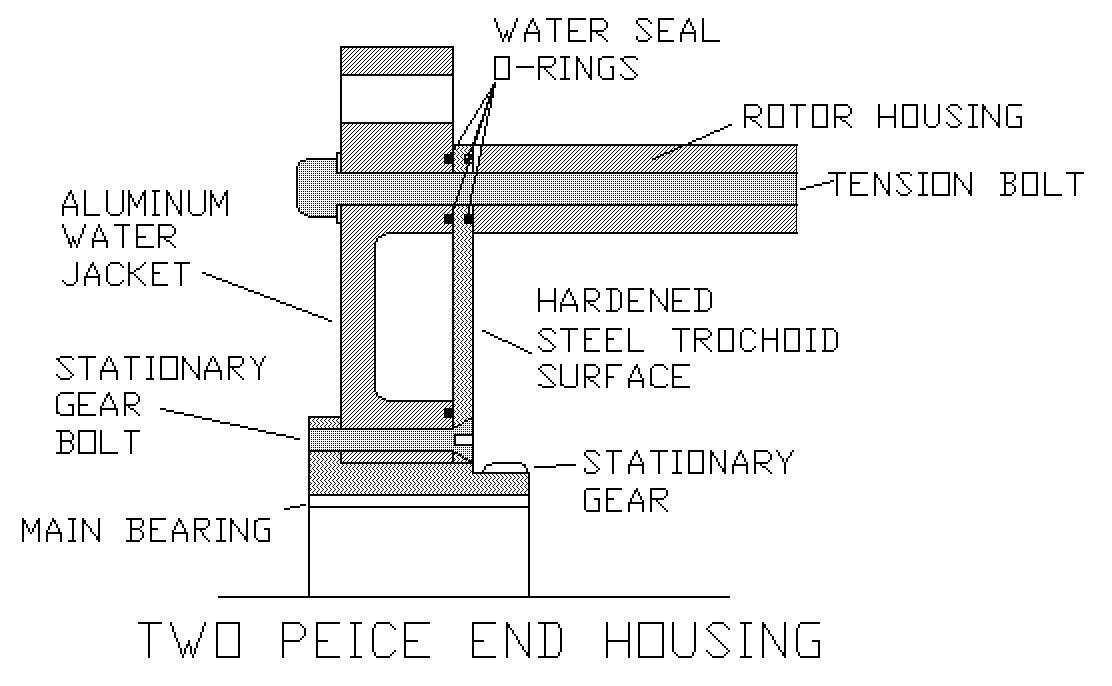
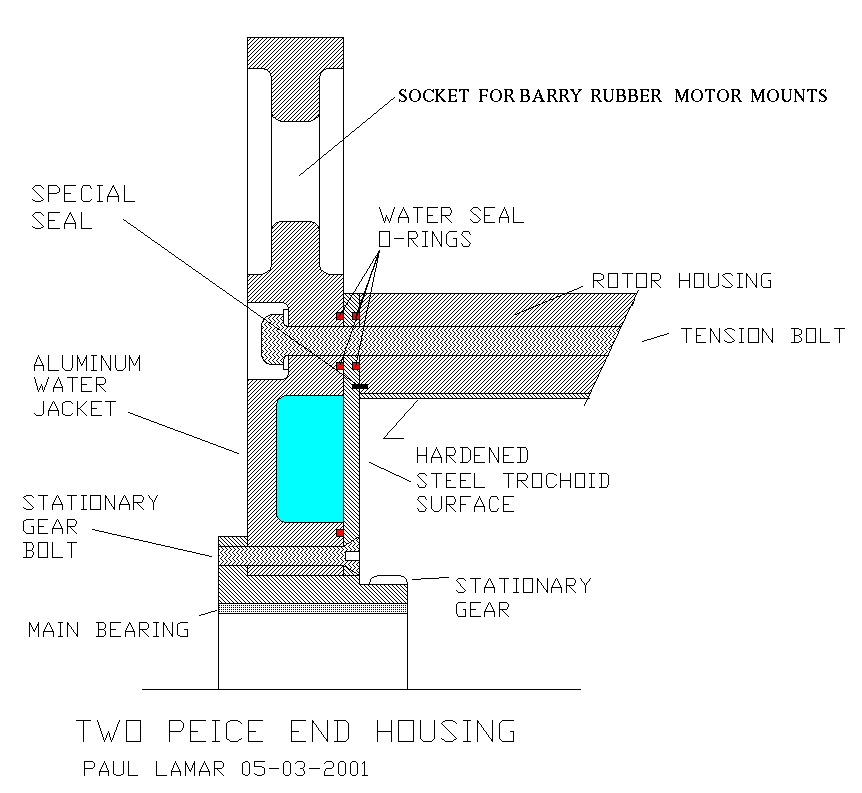
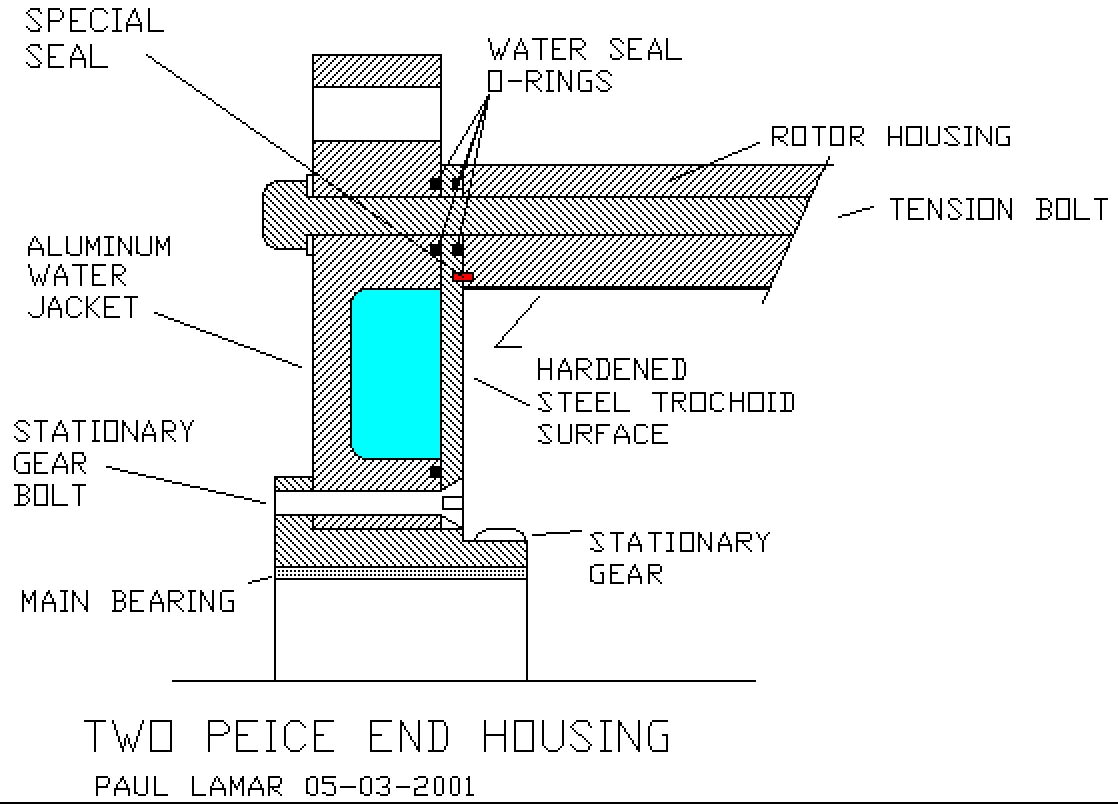
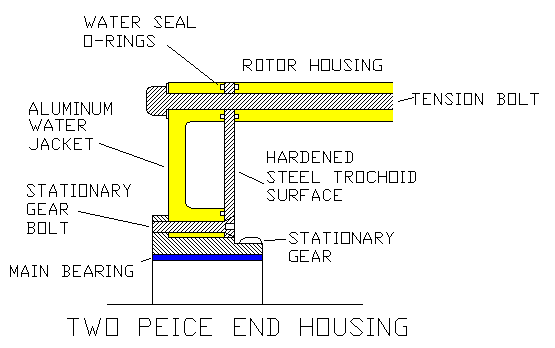
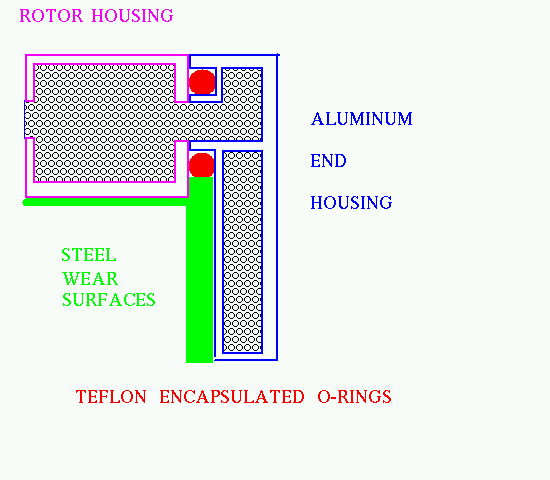
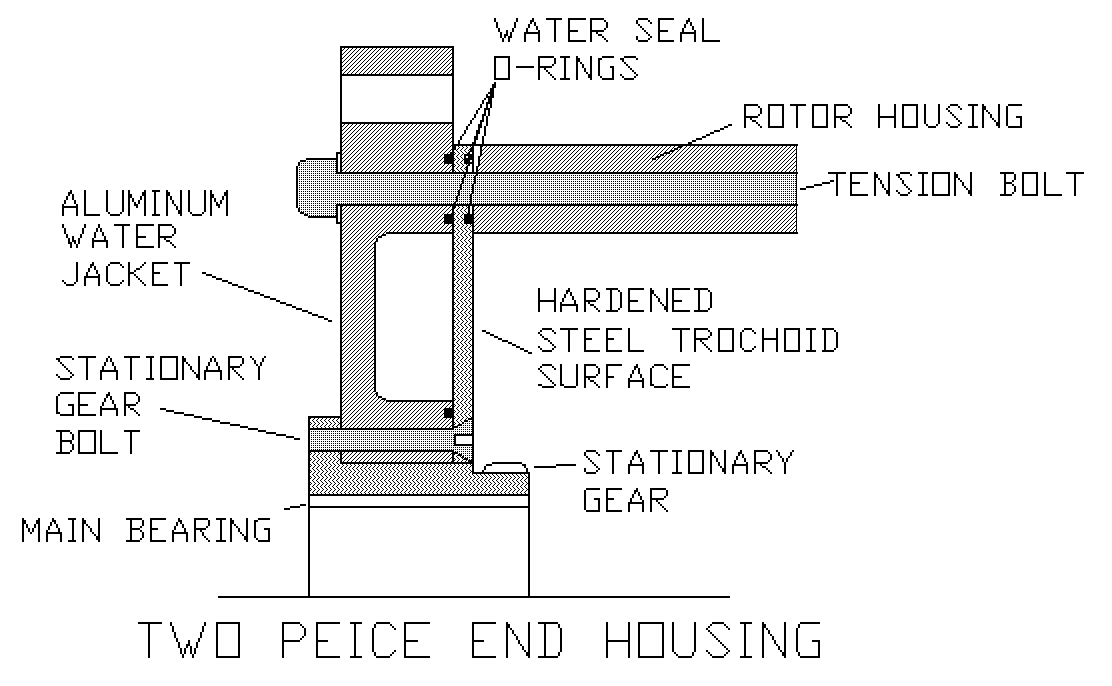
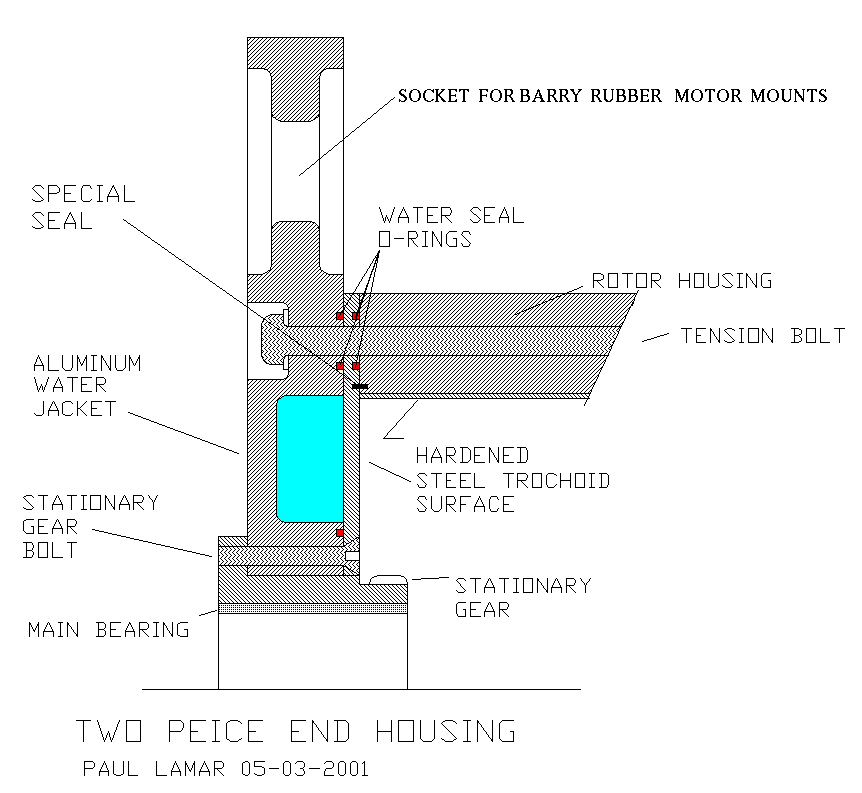
I am not sure what you mean but we discussed this awhile ago.
Here are some drawings and other stuff. The main hang up getting
any of this stuff tried is the casting patterns. If I went to a pattern
maker he would charge $5000 or more for each end housing.
If somebody has access to an NC machine shop I will design
the patterns and core boxes in Rhino and export them as iges for
a Solid Works file. From that... one could load it into Surfcam or some
such NC code generator and machine the patterns out of tooling board or aluminum.
The easy way to do it is assume you are going to do a peripheral port right
from the get go. That simplifies the end and center housings greatly.
Paul Lamar ...No rotor no motor.
The Rotary Engine NewsLetter. Powered by Linux.
ACRE NL web site.
http://www.rotaryeng.net
Copyright 1998-2006 All world wide rights reserved.