For anyone considering an RX-8 purchase from Rupert in Australia. I
picked up mine last Wednesday and the actual costs were:
Engine $2100.00
Shipping $128.00
Customs / paperwork $55.00
----------------------------
Total cost $2283.00
The engine shipped from Australia Feb. 26 and arrived in Grand
Rapids, Michigan April 10. The outside looks brand new. The only
parts I have noticed missing are the exhaust manifold and bell
housing which are of no use to me anyway. This is actually the first
"live" rotary engine I have ever seen. It is unbelievably small!! I
can't wait to get started on it. This is almost as exciting as the
day I got married :))
To contact Rupert: Rupert Gardiner asian198@bigpond.net.au
Randy
Randy, is that a four port or six port? In other
words is it a flywheel or a auto TX flex plate? Some have trouble
telling the difference if the intake manifold is still
bolted on.
Paul Lamar ...No rotor no motor.
Paul,
This is a 4-port automatic with flexplate and counterweight with
coils, injectors, intake manifold, etc. My plane is rated for a 200
hp. Lycoming. I thought I could go up to 220 hp with the lighter
rotary weight and the 4-port is very capable of that.
I will be sending you my firewall dimensions soon if you would be
so kind as to do an engine "fitting" for me. My wings and fuselage
are done. I am at the point where I can still "fudge" the dimensions
of the turtledeck, sidewall and belly formers, firewall, etc. to
accommodate the rotary installation. Think smaller than a Pitts S-1 -
it will be tight. I may have to go with a fuselage mounted radiator
ala P-51.
I also plan on doing a version of your famous "terrorist car bomb"
radiator test with manometer. I would like to do something that has
adjustable intakes and outlets to get the best results. Maybe even
variable lengths to work as much plenum design in as possible so if
you have any suggestions on what to do or not to do or anything you
wish you had done let me know.
Are you doing any seminars at Oshkosh?
Thank you,
Randy
--------------------------------------------------------
I am trying to do a turbo compound forum at OSH. I have
about decided a cooling forum is not possible in an hour
and still do the subject justice.
If you put the rad in the aft fuselage you won't learn much
unless you replicate the the entire P51 system exactly as you will
have to have a long K&W entrance duct and a P51 exit scheme.
A lot of extra work not to mention large holes in the fuse.
K&W gave the proper coordinates which were used in the very
last model of the P51. If it is a biplane it won't benefit
much from such a scheme due to the modest speed other than
the space or aesthetic advantages.
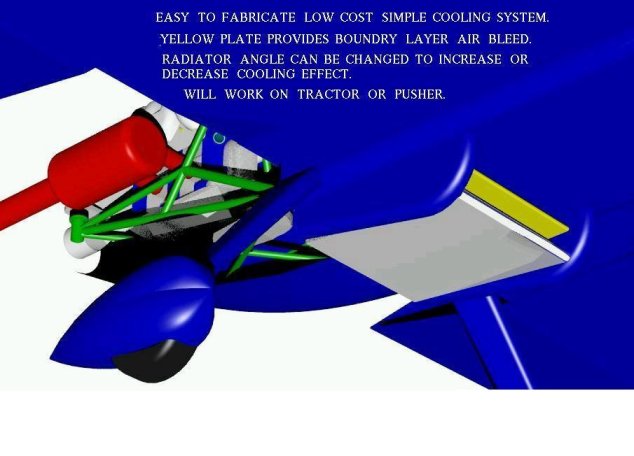
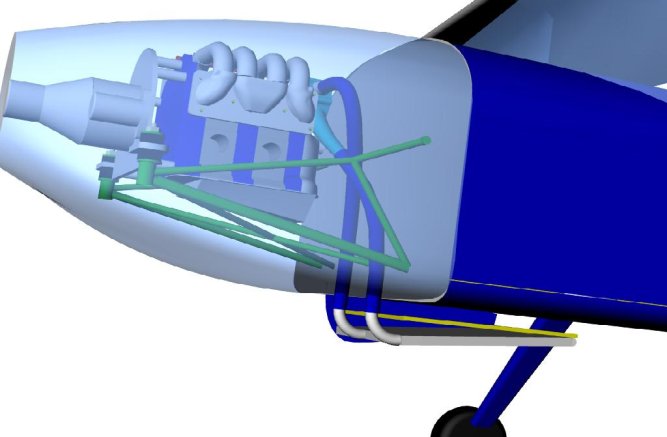
Consider something like this that can hide between the
landing gear legs. A lot LOT easier to build and install
and the water pump won't have to work as hard.
You won't need the optional yellow boundary layer
splitter plate as it is at the front of the airplane.
The bottom of the fuselage forms one wall of the
Kays & London wedge diffuser.
It it is VERY easy to adjust as you can change the angle
up and down. In fact with an electric servo motor
it could be adjusted in flight. Wide open for takeoff
and closed down for cruise. Also just about any rad
can be accommodated. The most modern, large frontal
area, thin rads can be used such as the late model
Dodge pickup truck rad modified for two pass with new end
tanks. The front end tank can be formed in a wing
leading edge shape. The rear a trailing edge shape.
No sheet metal required except for the sides. It is
about 30 inches long by 20 inches high by about 3/4
of an inch thick. Some pourous screen wire over the
opening will keep the rocks out.
BTW the turbo compound gear box outer housing is done.
My machinist worked on it till 9:PM yesterday.
Pictures later this week.
Paul Lamar ...No rotor no motor.
The Rotary Engine NewsLetter. Powered by Linux.
ACRE NL web site.
http://www.rotaryeng.net
Copyright 1998-2006 All world wide rights reserved.