Do you still have this intake manifold? IMHO given the
work and cost involved in making a new one it might not be worth it.
However if you want to make a new one use four tubes wrapped up
and over the engine about 15 to 20 inches long. Looks like you
have room over the top of the engine. I could be wrong about
that so you need to mock it up and check cowl clearance.
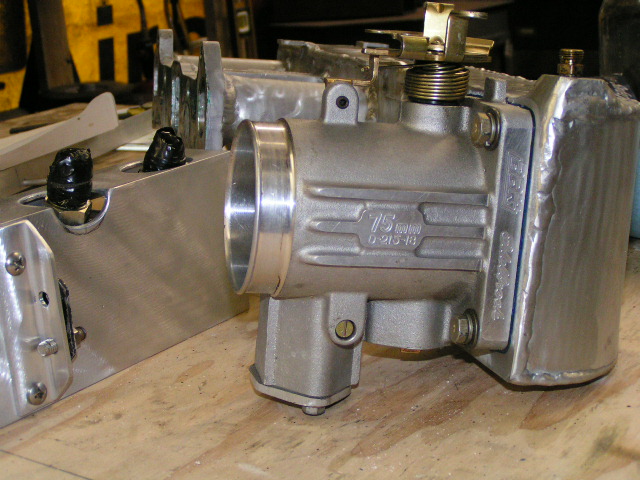
Please send us a picture of the throttle body that you have now.
You might be able to use it as is.
Here is a trick that will save money if not time.
Use a 3 inch square extruded aluminum tube for a plenum
and build the square throttle body plate into the front of it
using a stock Mazda throttle plate shaft.
------------------------------------
Here are a few more ideas. Take your pick. They would all
work about the same.
Let me know if you going to build your own and I will send
you patterns for cutting the sheet metal transitions.
Paul Lamar
Paul,
I do have the original intake and T.B. is an Edelbrock 75mm
Option 1: The simple fab would be to extend the tubes as close to the
cowl as possible with an air filter just behind the left cowl
inlet(nostril) and the T.B. just behind that. the overall length on just
the tubes if placed an inch away from outside edge of plenum/cowl would
be about 8-9"
Option 2: The cowl is already butchered so if the best performance
requires tubes over the top ,that is how it will be and the cowl will be
made to fit.
In option 1 my only concern is the EC2 MAP sensor may be affected by
turbulent or pulsating air with theT.B. 8-10" behind the prop.Not a
known fact just a thought.
In any case the original plenum has split as a result of a backfire
during startup and needs to be built stronger so give me your preferred
choice and I'll get started.
I would like the transition templates and any source for the tube and
bends.
Thanks for your time
Geir
I'll work on those transitions in a few days.
I'll need a drawing of the ports with dimensions as I am
not sure what Darrel Drummond did when he ported the engine.
Paul Lamar ...No rotor no motor.
Sorry to leave you without reply .I had to take a two week break in
building for my annual spring motorcycle desert race with my two oldest
boys .Damn its hard to keep up with those two at my age.Any way other
than a sprained ankle I'm back to building.
I plan to build an over the engine intake as you suggested for
best BSFC. Hopefully without to much sacrifice in H.P. I have been
talking to a local CNC machine shop owned by a fellow pilot with
interest in a rotary RV build in the near future.We discussed the
intake tube construction and he is going to machine a port flange that
will be as close to final dimensions as passable. I will then bolt the
flange to the engine and port to match the intake ports on the
engine.The flange then goes back to the machine shop to machine the
tubes to fit the flange. The plan is to machine the tubes in two halves
with a key where the halves come together. The halves after machining
would be finished /polished as desired and then welded together. The
key that is machined into the halves would give strength and also keep
weld puddle out of interior finished tube. The tubes will then be welded
to the port flange.We also plan to machine the bell mouths at the plenum
. The entire assembly will be built with annealed material and then sent
out to be heat treated after assembly.I am getting the work done for
trade but once the cad design is done the possibility for production is
open for others if interested. I will see where we are at when the
prototype is done and figure out the cost.Guessing around $1000. Not the
cheapest construction but integrity(potential inflite failure) and port
efficiency should be worth the expense.
On a side note I wanted to confirm that in regard to dimension of the
scoop opening verse the dimension at the opening of the diffuser, that
this area should remain the same area in and not be smaller at the scoop
opening as in the trumpet design. Thanks
Geir
Sounds like a good plan Geir. Send pictures of the machined flange.
Interesting approach. From the looks of it you have a four port
engine. Save the NC program on the flange. Others might
want to buy it.
Correct on the scoop opening.
Paul Lamar ...No rotor no motor.
The Rotary Engine NewsLetter. Powered by Linux.
ACRE NL web site.
http://www.rotaryeng.net
Copyright 1998-2006 All world wide rights reserved.