This bodes well for rotary engine Turbo Compound use as we
are asking both high speed and high HP transmission from
the V Ribbed belt.
http://www.machinedesign.com/BDE/mechanical/bdemech1/bdemech1_15.html
"V-ribbed belts
The V-ribbed concept combines some of the best features of flat belts
and V-belts. It employs what is essentially a flat belt with a series
of V-shaped ribs running the length of the belt on the driving
surface. These thin belts operate efficiently and can run at high
speed. But even more important, tensile cords have total support
because the belt ribs bottom completely on the sheave; there is no
wedging action. The total support of the cord permits high
load-carrying capacity. Theoretically, this design could provide the
highest capacity of any belt if reinforced with high-strength fiber.
To date, however, there has been no commercial demand for such
exceptional power capacity in this type of belt."
*****************************************************
That is up until the Turbo Compound rotary appeared.
**********************************************************
Snips....
Paul,
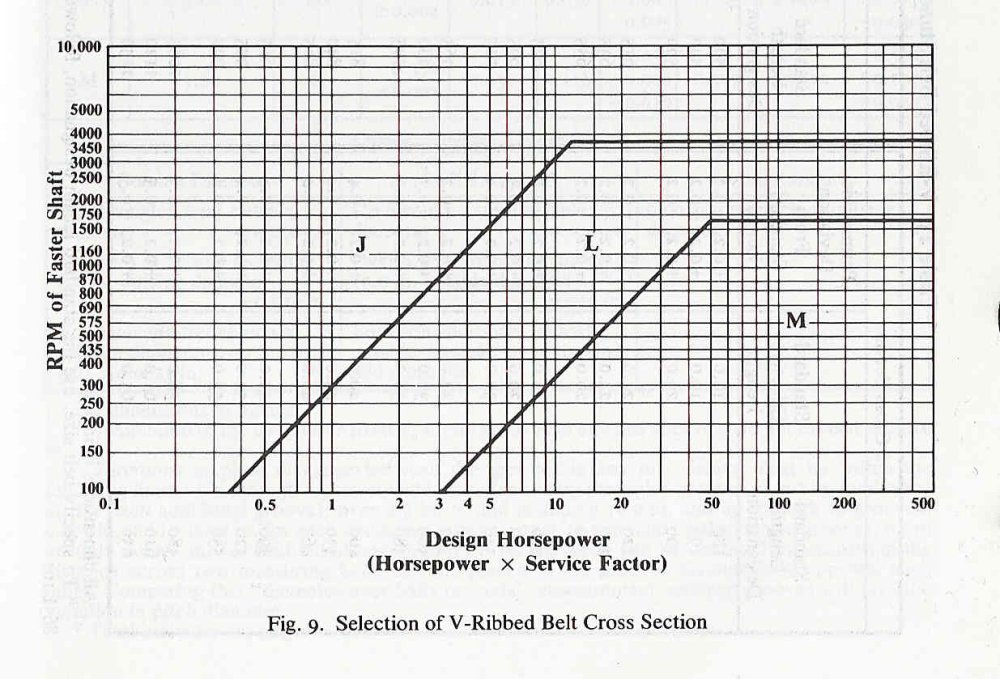
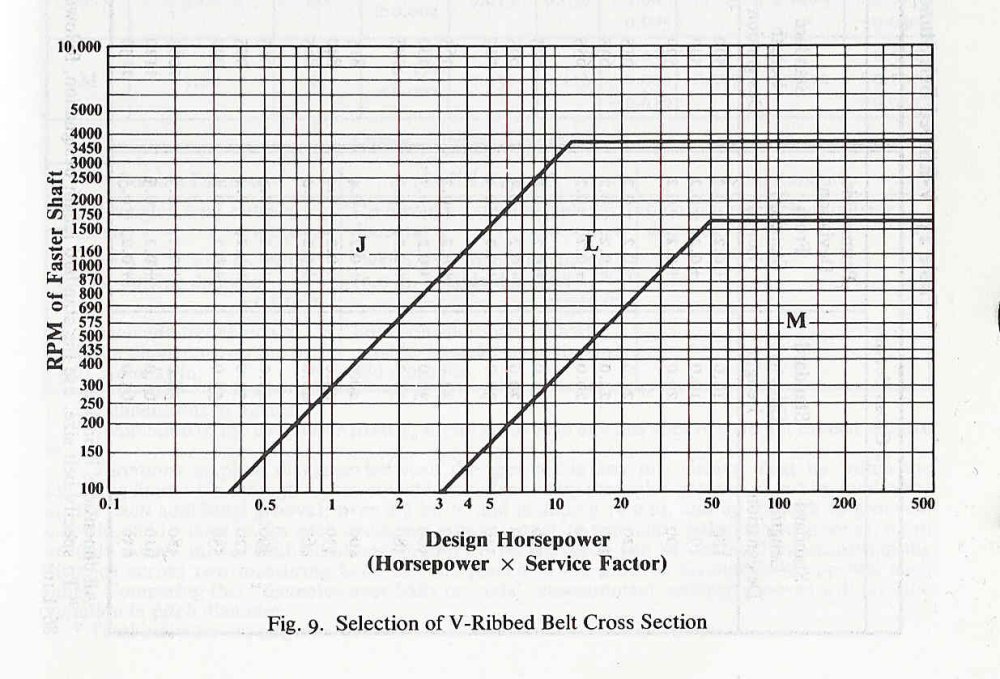
For the turbo-compound drive in the 25hp to 50hp range and at 6000rpm to
8000rpm we are going to be on the bleeding edge of what can be done with
friction belting because of the centrifugal force that reduces the belt
friction around the sheaves. The J-section multi-V is probably the only
one that will be light weight enough. Using the largest diameter
sheaves that will fit could help. It occurs to me that at these high
belt linear speeds there may also be some tendency for the belt to float
on entrained air as it rolls onto the sheave. The Gates belts may work
better because the truncated V cross-section would be less succeptable
to such an effect.
Better get accustomed to registering. It seems to be a growing trend.
I've had to register several times lately to get the desired literature.
BTW did you see the aircraft prohibition in the Carlisle literature?
Aubrey
Good points Aubrey. Perhaps we need small holes in the belts
to relieve the air pressure. The size I choose is the J size
which is a very thin belt. Much thiner than the size used
on auto engines. Of course the red line for the RX8 engine
is 9000 RPM and that is higher than what I am looking for.
No I did not see it but a lot of companies do that.
Don't tell them it is for aircraft :)
Here is a scan of the HP v RPM chart from Machinist Handbook.
Paul Lamar ...No rotor no motor.
The Rotary Engine NewsLetter. Powered by Linux.
ACRE NL web site.
http://www.rotaryeng.net
Copyright 1998-2006 All world wide rights reserved.