> >> Paul,
> >>
> >> I'm looking for a cad (dxf) profile of the V grooves for
> multi-groove
> >> belts. Is this something you have?
> >>
> >> Thanks
> >> Ken Bauman
> >>
> >> No but I have a multi V grove pulley set from McMaster Carr
> >> I will be using on the turbo compound engine.
> >> In .92 inches of width there are 10 grooves.
> >> The depth is about .090". Hard to measure exactly. I might
> >> be able to take it over to the machine shop and put it on
> >> the optical comparator if it is real important to you.
> >>
> >> This looks like a much finner pitch than the units used
> >> on the new car engines to drive the water pump and
> >> alternator. I don't have any of those lying around.
> >>
> >> When I drew it I did not take the trouble to model
> >> it exactly.
> >>
> >> Paul Lamar ...No rotor no motor.
> >
> > Machinist Handbook has them, I don't have a
> > scanner, however I might be able to take a picture
> > and send that. Not sure on the page either, but
> > I'll look it up tomorrow.
> >
> > Jarrett
> >
> > I have Mac Hinnery's hand book.
> >
> > Here it is.
> >
> > Paul Lamar ...No rotor no motor.
>
> Thank you
>
> Ken
>
> Ken, I think this is the web site you are looking for.
>
> -------------------------
>
> I take it back. That Gates web site sucks. Who ever heard
> of having to register before you can download a pdf catalog.
> The on line catalog is ridiculous as well. Sometimes these
> people shoot them selves in the foot.
>
> Here is a better one.
>
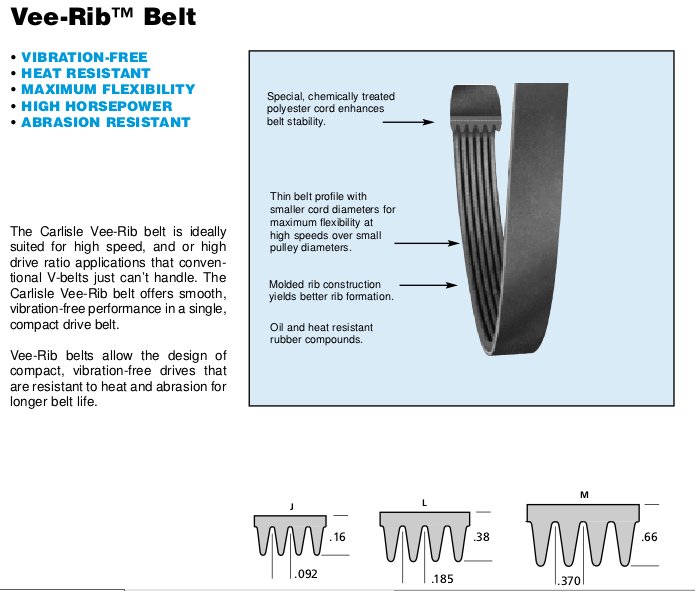
> http://www.cptbelts.com/products/vribbed/vee_rib/index.html
>
> You want a 3D DXF or a 2D DXF ?
>
> Paul Lamar ...No rotor no motor.
>
> ------------------------------------------------
>
> Paul,
>
> Hutchinson is a good source of info for Poly V belts:
> http://www.hutchinsontransmission.com/
>
> They will mail you a design manual on request, which includes
> detailed
> tech info and a calculator for sizing.
>
>
> Regards,
>
> Gordon.
>
>
> Thanks Gordon. I bought some cast iron pulleys from Mac Master but
> I am not happy with them. The three inch pulley weighs 1.5 pounds
> with QD bushing and has an RPM limit of 8340. The 4.5 " large one
> weighs 2.75 pounds and has an RPM limit of 5560 making it marginal
> for this application. See the chart for the design point. I think
> I could do better if I found some steel sheet metal pulleys as
> found on
> most automotive engines these days. These are J section pulleys
and
> most automotive engines use the L section belts I suspect.
> The L section however looks marginal as far as RPM is concerned
for
> the stock RX8 engine with a red line of 9,000 RPM.
> This chart is probably rather conservative.
>
> Paul Lamar ...No rotor no motor.
>
>
> Paul,
>
> If you go to the Hutchinson link I gave and click on "contacts"
> you can
> request the design manual and a list of distributors for pulleys.
I
> think both aluminum and steel are available and should go to
> 10,000 rpm.
>
> The PJ section belt has a rib pitch of 2.34mm [.092"] and
thickness
> of 3.5mm [.138"], which sounds about right.
>
> Incidentally, the design manual lists "ultralight aircraft" as one
of
> the application categories and I know Simonini 2-stroke UL engines
> use
> these belts, so no worries about having to fib about what you
> intend to
> use it for.
>
> Regards,
>
> Gordon.
>
> Thanks again Gordon. What is interesting about these
> belts is they are not really V-belts at all. There is no
> wedging action going on. They are basically folded
> up, guided flat belts with much more effective width than
> a regular flat belt. The HP transmission capabilities are
> stunning. What is old is new again :)
>
> Paul Lamar
>
>
> Paul,
>
> Yeah these belts are really cool technology -- there is no
wedging, just
> friction. Some of the bigger ones are rated at over 1000hp, will
take
> high duty cycles, high rpm etc. and will last very long.
>
> They also have great efficiency, 95 to 98 percent, which is as
good or
> better than cog belts, which wear out quickly. I really like
these for a
> prop reduction drive and I'm sure they will start catching on once
> people clue into them.
>
> Regards,
>
> Gordon.
Guys,
I wouldn't get too excited about these belts until you look at the
whole
picture. At high power levels and high rpm's the static belt tension
required is huge. To use them for a PSRU: the engine sheave couldn't
be cantilevered off the engine shaft, the four bearings required
would
need forced lubrication, and a tensioning mechanism would be needed.
There are some benefits: the offset prop shaft would be useful for
some
airframes, if belt tensioning is done with an idler it could be used
to
drive an accessory. But, overall, I think it would be a challenge to
keep the weight low enough.
Aubrey
Aubrey,
A wide cog belt can't be cantilevered either and will need outside
bearing for support. It also needs quite a bit of tension and doesn't
tend to stay that way very long.
A direct comparison to cog belt shows definite advantages for poly v,
including better damping of shock loads, less heat, vibration and noise,
better overall reliability and longer lasting, and much less expensive
for both belts and pulleys.
As for slipping when wet, these belts are used in heavy duty outdoor
applications like crushers, quarries, hammer mills, tractors, etc., so I
think that a properly designed system should be able to transmit power
when wet.
Regards,
Gordon.
Lets clarify our nomenclature.
1. Poly V
2. V Ribbed
3. Cog
Poly V... is multiple V belts usually matched in length
as used in the Robinson helicopter. Wedging action.
V Ribbed.. basically a grooved flat belt. No wedging action.
Paul Lamar ...No rotor no motor.
------------------------------------------------------------
The belt that was slipping in the rain was a v ribbed fitted to a Hirth
engine in an ultralight, tractor configuration. The layout was all
cantilever, and maybe the tension was therefore not sufficient.
Colin Smith
-----------------------------------
Oh I am not surprised. Hard to get a cantilever design to be stiff
enough. Takes REAL large shafts and large and heavy bearings.
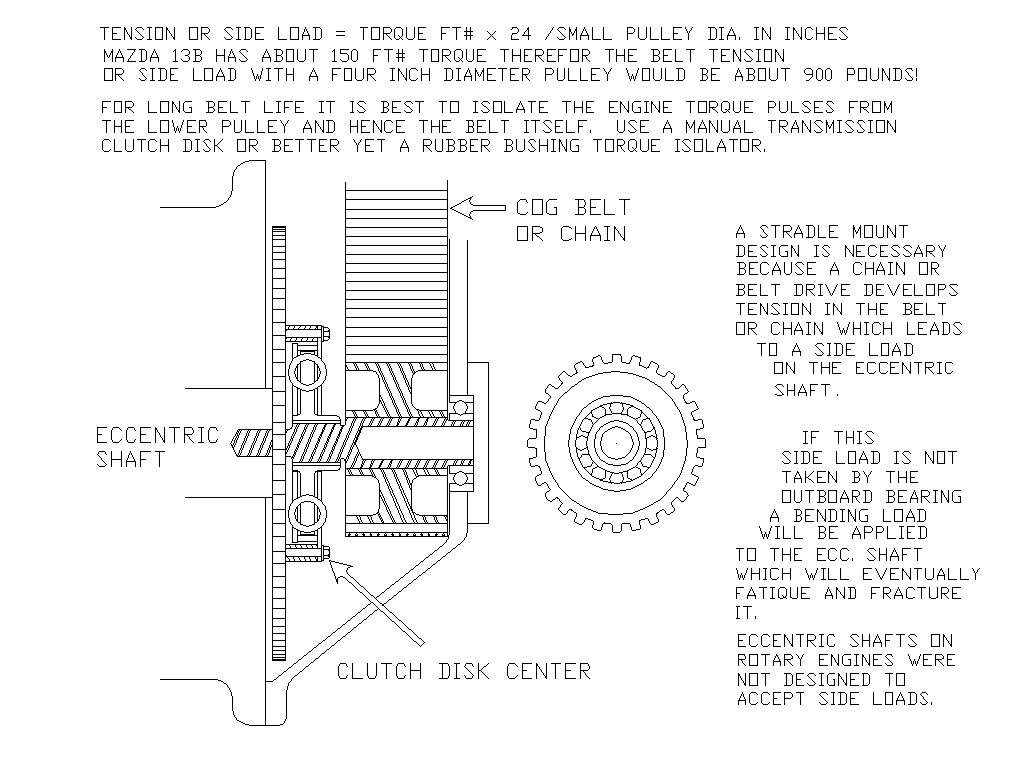
Not only that... three things will eventually happen.
The main bearings will go out on the engine, the e-shaft
will crack or the prop shaft will crack due to cyclical bending.
This diagram shows the problem. Notice there is no pre tension at
all of any kind. The belt tension generated is due to the HP
transmitted alone. Save for V, V-Ribbed and cog.
Paul Lamar ...No rotor no motor.
The Rotary Engine NewsLetter. Powered by Linux.
ACRE NL web site.
http://www.rotaryeng.net
Copyright 1998-2006 All world wide rights reserved.