>
> Great article on rotaries vs recip in the May issue
> of
> Sport Aviation!!!
>
> Dr. Bill Doell
I didn't think it was so great. The conclusion was that the
rotaries were
maybe OK, but the fuel consumption was prohibitive. One of
the rotaries
burned about 30% more fuel than the O-320 to cover the
same distance just a little bit faster.
Other than that he says the rotary sounds like a outraged
vacuum cleaner.
Al
Sounds like the article in RV Aviator. Of course 30% more fuel
borders on slander :) Perhaps there was something wrong with
the Power Sport fuel injection system. Tracy leans his to .47 BSFC
which is about the same as most Lycoming at .45. Tracy flys side
by side with his buddies in similar RV's in Florida burning
about the same fuel.
30% more fuel is about .58 BSFC. No doubt a full rich rotary
will burn .58 BSFC but then again so will a full rich air
cooled aircraft engine. A turbo charged air cooled aircraft
engine will burn as much as .65 BSFC on takeoff and climb out.
Lets go the other way. Say by some miracle the Lycoming
was leaned past peak to .40 BSFC. 30% more would be .52 BSFC.
Still not plausible. Lycoming does not allow lean of
peak and it voids the engine warranty last I heard.
The rotary will run smoothly as much as 200 degrees lean of
peak with no damage to the non existent exhaust valves if
you screw up and allow it to go to peak EGT :) Tracy Crook's
theory on this is the rotating combustion chamber rotary
engine is naturally stratified charge due to a centrifugal
affect on the mixture forcing the rich portion out towards
the spark plugs.
My RX8 gets 25 MPG at a steady 65 to 70 MPH which is comparable
to other 240 HP cars of the same size. Not 30% more fuel.
BTW Cars are not allowed to run lean of peak for emissions reasons.
The computer holds the mixture at stoichiometric (14.7:1) with in
plus minus .01. See the OBD II data captures. From the
air flow rate in pounds per minute you can calculate
the fuel flow rate in pounds per minute by dividing
by 14.7.
There is also the cooling drag issue. The Power Sport
installation is not known for low cooling drag.
In fact it is not known for effective cooling either :)
Paul Lamar ...No rotor no motor.
Hi Paul,
How do peak-power mixtures compare between a rotary and a Lycoming?
They typically talk about air cooled aircraft engines making best power
at 80deg ROP. I don't have any idea what FA ratio that would
translate to.
It would be key to know where these Powersport engines are operating on
the mixture curve, and whether at a leaner mixture they could make
enough power to keep up with the Lycs. I'm not debating whether it's
possible to design an RV8 system where the rotary would keep up with the
Lycoming for a given fuel flow, just whether these aircraft are capable
of doing so.
Other random comments:
Top speed is a poor predictor of peak/cruise power requirement.
Airframe drag (to include cooling drag) will dominate fuel economy at a
given cruise speed. Even on airplanes with the same engine, airframe
drag can vary markedly, though RV's are probably some of the most
consistent experimentals in that regard. One of the RV's is a nose
dragger. Everything else has a tail wheel. That the rotarys were
burning more fuel could be related to having to make significantly more
power to overcome cooling drag (or maybe even prop inefficiency).
The article noted that the rotary powered airplanes had faster climb
rates than the Lycoming. That would indicate more thrust at the climb
airspeed, which could be due to prop optimization or because of more
overall horsepower (or both). The article stated that all airplanes
were ballasted to the same weight for at least the climb portion of the
tests.
Regards,
Matt-
Peak power mixtures are around 12:1 in both cases.
The fact of the matter is there is not a significant
difference in fuel burn given the problems of building
identical airplanes with identical over all drag, one
with a rotary and one with an air cooled aircraft engine.
I think the rotary is 5% worse. 5% worse is what I maintain
and believe. However due to the higher percentage
of kinetic energy in the rotary exhaust due to the lack of
exhaust valves I would not be a bit surprised if a turbo
compound rotary eventually achieved a better BSFC than a
piston engine turbo compound despite starting from a 5% worse
BSFC. Then of course you have the exhaust valve failure mode
where it takes out the turbine. This was the Achilles heel of the
R3350 TC.
BTW somebody pointed out that the fuel cost is not the largest
cost of flying and airplane or driving a car. There are other
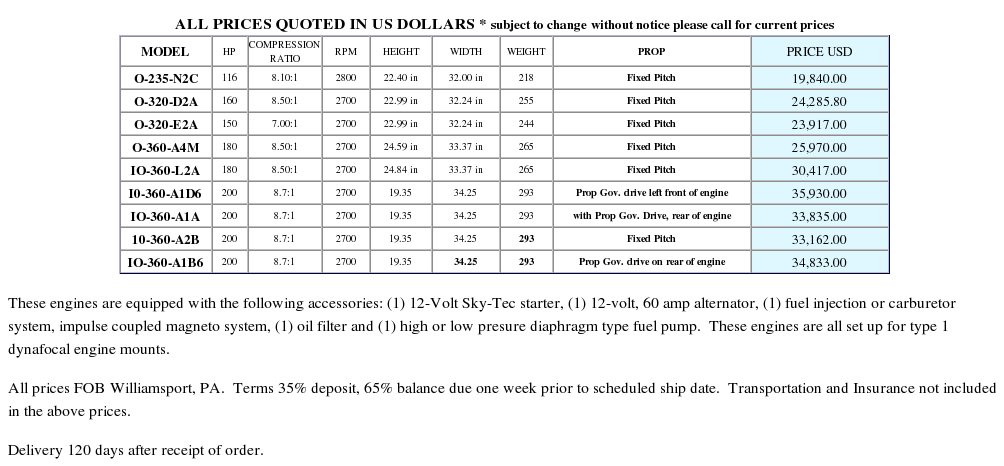
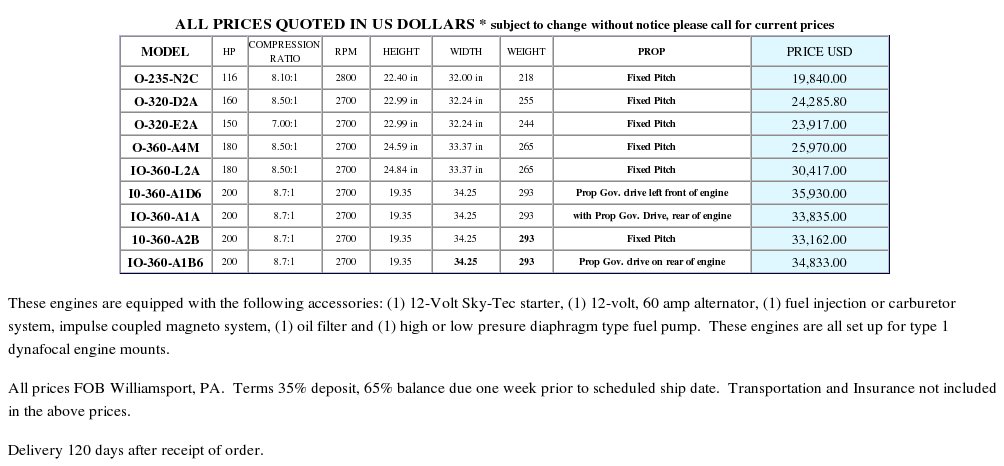
issues. lets say you spend $10,000 on your rotary engine
and $25,000 on your Lycoming. If you fly 50 hours a year
(which is typical) and you spend $4 a gallon for 100 LL
and $3 a gallon for auto gas your cost for gas is 25% less
right off the bat. If both engines get a TBO of 2000 hours
what is the cost per hour for the engine?
I bought a factory reman O-470 for my C182 and it cost $17,000
with my core trade in. That is $8.50 an hour for engine maintenance.
If I threw the rotary away at the end of 2000 hour my cost per hour
would be $5 an hour or less. Probably half that as the first cost
includes a lot of things like PSRU and radiators.
I think you get the idea. $40 an hour for fuel (10 gal an hour)
and $8.50 an hour for the engine is $48.50 total for the
AC engine. The rotary $31.50 for fuel (10.5 gallons an hour)
and $5 and hour for the engine for a total of $36.50 per hour.
Not to mention of course you spent $15,00 less right off the bat.
I know you are aware of all this being on here for awhile but
we always have new people that may not of heard it yet.
----------------------------------------------------------------
Hi Matt,
Here is a BSFC curve for the Lemans engine.
The one labeled economy is probably stoichiometric (14.7:1)
and the one labeled power is probably 12:1 best power.
Unfortunately Mazda did not plot BSFC at best power.
My point here is you don't give up much power by going to
stoichiometric.
It is very rare now a days for an engine manufacturer
to publish a complete BSFC map. The only one I have on
the rotary is 60 years old. Considerable advances have
been made in the rotary since then. Come to think
of it I might be able to measure the full power BSFC
using the OBD II in my RX8 at a full throttle acceleration
run when the RPM hits the HP peak of 8500.
No problem if I could find a flat place in the desert
where I could run flat out at 140 MPH at 8500 RPM
for a few minutes :)
I have seen the P-port engine run on the dyno at 18:1.
Unfortunately we did not have the wide band O2 sensor
interfaced with the dyno computer program so we could
not get a simultaneous plot of BSFC verses mixture
ratio and HP. We by no means ever got the engine dialed
in (as far as mixture was concerned) on the dyno to my
satisfaction.
Also I know for a fact the MT CS (primarily wood) props on
the Power Sport airplanes are noticeably less efficient than
a metal CS prop used on some of the competing RV airplanes.
Tracy Saylor (Fastest RV6 in the world. 238 MPH in the Sun 100)
tested an MT CS prop back to back with a metal CS prop and
was 15 to 20 MPH slower. Prop tip thickness and blade untwisting
was the speculation for this fact. One can easily untwist a MT
CS prop blade with one's fingers alone.
Paul Lamar ...No rotor no motor.
$25,000 for a Lycoming! I've got that in my RV-4 so far with a 13Brew,
and have only to purchase a prop, transponder, and EFIS and I am DONE!
No way a Lycoming can even come close to that.
Brian Trubee
The Rotary Engine NewsLetter. Powered by Linux.
ACRE NL web site.
http://www.rotaryeng.net
Copyright 1998-2006 All world wide rights reserved.