From "Powersport performance and fuel burn"
> Vans chose the speed at 150 kts,
> Vans decided the planes should fly at 2500 prop speed.
> The Lycoming need the 2500 prop speed to reach 150 kts.
>
> The Powersport [p-port] engine RV's will fly their 150 kts at
> 2100 prop speed.
> Because the Powersport engine makes 450 lbs/ft of torque at the prop
> at 2400 prop with the engine turning 5490 rpm, We CAN reduce the
> prop speed to 2100 RPM And still out power the Lycom. Engines.
snips.............
> Ray Richardson
Now that we know something about torque and HP we can make
a few calculations on what is going one here.
First the Power Sport PSRU gear ratio is 5490/2400 = 2.2875
HP = Torque X RPM /5250 = 450 ft# X 2400 RPM / 5250 = 206 HP
Assuming for the moment it is a completely flat torque curve
the Power Sport p-port engine is developing 180 HP at 4804 RPM.
450 ft# X 2100 RPM / 5250 = 180 HP. About right for 150 Kts or
172 MPH.
Sport Aviation article first paragraph page 36. Quote:
"All four airplanes took off and climbed at 130 Kts to
8500 feet as a group. Once level the pilots switched tanks
and flew to Eugene, about 80 miles away and back. Over Aurora
everyone switched tanks and descended to land." Assume for
the moment Eugene was 80 nautical miles away and not statue
miles that is 160 nautical miles distance or 1.06 hours
at 150 Kts.
At a BSFC of .47 and 180 HP that would be 84.6 pounds per hour or
14.1 gallons per hour. 1.06 hours at 14.1 gallons per hour is
15 gallons and not 7.8 gallons or 7.1 gallons as stated
in the article for the rotaries. Not possible.
For the Lycoming to do it while burning 5 gallons
an hour they would have to do it at 30 pounds of fuel per hour.
At 180 HP The BSFC would have to be 30/180 or .16 BSFC.
Totally and completely not possible. No way!
If you give them the benefit of the doubt and the assume
the Lycoming BSFC is an extraordinary .40 then the HP the
Lycoming powered airplanes generated flying to Eugene and back
was 30#/.4 or 75 HP. Equally not possible.
OK assume for the moment they made a typo error in
the chart and the rotaries burned 14 gallons an hour
which is about right for 180 HP and 150 kts. The Lycomings
burned 10 gallons an hour. The BSFC of the rotaries is .47 so
the BSFC of the Lycomings is then 10/14 X .47 or
.33!!! Totally and completely not possible as that is well
below the BSFC range of a diesel engine.
Check my arithmetic. Please!
Something is seriously SERIOUSLY wrong with this article.
It appears to me the numbers have been merely fabricated.
Shame on you Vans and shame on you EAA for not checking
the info.
Paul Lamar ...No rotor no motor.
------------------------------------
Paul,
I agree with you that the numbers given in the article are ridiculous. I
also agree with your approach to solving for the fuel flow.
However, to be completely precise one piece of information is missing:
the exact amount of power required to push the RV8 through the air at
the speed in question. You assumed in your example that it is 180hp, but
I suspect this amy be a little high.
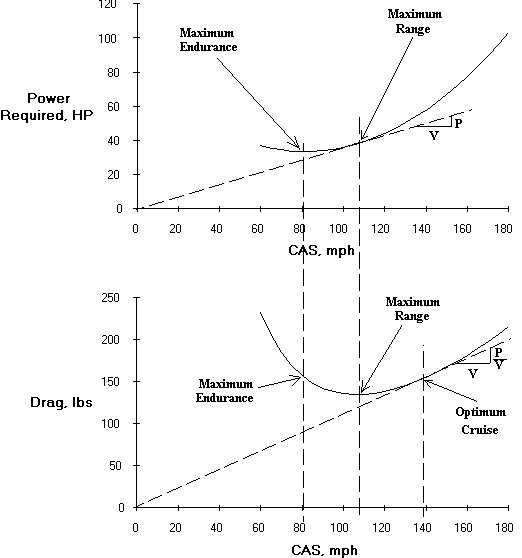
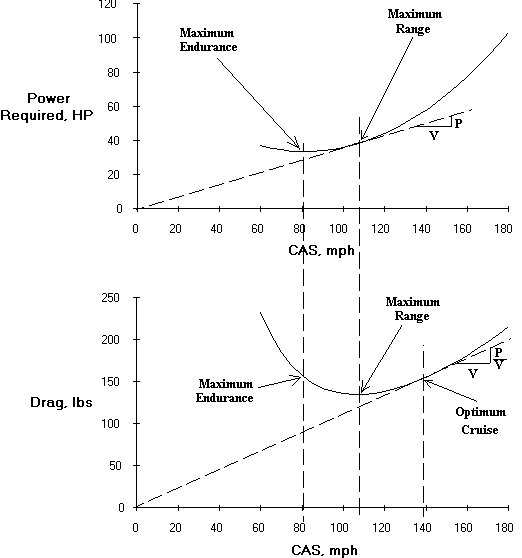
We know that in level flight thrust equals drag, so we can solve for the
amount of power required if we know the amount of drag at the speed we
are talking about.
However, I wasn't able to find a drag curve of the RV8 (Drag Polar). I
did find one for the RV6, but don't know how reliable it is.
We can use these numbers from the graph for the RV6 and see what we come
up with. We will use the formula for thrust horsepower:
THP = Drag x Velocity,
where Drag is in pounds and Velocity is in feet per second. Therefore:
THP = D x (KTAS x6080/60) / 550
Since horsepower is defined as 33,000 lb.ft./min, this equals 550
lb.ft/second or 325.7 lb. x kt.
This simplifies to THP = D x V / 325.7
From the graph for the RV6 we see that a speed of 180 kt. gives a drag
of about 200 pounds. So the power required is: 200 x 180 / 325.7 = 110 hp.
At a SFC of .47 that would give a fuel burn in pounds per hour of 51.9,
or 8.65 gallons per hour. (I have to comment here that this seems like
a very low fuel burn for 180 knots. I found this graph on a webpage that
attributed it to a CAFE report in a 1993 issue of Sport Aviation).
http://www.eaa1000.av.org/technicl/perfspds/perfspds.htm
In any case, even if the chart is correct and an RV6 makes only 200 lb.
of drag at 180 kt., the above thrust horsepower calculation does not
take into effect propeller efficiency. This is where I believe the big
discrepancy is and how the test was tilted to favor the Lycoming.
Like any wing, the propeller will have a certain angle of attack at
which it is most efficient. Since the angle of attack of a prop depends
on prop rpm, TAS, and diameter, prop efficieny will vary according to
the ratio of these factors.
The ratio: Velocity / rpm x diameter is the Advance Ratio:
J = V/nD
where J is the advance ratio, V is velocity in KTAS and D is prop
diameter. The most efficient J depends on the prop blade angle. Course
props (large blade angles) will be more efficient at larger advance
ratios. Fine pitch props will be more efficient at small advance ratios.
That is why the rotary was at a disadvatage in the test, which required
the same cruise speed AND the same prop rpm. With its greater power the
rotary was most efficient with its prop working at a course angle and
lower rpm. But because the test stipulated that the plane had to be
flown in the way that was most advantageous to the Lycoming, it skews
the results.
Another thing is the greater pumping losses from the engine at the
higher rpm. Even at the same MAP setting, running the engine at higher
rpm will use more fuel.
The end result is that this "scientific test" is complete horseshit that
was obviously planned carefully in advance to give a tilted outcome.
This is just cheating, nothing else.
Regards,
Gordon.
Power required = Drag x True Airspeed / 325.7
Power required is also known as Thrust Horspepower
The Rotary Engine NewsLetter. Powered by Linux.
ACRE NL web site.
http://www.rotaryeng.net
Copyright 1998-2006 All world wide rights reserved.