Paul,
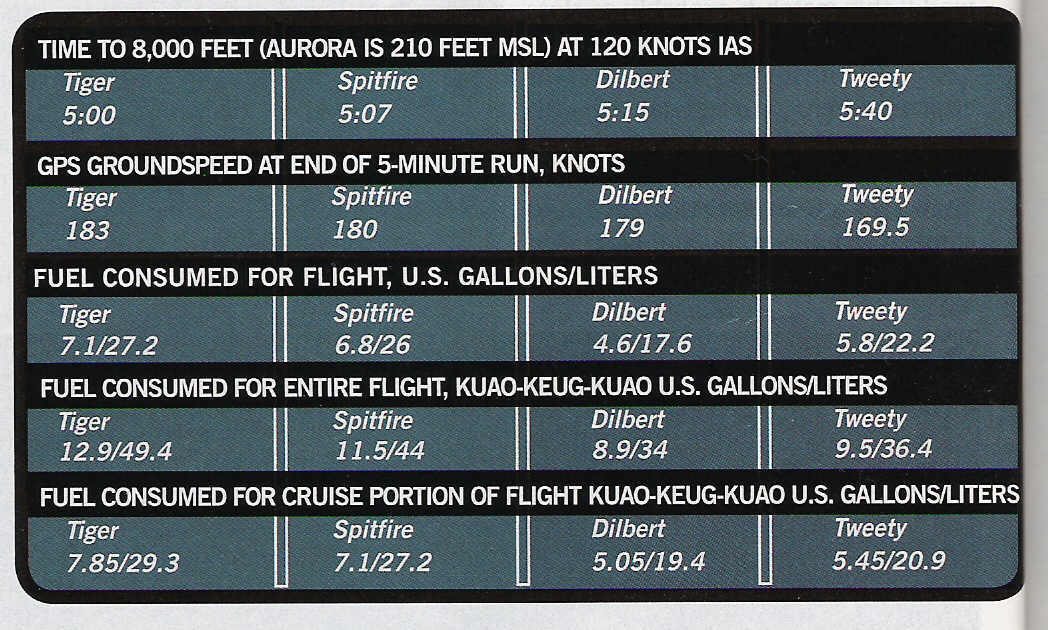
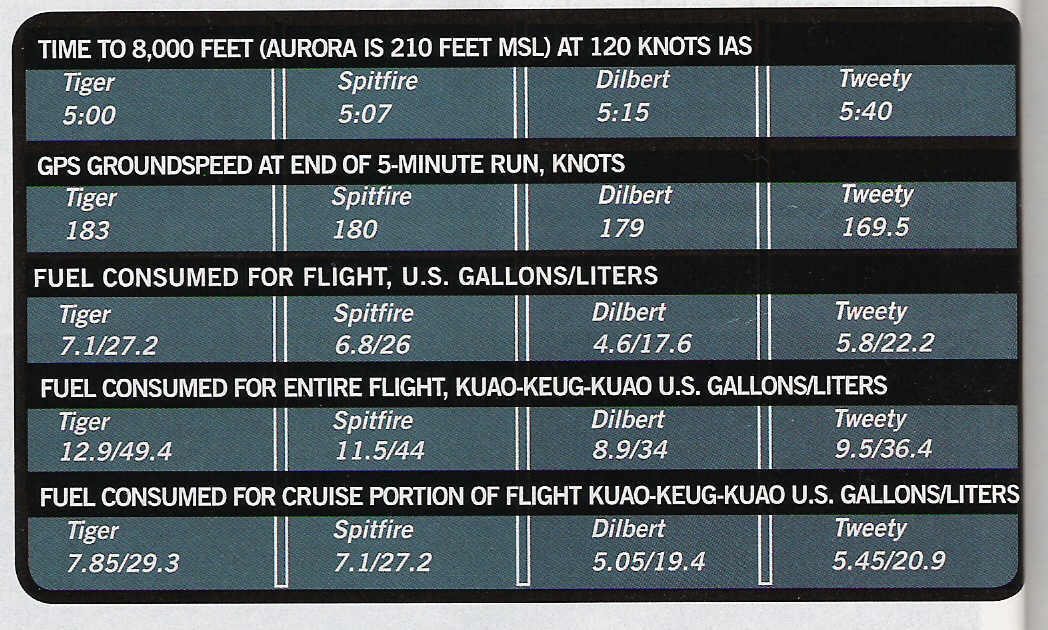
I agree with you that the numbers given in the article are ridiculous. I
also agree with your approach to solving for the fuel flow.
However, to be completely precise one piece of information is missing:
the exact amount of power required to push the RV8 through the air at
the speed in question. You assumed in your example that it is 180hp, but
I suspect this amy be a little high.
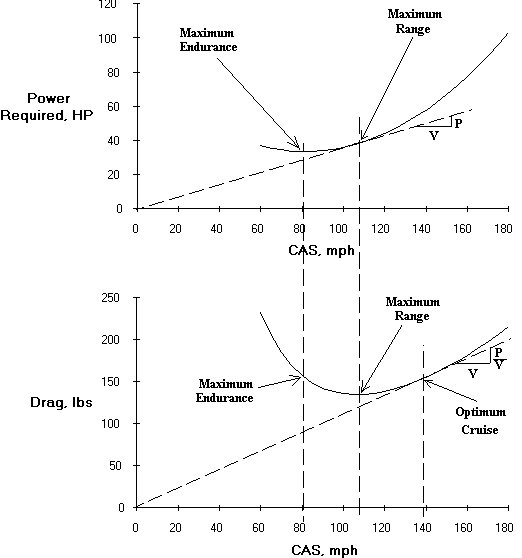
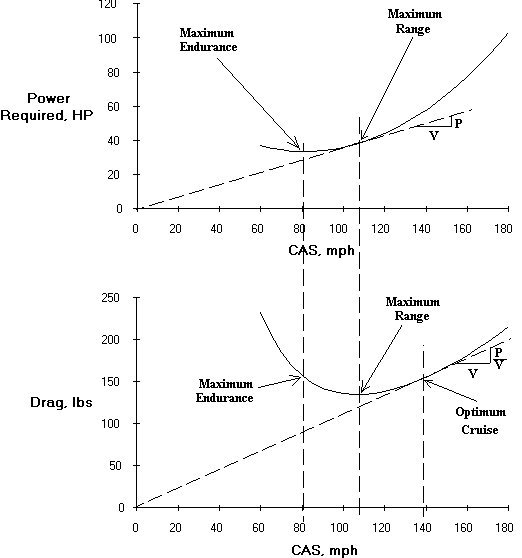
We know that in level flight thrust equals drag, so we can solve for the
amount of power required if we know the amount of drag at the speed we
are talking about.
However, I wasn't able to find a drag curve of the RV8 (Drag Polar). I
did find one for the RV6, but don't know how reliable it is.
We can use these numbers from the graph for the RV6 and see what we come
up with. We will use the formula for thrust horsepower:
THP = Drag x Velocity,
where Drag is in pounds and Velocity is in feet per second. Therefore:
THP = D x (KTAS x6080/60) / 550
Since horsepower is defined as 33,000 lb.ft./min, this equals 550
lb.ft/second or 325.7 lb. x kt.
This simplifies to THP = D x V / 325.7
From the graph for the RV6 we see that a speed of 180 kt. gives a drag
of about 200 pounds. So the power required is: 200 x 180 / 325.7 = 110 hp.
At a SFC of .47 that would give a fuel burn in pounds per hour of 51.9,
or 8.65 gallons per hour. (I have to comment here that this seems like
a very low fuel burn for 180 knots. I found this graph on a webpage that
attributed it to a CAFE report in a 1993 issue of Sport Aviation).
http://www.eaa1000.av.org/technicl/perfspds/perfspds.htm
In any case, even if the chart is correct and an RV6 makes only 200 lb.
of drag at 180 kt., the above thrust horsepower calculation does not
take into effect propeller efficiency. This is where I believe the big
discrepancy is and how the test was tilted to favor the Lycoming.
Like any wing, the propeller will have a certain angle of attack at
which it is most efficient. Since the angle of attack of a prop depends
on prop rpm, TAS, and diameter, prop efficiency will vary according to
the ratio of these factors.
The ratio: Velocity / rpm x diameter is the Advance Ratio:
J = V/nD
where J is the advance ratio, V is velocity in KTAS and D is prop
diameter. The most efficient J depends on the prop blade angle. Course
props (large blade angles) will be more efficient at larger advance
ratios. Fine pitch props will be more efficient at small advance ratios.
That is why the rotary was at a disadvantage in the test, which required
the same cruise speed AND the same prop rpm. With its greater power the
rotary was most efficient with its prop working at a course angle and
lower rpm. But because the test stipulated that the plane had to be
flown in the way that was most advantageous to the Lycoming, it skews
the results.
Another thing is the greater pumping losses from the engine at the
higher rpm. Even at the same MAP setting, running the engine at higher
rpm will use more fuel.
The end result is that this "scientific test" is complete horseshit that
was obviously planned carefully in advance to give a tilted outcome.
This is just cheating, nothing else.
Regards,
Gordon.
Power required = Drag x True Airspeed / 325.7
Power required is also known as Thrust Horsepower
-----------------------------------------------------
Paul,
In my previous message I forgot one crucial step, to convert from thrust
horsepower to brake horsepower before solving for fuel flow.
In the example using the drag number of 200 lb. at 180 kt. for the RV6
we found that it takes 110 THP to move it through the air in level,
steady flight.
To find BHP we need to correct for prop efficency, Neta, which is THP / BHP.
If we assume a typical prop efficiency of 85 percent, we get 129 BHP
from the 110 THP we started with.
At an SFC of .47, this works out to a fuel flow of 60.6 pounds or
10.1gph, still very impressive for 180 knots true airspeed. I think that
drag chart for the RV6 is a little optimistic (published in Sport
Aviation, so take obligatory grain of salt).
Just to further check this, I found a CAFE report on the RV8, which gave
a fuel flow of 13.9 gph at 191 KTAS.
Assuming an SFC of .47, we can calculate the thrust horsepower:
SFC = FF / THP
Therefore,
THP = SFC / FF = .47 / (13.9 x 6) = 177.4
Now we can figure out how high the prop efficiency is since we know the
engine is 200 BHP.
Since Neta = THP / BHP, we get:
177.4 / 200 = .88
This is pretty good prop efficiency, or maybe the Lycoming IO-200
angle-valve in the VAN's prototype RV8 that was the subject of the CAFE
test was hopped up a little and putting out more than 200 hp.
We can also solve for drag, since:
FF = SFC x THP = SFC x D x V / 325.7
We can restate that equation to solve for drag:
D = (FF / SFC) x 325.7 / V, which is the same as:
D = THP x 325.7 / V
So we get:
D = 177.4 x 325.7 / 191 = 302.5
That's the drag of the RV8 at 191 KTAS, 302.5 pounds.
This is 100 pounds more than the graph I found for the RV6 at 180 KTAS,
which was also a CAFE report published in Sport Aviation. It seems to me
that this confirms that the RV6 graph is a little optimistic.
In any case, the thing to remember is the prop efficiency, which has a
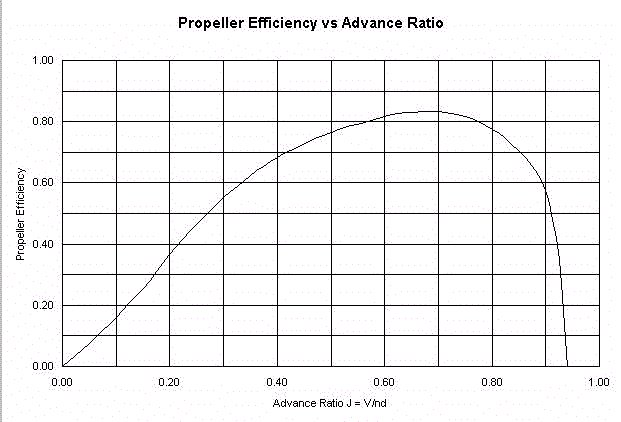
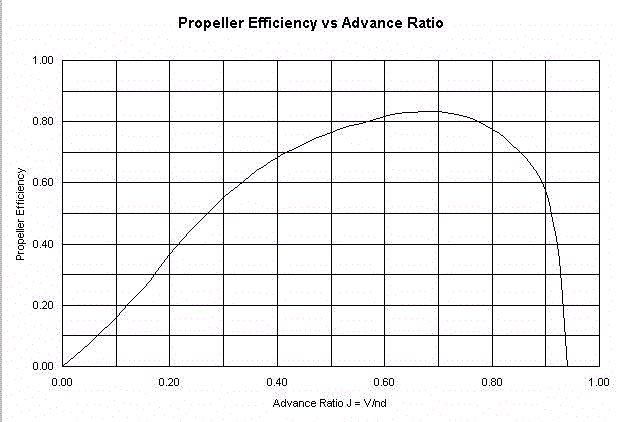
huge effect on fuel consumption. The attached graph for a McCauley 7557
prop as used on some C-172s shows the correlation between prop
efficiency and advance ratio.
Notice that the prop reaches a peak efficiency of just over 80 percent
at an advance ratio of .7. And notice how the efficiency plummets as
advance ratio decreases -- at an advance ratio of .2 the prop efficiency
is below 40 percent.
Remember that advance ratio, J, is Velocity divided by rpm times
diameter, J = V / nD
As n (rpm) increases, the ratio decreases. As the ratio decreases, prop
efficiency nosedives.
Van knew exactly what he was doing when he set up this test. By forcing
the rotary to fly at the same speed AND rpm as the Lycoming ship, he
knew the rotary would be running at a lower prop advance ratio and lower
prop efficiency.
This test was conceived very cleverly so the bigger engine and prop on
the rotary would be giving up a lot of prop efficiency.
This is simply a dirty trick and lousy cheating, nothing more. Of course
this is what you get when you have a magazine that let's its advertisers
write stories. Shame all around.
Regards,
Gordon.
--------------------------------------------------
Hi Gordon,
The Vans article and chart says fuel burned for 160 N miles!
It did not say fuel burned per hour. It did not specifically
say at what speed HP or RPM the test was run at. It did say
8500 feet. Ray Richardson gave us the other numbers from
info he had.
According to google it is 87 miles to Eugene from Aurora.
Round trip would then be 174 miles.
On 7 gallons that would be 25 MPG for the rotary.
On 5 gallons that would be 35 MPG for the Lycoming
I doubt seriously you could fly an RV8 at any speed
HP or altitude with any prop that would yield 35 MPG.
If that were the case max range for an RV8 with 42 gallons
would then be 1470 Miles!!!!!! That is 50% greater
than any GA airplane I can think of or find.
BTW I would love to have any rotary powered airplane
that got 25 MPG or a max range of 1050 miles.
That is much much better than my C182 that gets
13 MPG with twice the tankage (84 gallons) and about
the same max range.
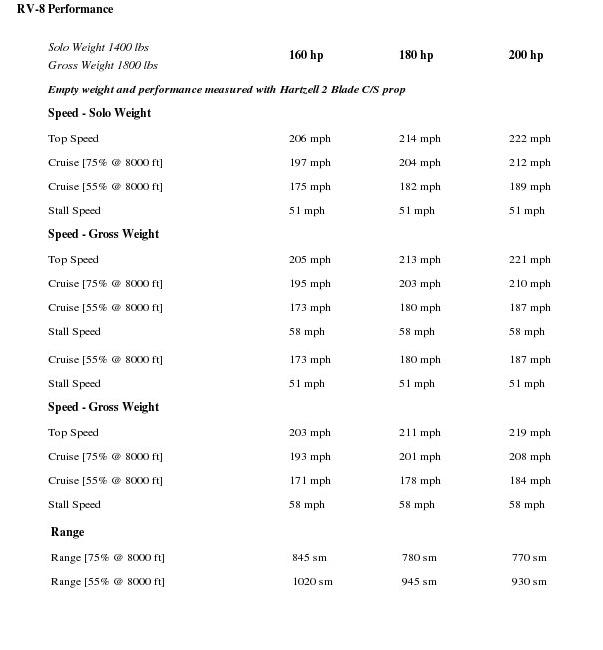
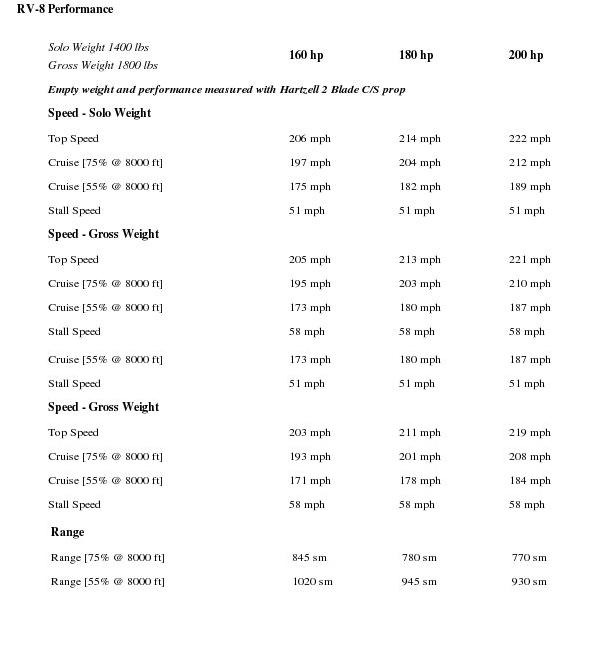
Here is an RV8 performance chart from:
http://www.pilotfriend.com/experimental/acft7/37.htm
Paul Lamar
The Rotary Engine NewsLetter. Powered by Linux.
ACRE NL web site.
http://www.rotaryeng.net
Copyright 1998-2006 All world wide rights reserved.