http://www.cozygirrrl.com/menupage.htm
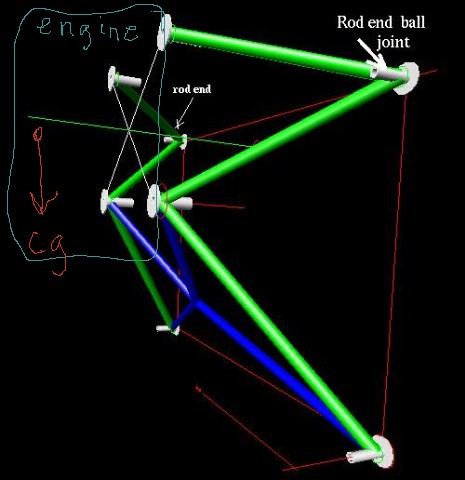
Chrissie, this will also work but it is so out
of the mainstream you might have trouble
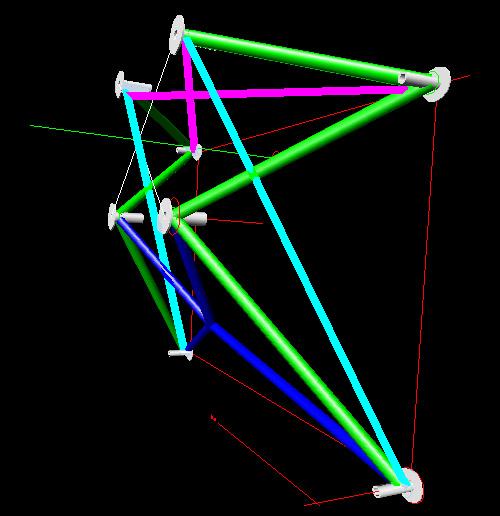
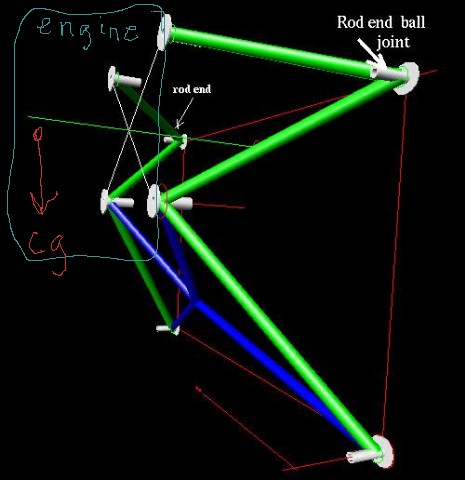
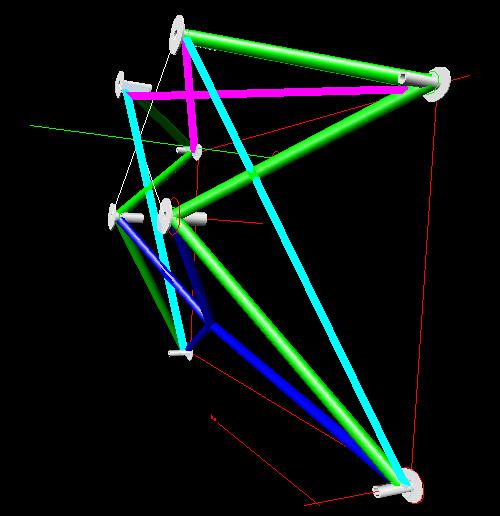
convincing people to try it. All shear and torque
loads are taken by the two lower rubber bushings.
The top rubber bushings and two MM tubes deal only with
the engine moment about the firewall.
One tube at the top would do as well but there are usually
two firewall hard points up there.
Basically it is the same as our rotary engine Schertz
beam motor mount.
Here are the rod ends to use.
As is you will get cracks at the junction of the top
tubes and firewall hard points.
------------------------------------------------------------------------
Paul,
Unlike the schertz beam mount for the rotary, the cg of the engine/prop
is substantially forward of the lower mount bushings. The g loading
moment about the lower bushings would be much greater than is the
case on the rotary schertz beam. I would think the cg of the
Lycoming would be at least 12" away from the bushings. Then a
6g load on the 300 lb engine would be an 1800 lb-ft moment that
the rod ends would have to resist.
Aubrey
I agree Aubrey but they won't fail. The occasional 6 G
vertical load may bottom them out but won't fail them.
The upper and lower bushing are about a foot apart
vertically so that is 1800 pounds tensile load on both
tubes at 6 G. Each rod end will see 900 pounds at 6 G.
The steel strap surrounding the rubber bushing is at
least .065 thick by 1/2 inch wide. At a yield strenth
of 40,000 psi it will take a max tensile load of 1300
pounds. If one wants something more secure one should use
a $6 solid half inch rod end with a tensile rating of
8000 pounds. Just less vibration isolation. Actually
a solid 1/4 inch rod end would do at 1700 pound rating.
The rubber rod end load rating is 270 pounds continous for
less than a bottomed out mount. The continous one G tensile
load is 300 pounds total and 150 pounds each rod end.
The other bad thing is the lower two stock rubber bushings
are now catching hell with the total prop torque and vertical
shear load. Consequently they will have a shorter life.
I never said it was a good design :) Just better than
what Crissi had.
Here is the right and conservative way to do it.
Paul Lamar ...No rotor no motor.
The Rotary Engine NewsLetter. Powered by Linux.
ACRE NL web site.
http://www.rotaryeng.net
Copyright 1998-2006 All world wide rights reserved.