Hi Paul,
Read your paper about your turbo compound project - very impressive.
Clearly a lot of thought (and work) has gone into the project. It
would certainly be a boon to the airborne rotary to see such a project
reach commercial viability.
About the only thing that caught my attention as a potential downside is
the use of the stock Mazda Turbo. I am personally aware of at least 5
cases where the turbine wheel section has malfunction in aircraft
usage. I suspect that the turbo was simply not designed to handle boost
for considerable periods as might be used in aircraft and may have also
encounter "over speed" conditions at altitude. You are probably aware of
these failures, but thought I would mention it.
I would think the mechanical coupling from the turbocharger shaft to the
output gear box assembly might pose a few challenges, but, of course,
that is what a project uncovers. Nice CAD drawings and impressive
machine work in the photos.
Only other thing I could think of is that it might be useful to provide
a couple of examples of the calculations you made to arrive at the % of
efficiency increase - that is one thing any critic is going to
potentially challenge.
Good luck in your efforts, Paul. Certainly a significant undertaking
with obvious benefits, I would like to hear how things work out when you
get your prototype together and running.
Best Regards
Anonymous
Not the full paper. Just the abstract.
Yes we know about that. I figured out what the problem
is. I got a clue by calculating the centrifugal loads
on the blades as a function of TC RPM. The loads become
enormous at 80,000 RPM and above. The Wankel exhaust
heat is only a part of the problem. The turbocharger
turbines are indeed coming apart due to over speed. The
compressors are not coming part because they do not also
have to deal with the Wankel exhaust heat as well.
The automotive turbo charger turbine is over designed,
HP wise, for one simple reasons. It needs to accelerate
itself rapidly due to the acceleration demands of the car.
Cars engines never sustain max power for very long.
Basically the turbine over drives the compressor.
Consequently the turbocharger turbine never runs for long at
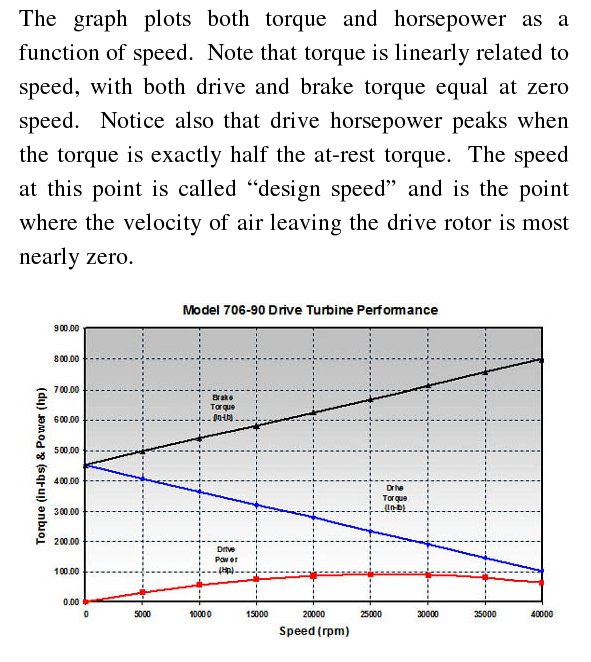
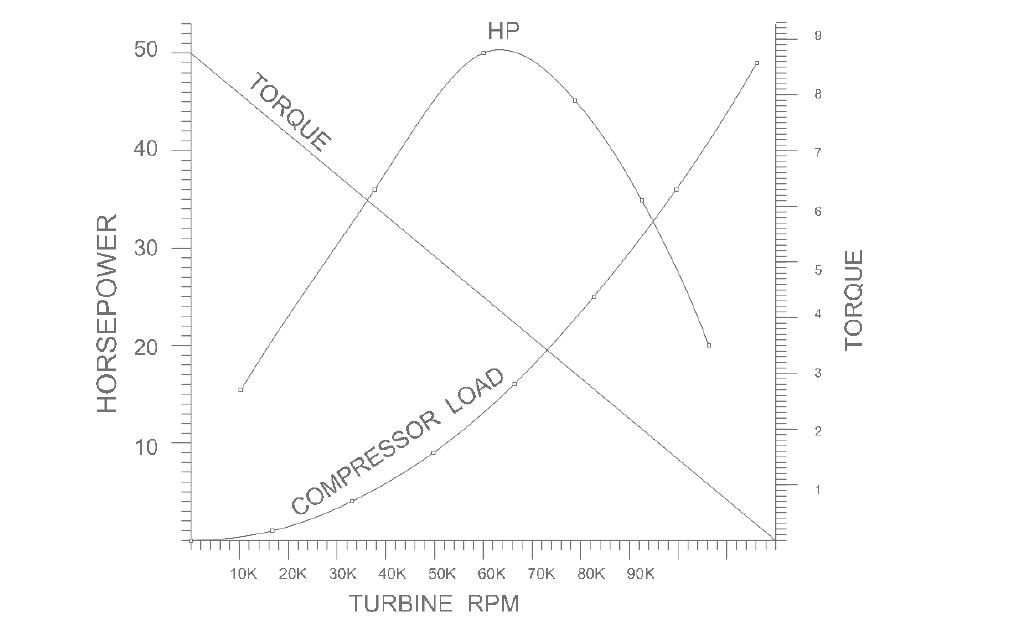
over speed RPM. Here is chart of the situation.
Turbines have max torque at zero RPM. The torque
falls off in a straight line as the turbine blades
approach the Wankel exhaust gas velocity.
This causes the HP to increase to a point and then fall
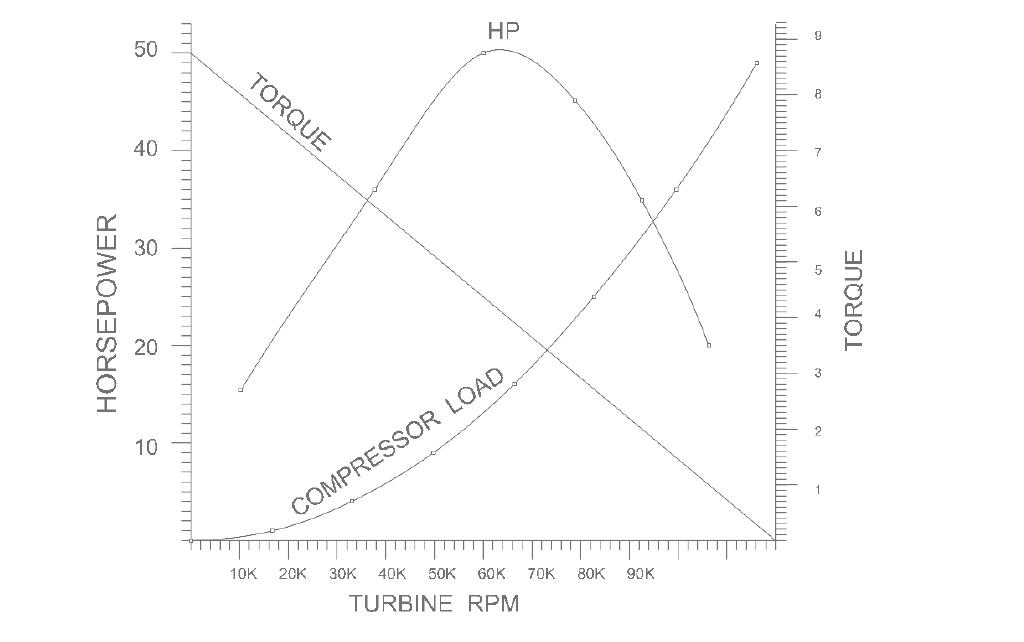
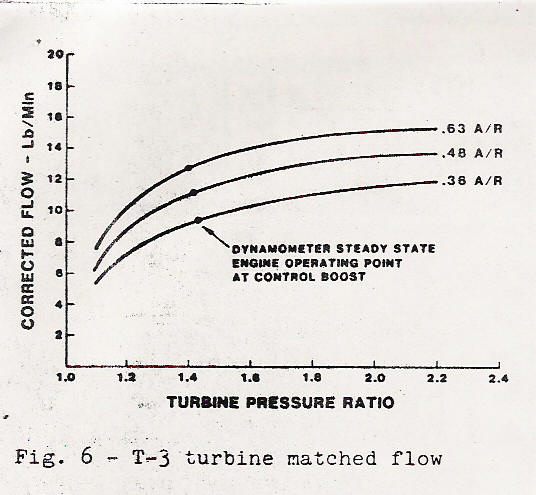
off. In an automotive turbo charger the compressor size
relative to the turbine size is chosen to be such
that the turbine HP is always way more than enough
to provide the boost required at steady speed.
You can see this relationship in the second chart.
The waste gate and back pressure of the muffler system
serves to limit the boost for the brief period of
time the automotive engine is generating max HP.
The bottom line is if you want the stock TC turbine to
live in aircraft service you merely load it down with a
larger compressor. Exactly what Dave Leonard did. Now what
loads it down even more is connect it to the eccentric
shaft through a gear box and drive belt to take advantage
of all that excess turbocharger turbine HP. The turbo
compound configuration.
--
Paul Lamar ...No rotor no motor.
The Rotary Engine NewsLetter. Powered by Linux.
ACRE NL web site.
http://www.rotaryeng.net
Copyright 1998-2006 All world wide rights reserved.