Giffen Marr wrote:
Paul
Am I to understand that the TC Drive is to be driven by a shaft
from the
Turbo compressor? If so, aren't shaft rotational speeds of 60k to
80k going
to present a problem?
Giff Marr
LIV-P/20B 45%
What problems did you have in mind? This is what I tink I am going
to use in the 1/2 inch size.
Paul, you are joking right?
Mark W.
No Not joking. What problems do you see?
--
Paul Lamar ...No rotor no motor.
Lack of balance, lack of strength, a horrible failure mode with an easier
released projectile.
At 80K RPM, any imbalance will be be exciting it with 480KHz (two per
rev).
At this frequency, you will at least wear out the metal to metal contact
points in the universal (although as Reeves says, you will be very
unlikely
to get up to this RPM.). Turbines normally use some sort of splined
coupling, a rigid coupling with a floating oil damped bearing, or driving
lubs these days.
Be really careful testing this Paul.
Mark
Thanks Mark. I think I will test both the bellows type as Reeve
suggested and this type if the off the shelf versions are
reasonable well made with tight tolerances. The drawback to
the bellows type is a somewhat larger OD for a given torque rating.
The second web site Reeve mentioned offer balanced bellows
type.
http://www.rw-america.com/PDF-couplings-line-shafts/MK_miniature-bellows-couplings.pdf
BTW what are "lubs" ?
Alignment is near perfect when the engine is cool.
I am concerned with slight mis-alignment due to temp difference
in the various parts as the engine and turbo charger
warm up.
Paul Lamar ...No rotor no motor.
Paul,
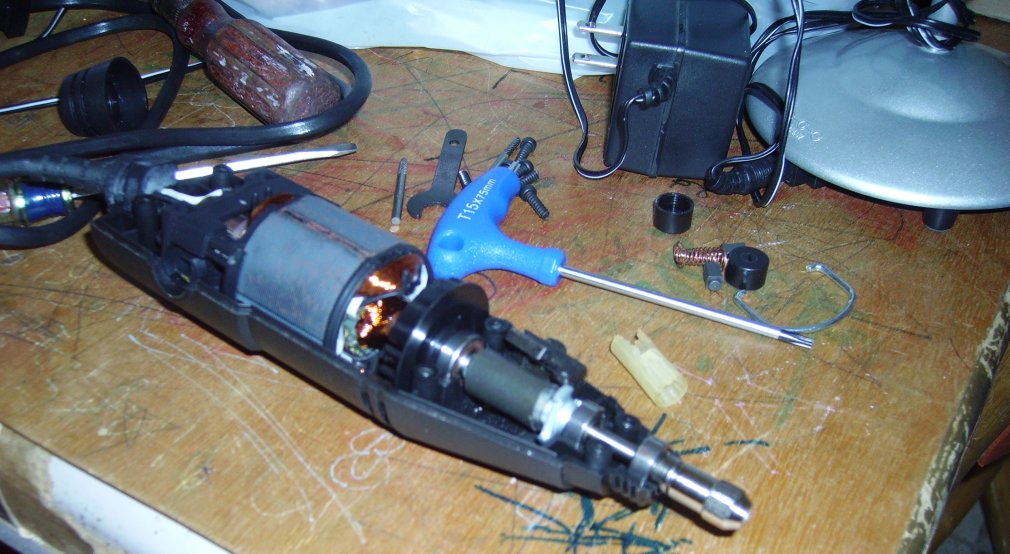
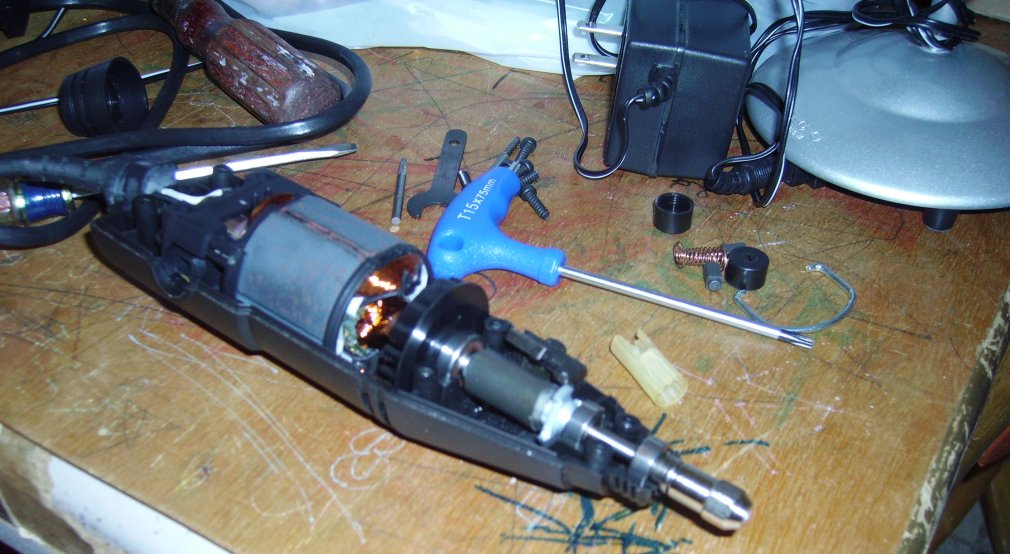
Sunday, my Craftsman branded "Moto-Tool" quit suddenly. The yellowish
cylinder you see lying behind the tool in the picture was apparently a
silicone rubber splined sleeve that coupled the motor armature to the
spindle. The sleeve bears no resemblance to silicone rubber now. It is
waxy and brittle. (We had some silicone rubber Razor scooter wheels
that deteriorated the same way.) I found a piece of Tygon type vinyl
tubing that would slip snugly over the splined shafts and topped that
with heat shrink tubing to make the fix you see in the picture. It
works perfectly to 30,000 rpm. The friction between this type vinyl
tubing and any clean smooth surface is tenacious. If the heat shrink
hose clamps that Tracy uses are available in a small enough size, this
scheme may work for a couple hours of testing on the turbo compound.
The mass is low, so, if it self-destructs it won't be a big deal. Also,
it will be easy to replace.
Aubrey
Good idea Aubrey. I'll give it a try. Tygon you say.
--
Paul Lamar ...No rotor no motor.
The Rotary Engine NewsLetter. Powered by Linux.
ACRE NL web site.
http://www.rotaryeng.net
Copyright 1998-2006 All world wide rights reserved.