Paul,
As promised, I visited the folks at Global Rotary Power in Bowmanville,
Ontario this afternoon. I met George Payne, who’s in charge of marketing
and flies a Piper Archer 3, as well as company head Kurt Wiesbaum whose
flying credentials go back to WW2 in which he flew the Me-109, no less.
The license plate on Kurt’s VW reads “ME CIX,” and he still flies regularly.
I know a lot of people on this forum are interested in knowing if this
outfit is “for real.” Well, the company is definitely at the startup
stage and is “bootstrapping” itself forward on a day-to-day basis, as
George readily admits. They have no manufacturing facilities at all, or
even any engines in inventory. They are trying to secure investor
financing, but are not finding many takers – not surprising considering
that sport aviation is not exactly at the top of the list for most
venture capitalists, in fact it’s probably at the bottom if it is even
on the radar screen at all.
That does not mean that Global Rotary does not have a good idea or even
a workable plan. They are firm believers in the Wankel engine and have
been involved in various aspects of the rotary business for many years.
Kurt worked years ago with Paul Moller and has had close ties with the
Wankel people in Germany for many years. The German company has been
making small rotaries for years for use in ultralights, karts, and other
applications.
These German Wankel engines are all-aluminium and very lightweight, with
400cc per rotor displacement. They are charge-cooled, which means the
rotor is hollow and the intake charge is passed through there in order
to cool the rotor. They are available in 40hp single-rotor and 80hp twin
rotor and weigh no more than two-stroke engines of similar power output,
which is quite remarkable. Global Rotary is currently importing
assembled engines from Germany, but plans to manufacture them here in
North America with the help of Atkins Rotary Specialties Inc.
http://www.atkinsrotary.com/
Eventually, they intend to build a manufacturing facility of their own
and build the engines in Ontario. Not having any firsthand experience
with these engines, I wanted to know how good they are. You and others
have mentioned the coating flaking off the aluminium castings and George
acknowledges that this has been an issue, although he stresses that it
has not adversely affected the engines’ longevity and durability. The
stated TBO on these engines is 2000hrs, which is impressive, but again,
I don’t know how realistic that number is in actual practice. In any
case George admits that they are looking at improving the technology,
perhaps an improved coating, or even a steel liner.
George tells me that there is considerable interest in the ultralight
and Light Sport Aircraft community in these engines. Having been
involved in the ultralight and LSA community, I can attest that there
has been quite a bit of enthusiasm about the possibility of rotary power
as a replacement for 2-strokes, in particular. Having logged my share of
time in both two and four-stroke Rotaxes – both are quite reliable if
handled properly – I can honestly say that I relish the idea of rotary
power for these small, fun planes.
George tells me that he is in contact with ultralight and LSA
manufacturers who have expressed lots of interest but no sales yet at
this point. George has been very forthcoming about the details and has
shown me names and correspondence with these companies but has asked me
not to make those public, as these transactions are still in the
discussion stage.
Those familiar with the LSA and ultralight segment know what a lock
Rotax has on this market. It will not be an easy nut to crack, I told
George and Kurt --and they seem fully aware of the challenge – and
confident that the Wankel’s superiority will win it a place in light
aviation.
Aside from the small aluminium engines which are charge-cooled, the
company plans to sell larger 650cc per rotor displacement engines based
on the Mazda 13B. These will also be assembled by Atkins, using new
Mazda parts. These engines have the cast-iron end housings and are
considerably heavier than the all-aluminium 400cc engines. Again, the
company eventually plans to bring manufacturing in-house once they have
established some sales momentum and can put financing in place. The
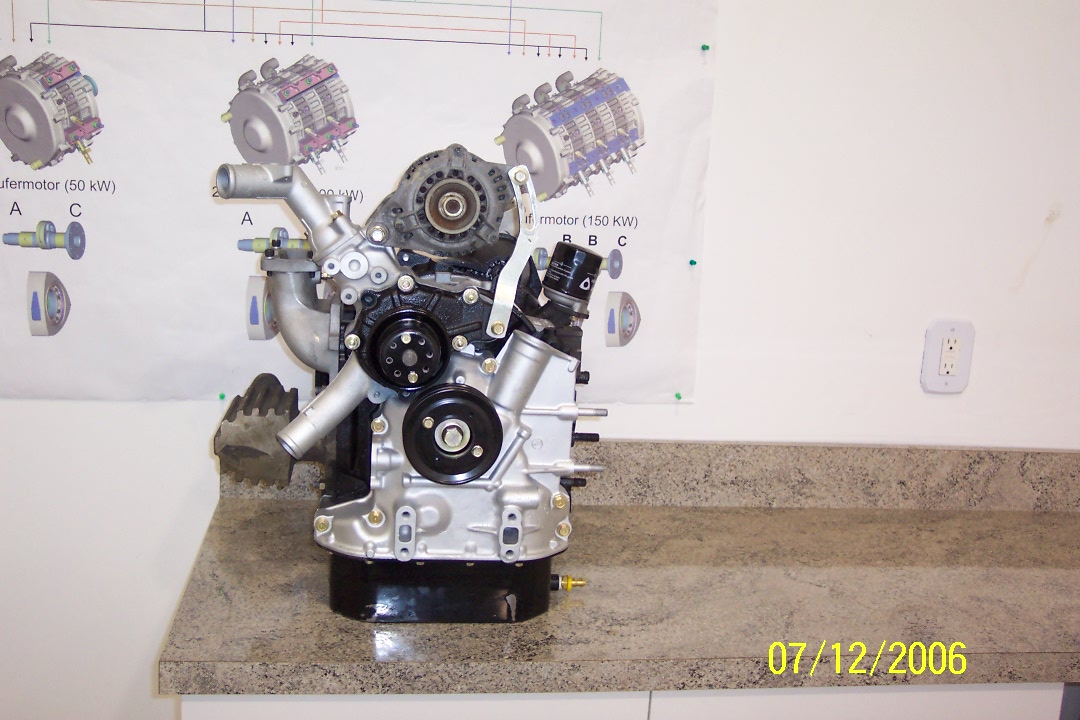
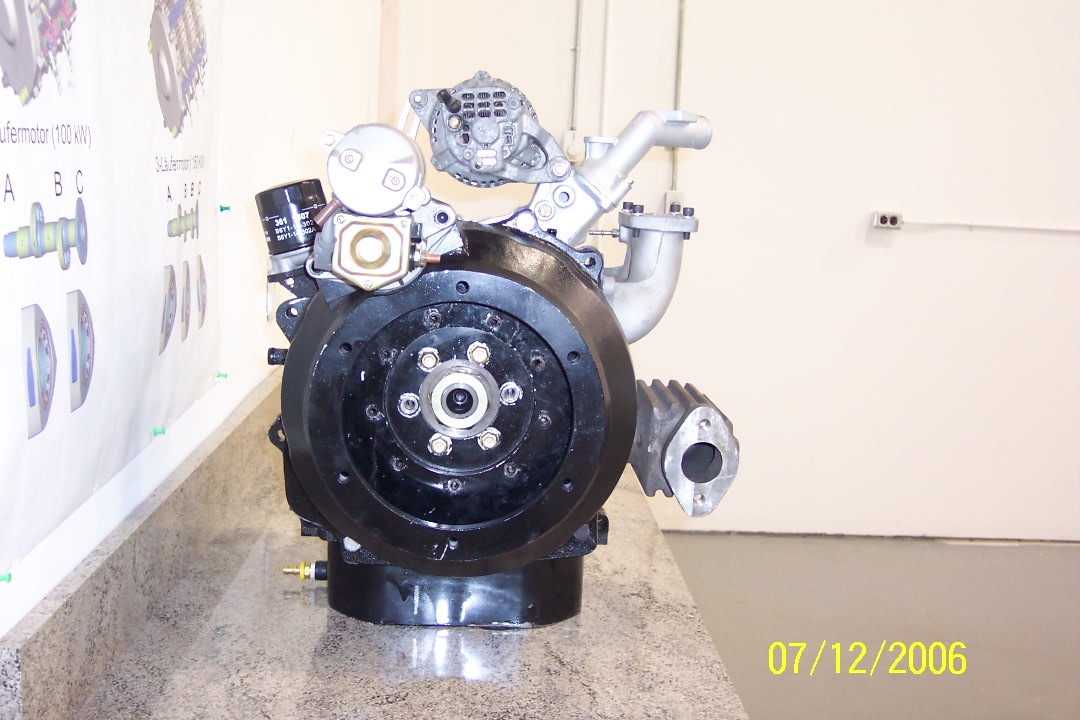
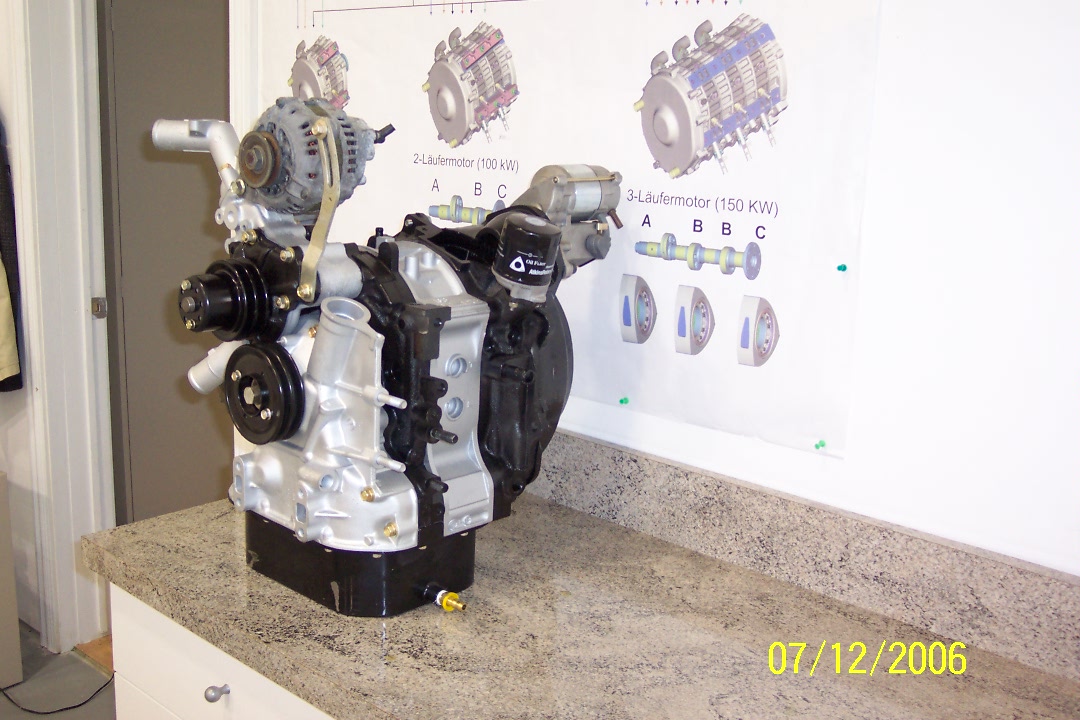
company had one single-rotor engine in stock, which is intended for a
genset and I snapped a couple of photos of that engine, which I have
attached here.
As George mentioned here previously the company is exploring a number of
different market segments besides aviation, including marine, industrial
and others. The company is even exploring the idea of bringing its
own-design genset to market.
As you mentioned, this may sound like a scattershot approach, but it may
make sense for this company at this point in time because it is now
essentially a sales operation. Anything they can do to sell more
engines, regardless of where or into which market, will give them
much-needed cash flow, which will in turn allow them to transition from
a sales operation into a manufacturing concern.
And there is yet a third and very exciting engine possibility on the
horizon, a modular rotary being developed in the former East Germany
that is all-aluminium and will be available in single through four-rotor
configurations. I was able to photograph some drawings of this engine’s
internals but cannot make those public for now, because the technology
is proprietary. But the technology and engineering is very impressive
indeed. If this becomes a commercially available engine, it will indeed
be very big news in the rotary community and the homebuilding community,
as this engine will sport an eye-popping power-to-weight ratio.
And yet another possibility is the certified Russian Aero rotary. George
is interested in exploring this possibility with his Russian contacts,
with a view to importing these engines to the North American market.
This would no doubt be huge news for the amateur-built community.
So to sum up, Global Rotary has the small German-built engines and the
Atkins-built Mazda-based engines available immediately to the homebuilt
community. Right now they are just a sales and support organization for
these engines. They can sell the engines to customers and will provide
after-sales support. They are also hoping to close some deals with
airframe manufacturers in the LSA segment, which would certainly give
them a big boost in terms of visibility and credibility.
In the meantime, those among us who may be looking for an engine for our
own project are probably asking the big question, namely how risky is it
to plunk down your cash with this outfit? It’s a good question. Let’s
face it, the homebuilt industry is notorious for fly-by-night outfits
who grab the cash and then go belly-up, leaving customers holding the
bag. Well, the only thing I can say is that you have to do your own due
diligence and proceed with caution.
Global Rotary is certainly a very small concern at this point. Their
facility is a single unit in an industrial strip mall of maybe 2,000
square feet total. There is no manufacturing or even a maintenance
facility at this point, although to be fair, they just moved in a few
weeks ago. So buying an engine from this company is not exactly the same
as buying one from Lycoming or from Rotax -- although to be precise you
would not buy direct from the manufacturer there either, but from one of
their dealers. And even here, there have been many cases I’m sure of
people getting stiffed by unscrupulous operators.
This appears to be the nature of the game in this neck of the woods.
It’s not like going into Wal-Mart or Home Depot and buying something.
When we buy aircraft engines or parts or kits or what have you, more
often than not there is a small mom and pop outfit at the other end that
may not be stable and could disappear in a puff of smoke at any time. A
lot of people have been burned in the homebuilding community, by a lot
of different operators.
However, I get the sense that George and Kurt are in this for the long
haul and they intend to build a business selling rotary engines for
light aircraft and other applications. Kurt is certainly an old-school
gentleman in the European tradition and I don’t believe that after
having survived the war, in which he was taken prisoner, spent several
years stateside in a POW camp (where he was treated better than the
treatment he got as an airman in the Luftwaffe, he says) and then
immigrated to Canada and went on to build a successful business and
family there – well, I don’t think this guy fits the mold of a flim-flam
man who now in his twilight years is going to go hunting for victims to
rip off.
Bottom line, if I was looking for a ready-to-go rotary engine right now
I would not have reservations about doing business with Kurt and George.
However, I would make sure I knew what kind of engine I was getting for
my money and how good that engine is – and therein lies the rub. We just
don’t know enough about the product yet to pass judgement. Hopefully we
will begin to see some of these engines flying in North America soon and
then we will start getting to know them.
Until then, I’m sure George will try to answer any issues that come up
on this forum.
Regards,
Gordon Arnaut.
The Rotary Engine NewsLetter. Powered by Linux.
ACRE NL web site.
http://www.rotaryeng.net
Copyright 1998-2006 All world wide rights reserved.