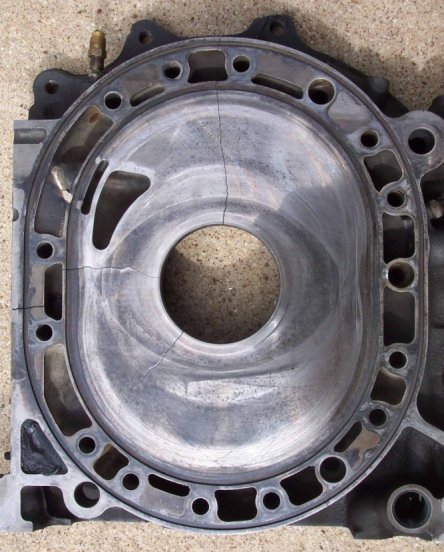
Here is what Svens at NRS told me about his apex seals.
"Hi Doug,
My website does not say what the material is but believe me it is Silicon
Nitride.
The results achieved with my product speak for themselves, I see no need to
disclose proprietary data on my seals that will only benefit my competition
and leave me at a disadvantage. If and when I see the specs for Iannetti
seals I might consider offering this info more freely. We have several cars
in Australia running the seals in circuit racing with unprecedented
reliability and performance. One of my AU clients recorded the highest
cranking compression ever with the 2 pc 3mm grey's (over 25 years in
business) and all he ever buys now is 1 pc seals because he claims they
perform well enough to keep him in front of the pack. The 3mm 1 pc seals in
the crispeed built "V8 killa" car pulled slightly more vacuum than stock 2
pc 3mm steel seals after about 2 hours at idle. More importantly to this
builder was the fact that the seals were able to take stresses that would
have normally began to warp the factory 2 pc 3mm seals or flatten the apex
springs. In fact they were not even being affected after back to back runs
at 685 RWHP. The vacuum is perfect run after run and even after a full pull
it settles back to perfect idle and vacuum. Stock seals after continuous
running and heat soak would have started to compromise sealing until the
engine cools down.
Thanks
Sven Nielsen"
Cheers
DougFir
There is no doubt that SiNi ceramic seals will distort less
at 500 to 750 F or so than iron seals. This is due to
the lower thermal expansion coefficient.
I would still like to see a simple impact comparison test between
SiNi seals and stock Mazda cast iron seals. Just clamp them
in a vice and drop a large ball bearing on them from a known
fixed height.
I would also like to know what the surface finish is compared
to the latest Mazda stock apex seals. Surface finish is very
important.
--
Paul Lamar ...No rotor no motor.
Paul
OK. Do I have your permission to forward this post to Sven?
DougFir
Sure. He can also join up if he has the time.
Paul Lamar ...No rotor no motor.
Paul
I have been corresponding with Sven at NRS and he has been very forthcoming
about his products. Here is the latest note. Please put him on the list or
contact him directly. This post came in today from him.
>Hi Doug,
Why don't you give me a call? Also I would like the link to the thread for
the discussions.
You know with all this talk about properties the one I thought you guys
would be interested in is the Weibull Modulus which no one seems to care
about. Weibull Modulus for my material is 20 - 30 which blows away your
enclosed example.
I am attaching another pic for you to review. It is of a cracked iron that
came from a 1000 hp drag engine. The leading and trailing wires were
installed reversed! This engine grenaded very hard and I have never seen an
iron that bad before. The cracks are completely through to the other side
and are very severe. All 6 apex seals survived without a lick of damage.
I understand how the material properties are so important to users in this
application but all of the specs in the world mean shit when it comes to
real world use. Data on paper doesn't necessarily translate to practical
performance. That is why I gave away 8 sets of seals for testing before ever
considering them for market.
I encourage Paul Lamar to contact Paul Moller at Moller International for
his evaluation of my product. I made a set for them just prior to the
release of my product to market.
Moller International built an engine using the grey seals in an air cooled
stand by generator system in a constant motoring mode (spinning 24 hours a
day except when needed for power). Ceramic Apex Seals were chosen to
significantly reduce motoring drag (very important in this application). NRS
Ceramic Power Seals exceeded the customer’s requirements by over 30%!!
NRS Rotorsports also made a set of seals for this same customer out of a
very expensive ceramic material of their choosing. The seals failed almost
immediately under the same harsh conditions. On paper this material was the
cat's ass.
It was in this application where Moller International recorded the steel
seals glowing red hot, in fact the seals actually extruded from the slot.
Happy Trails,
Sven Nielsen
NRS Rotorsports
10424-75 Street
Edmonton, Alberta, Canada
T6A 2Z5
780-468-2567
nrsrotorsports@shaw.ca
I have contacted Paul Moller way more than I need to :)
Sven, if I were you I would not use Moller as a reference.
His negative image might rub off on you :)
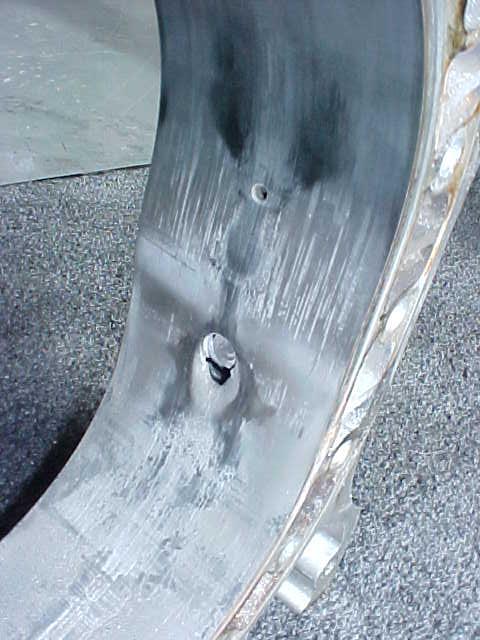
That is an impressive picture.
First picture of a cracked housing or an actual cracked iron housing I
have ever seen. Here is another one for your collection. This is a melted
rotor housing from an engine run at high power without coolant and
the Ianetti ceramic seals survived and went on to
be used in another race engine. Picture from Dave Lemon
at Mazdatrix.
Paul Lamar ...No rotor no motor.
The Rotary Engine NewsLetter. Powered by Linux.
ACRE NL web site.
http://www.rotaryeng.net
Copyright 1998-2006 All world wide rights reserved.