Here are my rules. Any fuel is allowed. Must have a top
speed of over 120 MPH to insure good acceleration at 80 MPH
and hill climbing ability.
Must pull over one G lateral on the skid pad. Must do 0-60 in less
than 7 seconds with just the driver on board. Must hold four
200 pound people. Must stop from 60 MPH in less than 160 feet.
Must have effective air conditioning and an automatic
transmission. Must have a range of over 350 miles.
> Must also be able to refuel in less than 5 minutes.
There are no other rules other than meeting
federal crash and emissions requirements.
Paul Lamar
I think with a six speed auto or CVT, the diesel Jetta they just
stopped making can meet these...
-dave
--
Best Regards /Mit freundlichen Gruessen,
dave ( at ) arb.net http://arb.net
Why did they stop making it? I don't think a diesel will
meet future smog rules. I could be wrong. I also doubt it will
pull one G lateral on the skid pad.
Paul Lamar ...No rotor no motor.
You hit the nail on the head Paul... the new 07' emission standard our
brilliant EPA have enacted ends the CRD Jeep Liberty (They couldn't
make
enough of them with about 22 days on the dealer lot) and the Jetta /
Beatle sales here in the USA... I don;t know why they didn't add post
treatment to them before 07' but Jeep will begin selling the MB CRD
Grand
Cherokee here in Jan 08' - called "BlueTec". I would think VW can't
be far
behind. The technology has been out for a while now.
What really bugs me about the EPA is the TONS of particulates the
8,800+
GVW ( or highter?) trucks and machinery bellow out every day does not
change. Yes, the over the road trucks must "start" to have controls
for
NEW trucks after Oct 06, but why take away the 50 mpg cars now? In
the big
picture, they are a minor contributor..
-dave
Black smoke from the big trucks and school buses are
still a big problem nation wide. I just got back from driving
across the country and back.
Paul Lamar ...No rotor no motor.
Paul,
We are totally at odds here. What is the relevance of 0-60 in less
than 7 sec vs less than 8 sec to the ordinary driver? And will he
ever experience 0.9 G much less 1.0 G and recognize the difference?
Numbers are simply numbers.
Perception IS reality!
John Dinkel
OK I'll settle for .9 G and 8 seconds. I set those numbers to
eliminate the stupid over weight poor ride and handling hybrid
cars that use rock solid tires to reduce rolling drag.
BTW if the same extremely hard tires were used on a Civic or Corolla
it would get better millage as well. The hybrid Toyota Prius's good EPA mpg
numbers come somewhat from the rock hard tires, the expensive
aluminum body parts, the steeply raked windshield and the
optimized aerodynamic roof shape.
If you applied those same features to the econo boxes they too
would get better MPG. The new Civic is a step in the right direction
with its steeply raked windshield. Note the little Civic side ports
ahead of the front side windows. Same as the Prius.
BTW I would change the EPA millage test schedule to the average
of ten flat out 0 to 60 MPH runs and steady speed fuel consumption
measurements at ten MPH increments from 40 to 80 MPH.
This will give real numbers on overall efficiency of the
complete system adjusted for the way people really drive.
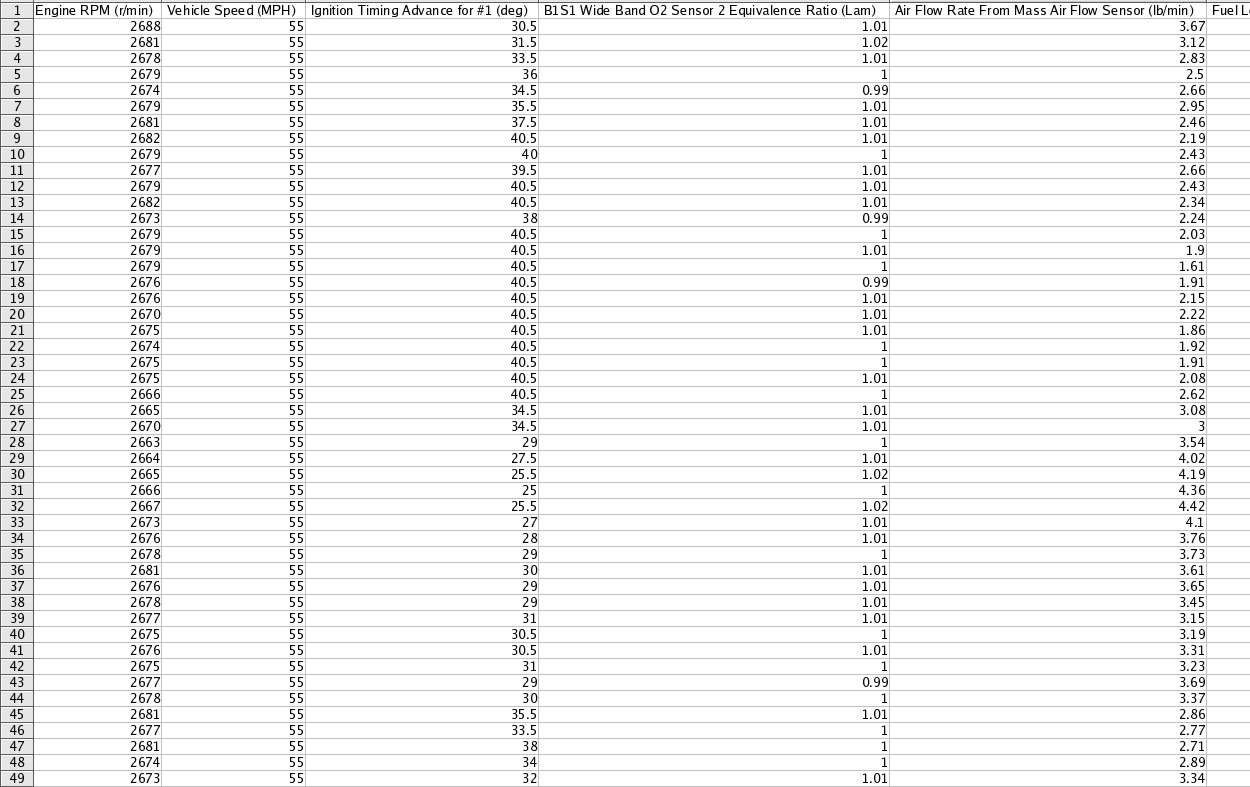
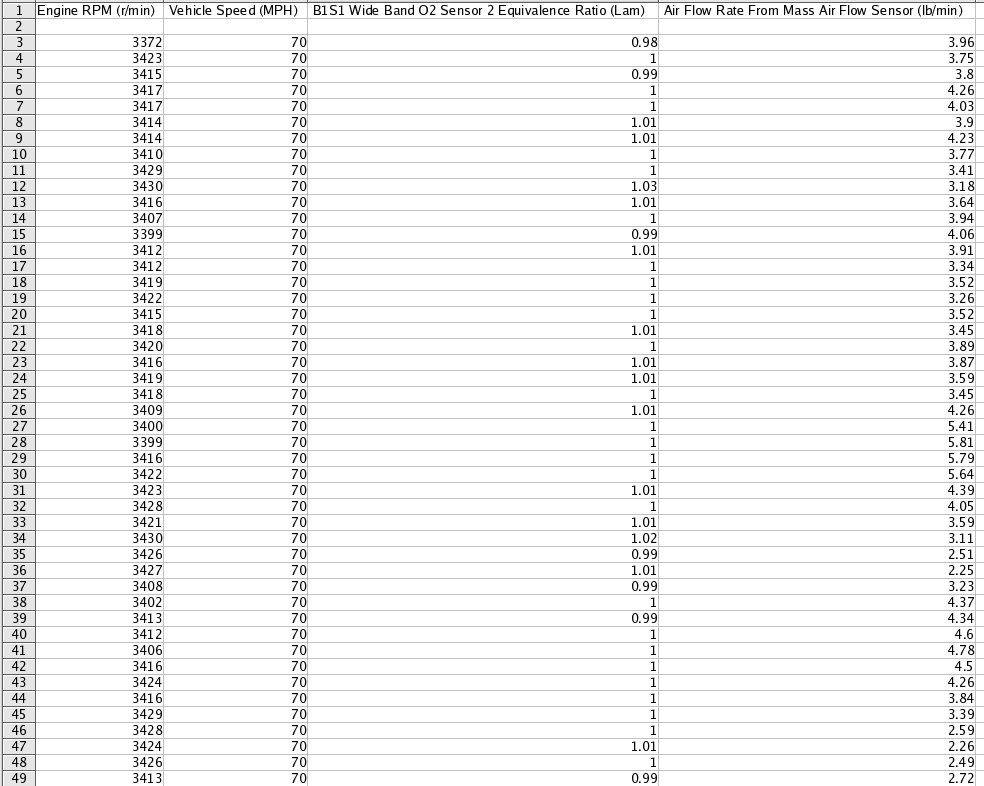
Another thing that is happening as far as I can tell. My 2004 Honda
minivan consumes a lot of fuel when it is started up from cold. I
suspect the mixture is extra rich to light off the cat converter.
I can test this with my OBD II software but I have not gotten
around to doing it. My 2003 RX8 also suffers from this particular
problem as does Robin's PT Cruiser. The rest of the time the fuel
mixture is stoichiometric which does not give the best BSFC or MPG.
Leaner at low power (freeway cruise power) yields better BSFC. This
is done to minimize NOX. Other methods of reducing NOX should be
developed.
I would add another test and measure the fuel consumed by
an idling engine for the first ten minutes after it is
started from cold. Say 45 degrees F or some such.
Furthermore the weight and volume of the engine has a profound
effect on the over all weight of the car. Compare the
3000 pound weight of the RX8 with its 200 pound engine
to the average 3500 pound weight of of similar four passenger cars
with about the same performance. Mazda could easily reduce
the weight of the RX8 engine to 150 pounds with aluminum
end housings further significantly reducing the over all weight
of any car designed to use it.
Paul Lamar ...No rotor no motor.
The Rotary Engine NewsLetter. Powered by Linux.
ACRE NL web site.
http://www.rotaryeng.net
Copyright 1998-2006 All world wide rights reserved.