The reason I am so grumpy about this subject as I have
been battling with people for many years about the intake
design. I had a brief friendly discussion with Bill Eslick at
OSH this year on this subject. Bill has 400 hours on his
engine and he has changed the intake design at least once.
He seemed resigned to having a 150 mph airplane.
I know he is interested in going fast as he entered the
Dayton to OSH race last year. He did not do well. Three hours
and eighteen minutes or 142 mph. Most RVs are averaging around 200
mph in this race and Dave Anders did 244 mph in his RV4
this year. Bill's current intake is a long dynamic chamber which
I stated over and over again a few years ago is not
the right thing to do. Even Tracy abandoned it after he convinced
a lot of people it WAS the way to go. Chuck Dunlap's airplane
had something similar with equally disappointing results.
Mistral spent a lot of dyno time and money on the side port intake
and they got only 190 HP at 6000 rpm or so.
People think the RX8 engine is a magic 240 HP engine all
by itself regardless of the intake. It WILL generate 240
HP at 8500 RPM with the right intake system. That is 28 HP
per 1000 RPM. So 7500 is 212 HP and 6500 is 184 HP.
No getting around it. Putting it another way the max torque
on the side port engine is about 160 foot pounds maximum no matter
what you do. It is, after all, only a 160 cubic inch engine.
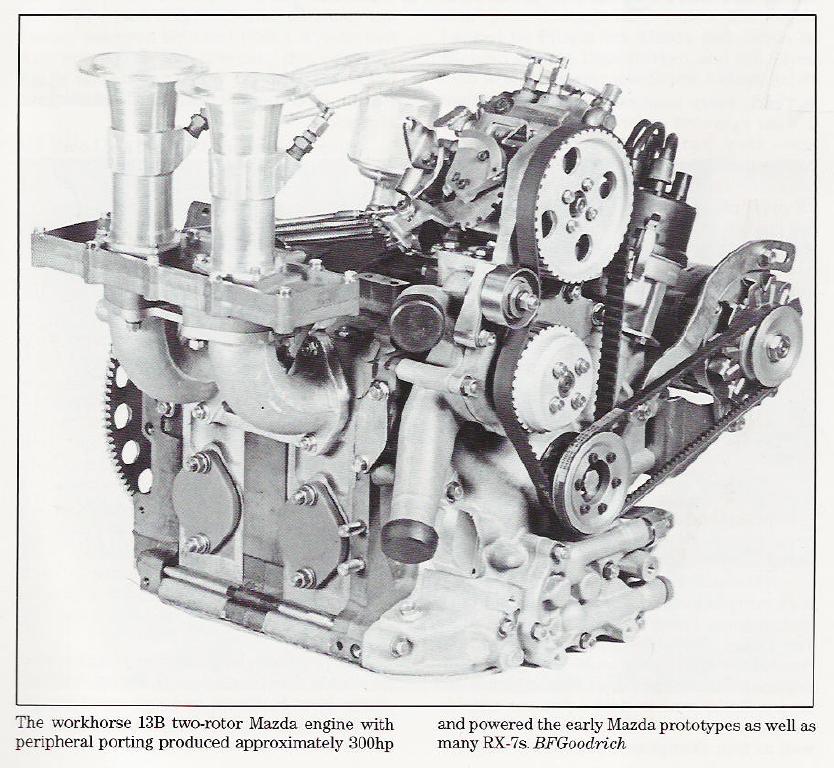
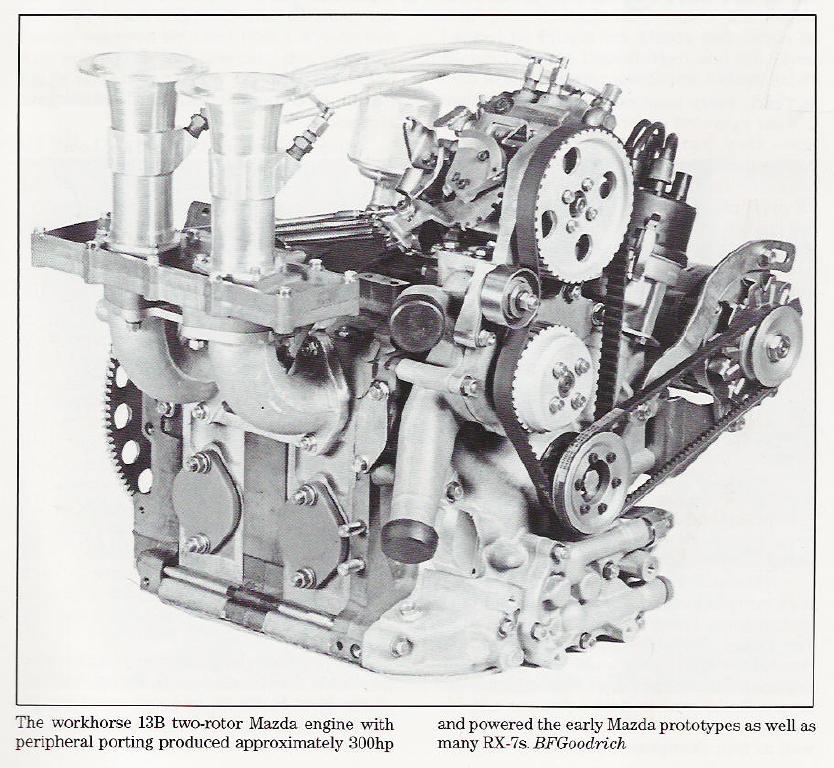
The p-port on the other hand is an easy 200 HP no matter
how you mess up the intake system. 200 foot pounds of torque
is no problem. Moving the torque peak up by shorting the
length of the runners results in a lot more HP. 300 HP at
9500 RPM with 2 inch diameter runners and a slide throttle
is no problem at all. We demonstrated 240 HP at 6500 RPM
on the dyno using about 2 inch runners and a carb no less.
The other major factor is the skin friction drag inside
the runner tubes. Four, 1.5 inch diameter runners, have four
times the surface area and skin friction drag as two 2 inch diameter
runners if my arithmetic is right. Probably more as the
air velocity could be higher. This increases the pumping losses.
The high power RX8 six port/runner engine is even more of a
nightmare. Mazda had to do it to get more torque at 2000 and
3000 RPM for car use. The four port/runner RX8 engine is worse
as the breathing is becoming limited over about 6000 to 7000 RPM.
A p-port intake system is easier to build as there is no flange
bolted to the side of the block. Just use the slide throttle
design on the web site.
Ironically there is no BSFC advantage with the side port.
Probably on the contrary as the pumping losses are higher
with the side ports and multiple runners.
Don't get hung up on low RPM. Forget everything you know about
piston engine RPM. The rotary is a different animal. It is
more akin to an electric motor than a piston engine.
There are no parts that jerk back and fourth, fatigue and
crack. Forget the 2.17:1 gear box. It is ancient history.
Go for the 2.8:1 gear box or even 3:1. Also go for a constant
speed prop if you want a lot of MPG.
I'll be talking more about props soon.
Paul Lamar ...No rotor no motor.
Paul,
In your defense of the P-port.
As a P-port convert I recently went over two years and many folders of
print
outs and notes. It was obvious to me my early interest for the Renesis
engine was based on information pertaining to automobile usage and the
'newest is best' mindset. For those of us after the big horses (over
240Hp)
in a small package, the P-port manifold is the least complicated and
lightest manner to get the required volume of air in the engine. This is a
fact not opinion. Mazda engineers have told me as much repeatable. Final
sunk in I guess.
I found it useful to make long lists evaluating my needs, the possible
engines configurations, PSRU ratios, and propellers to accomplish the job.
Excuse the evangelizing. New converts are usually the most enthusiastic:)
DougFir
Took long enough Doug!
George (down under)
For the new guys here is the Guru racing beautiful p-port
pictures again.
I don't know how much HP this beast has :)
Paul Lamar
George,
Yes you are correct but I had a few more variables to contend with. I was
planning to use the early front housing like shown in the Guru Racing photos
and also mount the pump remote. This housing appears to be very robust.
I don't know if Guru's P-port manifold can be made to work with our
applications. I can't seem to find a way to contact them to ask either. Do
you have their email address?
Paul definitely over 300Hp judging by the fact that Mazda accomplished that
number with carbs. long ago.
DougFir
Well maybe on carbs. The racing engine most used in the 1980's had
mechanical fuel injection and a slide throttle.
Paul Lamar
The Rotary Engine NewsLetter. Powered by Linux.
ACRE NL web site.
http://www.rotaryeng.net
Copyright 1998-2006 All world wide rights reserved.