Paul wrote;
Did you receive the suggestions I sent Al? They are not
mentioned in your last message just above.
-----
I did receive it, but when I went back looking for I couldn't find it. One
photo I recall is where you had drawn a red line showing more space above.
That photo was of the wing root radiator which is in the other wing. The
oil cooler is narrower than the rad, and is placed at more of an angle in
the wing, so it is more perpendicular to the flow path, and the exit face is
not as obscured as in the case of the rad. (Some thickness of foam above the
rad is to insulate the upper surface of the wing)
-----
How well is the oil cooler sealed in the duct?
------
There is just a small gap on each side to reduce the heat transfer into the
fiberglass and foam.
-------
The stock second gen RX7 oil cooler core is 19.5 by 4.5 by 2 inches
thick. 175 cubic inches with turbulators inside the tubes.
Does your oil cooler core have turbulators inside the tubes?
Turbulators increase the area and therefore heat transfer from
the oil to the metal in the oil cooler.
--------
My oil cooler core volume is about 380 cubic inches. It uses the Griffin
extruded flat tubes which have internal webs (fins) about every 1/4" to
provide strength for high pressure. My thought is that the limitation in my
case is heat transfer to the air, not the oil to the metal.
-------
Mazda specifies 5 W 30 weight oil for the RX8 engine. Lower
viscosity oil also increases the heat transfer coefficient
of the oil to metal interface. What weight oil are you using?
--------
I'm currently using Castrol 20-50. When I get to the 20-25 hour point (or
sooner if I have the oil system open for some reason) I plan to change over
to Idemitsu 20-50.
-------
I think those suggesting more of a ram inlet scoop, and those suggesting a
less shrouded exit fairing are both correct. The net change needed is more
pressure differential between inlet and outlet, and either change will
likely accomplish that, and either change will result in more drag.
As I see it now; the inlet was designed on the basis of a more negative
pressure at the outlet, alleviating the need for a ram scoop. The outlet
was designed based on an assumption of an inlet air flow equivalent to a ram
scoop, so the end result was a combination that is not effective. The exit
fairing is designed to speed up the exit flow so it will merge at something
closer to free stream velocity, and simply to protect the core from things
being dropped in. With too little inlet pressure to produce the flow there
will likely be very turbulent flow aft of the fairing, increasing the
pressure in that area. Cutting back the fairing (moving forward as in the
Rutan case) increases the negative and brings the air out at much less than
free stream velocity.
So, which is better for cooling and drag - scoop or unshrouded exit?
An extended scoop is an easier thing to try.
Of course, I may still be missing the target entirely.
Meanwhile, I have another problem to deal with - a fuel leak(s) through the
inner surface of the foam core strake into the foam. Bummer!
Al
"There is just a small gap on each side to reduce the heat transfer
into the fiberglass and foam."
That could very well be a big part of the problem. It is a mistake
most people make. I would fill it with red RTV and do some heat
test on the foam. If it is not the spar 200 F should not be a
problem on the fiberglass skin. Perhaps you can get some stickers
that change color with temp and paste them over the rad.
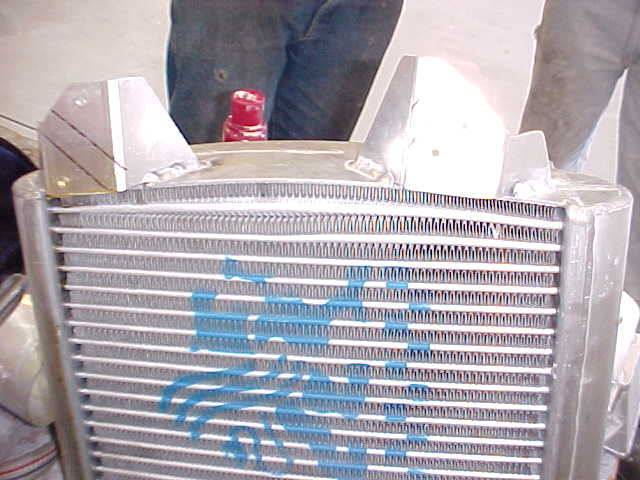
I am familiar with that Griffin oil cooler tube. Here is
a picture. I don't think it is as good as the Moline
stock Mazda 2nd gen oil cooler. Ops I can't find the picture
I thought I had but this is a picture of a Griffin oil cooler
that prompted the change to an extrusion with a rib every 1/4
of an inch :)
As always it is going to be interesting as things progress.
I think Idemitsu now has 5 W 30 as it is called out for the
RX8.
Paul Lamar ...No rotor no motor.
The Rotary Engine NewsLetter. Powered by Linux.
ACRE NL web site.
http://www.rotaryeng.net
Copyright 1998-2006 All world wide rights reserved.