Hi Paul,
I had to scan paper and put it into Word to get this out without a
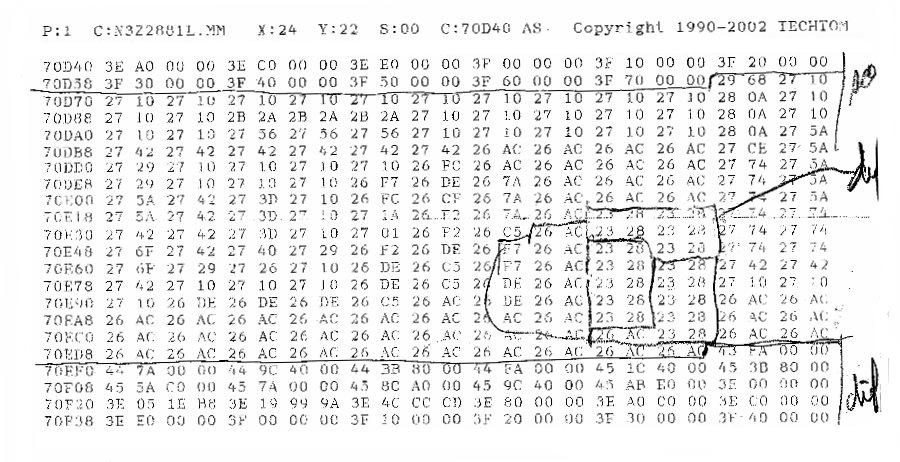
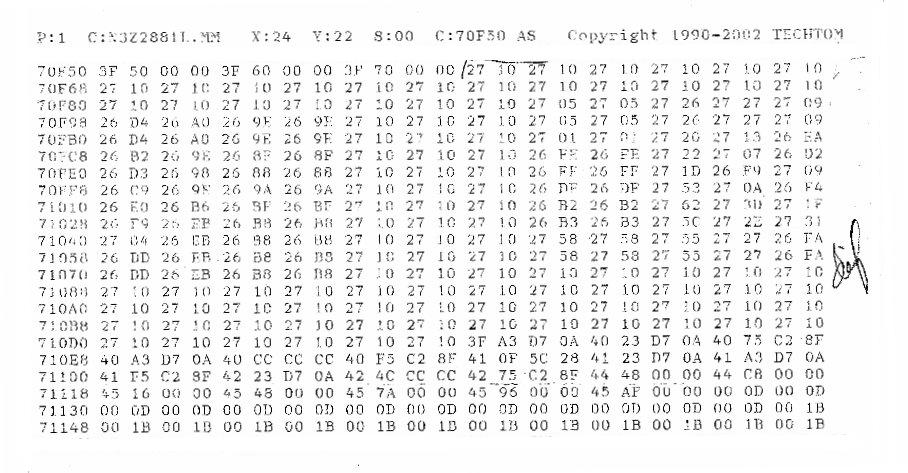
lot of trouble. Numbers on the left are hex byte positions out of 7FFFF
total. Map starts at 70D6C, two byte word, 29 68 hex converts to 10600,
move decimal 4 positions left for A/F=1.06 at this position. The
numbers from 70CFC through 70D2B are 12 RPM's (horizontal scale) in
single precision floating point (990 RPM to 5500 RPM). Those from 70D2C
through 70D6B are 16 volumetric efficiencies (.125 to .9375). As you
can see, a large portion of the map is on or close to "27 10", which is
1.00. There are other Target Oxygen Maps for special conditions but
this is the main one.
Jim
Here you go!!!
Best regards,
Jim Langer
Racing Beat, Inc.
714-779-8677
Fax 714-779-2902
www.racingbeat.com
Thanks Jim. Very interesting. Perry Mick runs the stock 2nd gen
computer in his airplane and this could be very useful.
Right now Perry is working on an variable gain amp to modify
the mass air flow signal to lean his mixture. Here is a chance
to achieve this leaning by modifying the mixture map directly.
Perry, you will have to swap out your computer for an RX8 version
with CAN or OBD II input output I think.
BTW Perry uses his airplane to commute to work, weather permitting,
and has 450 hours so far.
Jim, Is this Techtom Mighty Map DOS or Ver-3 output?
http://www.technosquareinc.com/mitelite.htm
I'll have to fire up some of those old DOS computers
I have lying around.
I'll write a DOS program to convert this stuff
to decimal to make it easier for a human to read
and send you the program. Perhaps you can print the
data to a file which was a common practice in the old
DOS days as I recall. Also hitting Control P turns
the printer on and prints everything that goes to the
screen... also as I recall.
Do I have it all?
Is this a stock RX8 table or a modified table?
Paul Lamar ...No rotor no motor.
---------------------------------------------------------
OK What we have here I think is a two dimensional map of
mixture ratio verses volumetric efficiency.
In this case volumetric efficiency is the same as manifold
pressure. 29 inches of mercury is one. BTW It is interesting
that the best the RX8 intake system can do is .9375 times
29 is 27.2 inches of mercury. A P-port would be up to 1.2.
Jim, what I would like you to try is a lean mixture only at RPMs above
5000 RPM and volumetric efficiencies in the range of .5 to .8.
This I think is where the stratified effect starts to take
hold and the point where we are running the engine during cruise
in aircraft.
This is like driving down the road in fourth or fifth
gear at less than 60 MPH. Something one might do if one
were interested in immediate acceleration without down shifting.
Or sometimes people just forget to shift as the engine is so smooth
and quiet up to 6000 RPM.
Admittedly this is not as good as being in sixth gear with
a wider throttle opening at 3000 to 4000 RPM. Unfortunately
the positive effect of lower RPM and less engine friction is not
helping the high RPM stratified charge effect.
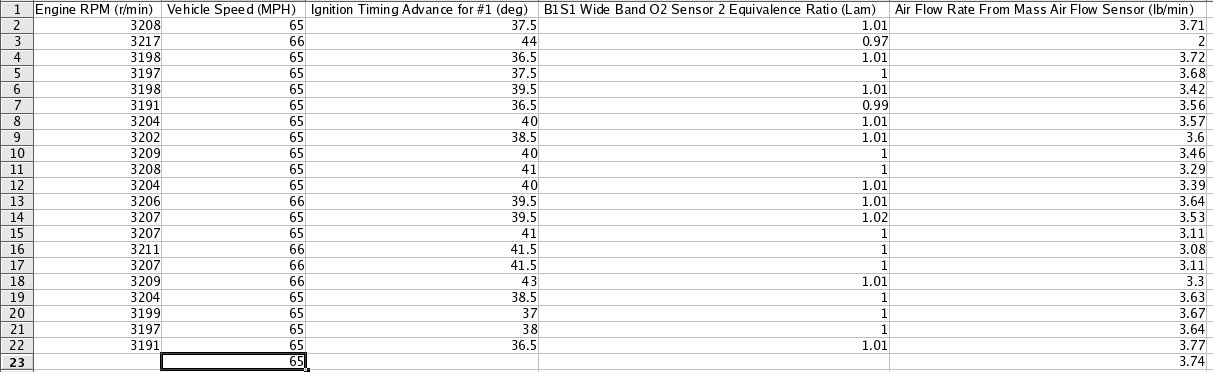
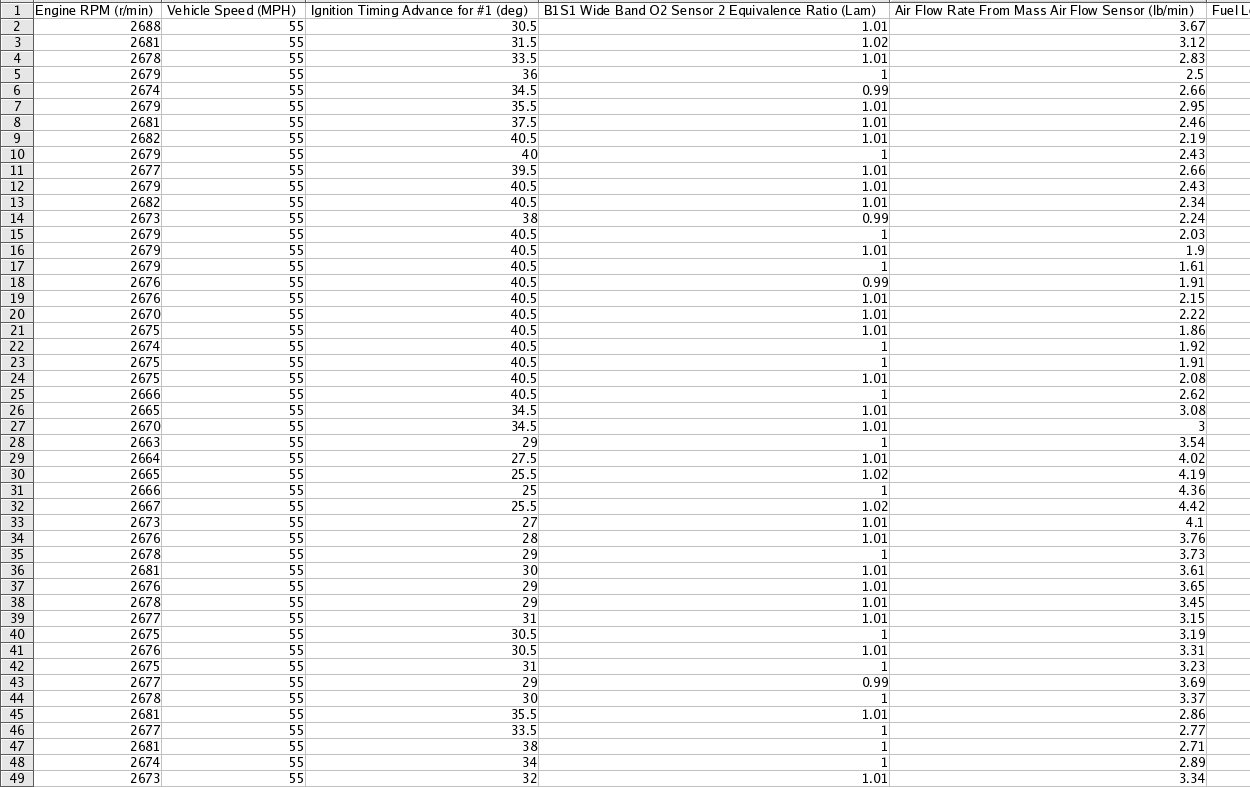
We can do an OBD II fuel consumption test by recording the
mass air flow and dividing by 14.7 to get the fuel flow
at say a steady 60 MPH in fourth and fifth gear and then
repeating the test after the map was leaned in this range.
Paul Lamar ...No rotor no motor.
The Rotary Engine NewsLetter. Powered by Linux.
ACRE NL web site.
http://www.rotaryeng.net
Copyright 1998-2006 All world wide rights reserved.