G'day
Back from Oshkosh and Canada and would like to subscribe again to the
list.
Called into the Mistral tent a few times but didn't get to catch up with
you.
Baz Mayne ( Australia, Renisis on Cobra Arrow )
First flight:
"G'day everyone,
Yep, finally got to do it.
I scared the crap out of myself as everything happed so quick.
I can't give any figures as I was too busy trying to save my arse,
if there had been any buttons on the seat cushions the pucker factor
would have neatly plucked them off.
Ground roll was good, but before I could see what the speed was it
lifted off and went almost vertical. I managed to catch it before
it stalled but it continued to porpoise badly, then the engine
started running rough. By this time i was at the boundary fence
and I picked out the paddock to crash in. It was still climbing
and the porpoising reduced so I continued with the circuit. On
downwind the engine smoothed out a lot and it was stable. It was
good enough for me to take a pic out the front. I had no idea
whether the porpoising would return when setting up on final and
was resigned to a probable crash landing. It didn't happen, it
behaved in a very stable manner all the way down and onto the
ground for ( what the CFI called ) a smooth landing.
The knees were like jelly and I thought that maybe I needed to
change my jocks but on reflection most of the problems were of
my own making. Firstly I have no idea of the take off speed, I
was too busy looking down the runway keeping it straight.
Secondly I think I had too fine a pitch setting and the rough
running was due to little or no load on the engine. Thirdly I
had been agonizing about doing the first flight for so long that
I was a nervous nelly.
The good aspect of the flight was that it was very stable in roll.
The controls are heavier than I thought they would be and the pitch
is way too sensitive.
I'm sure everything can be sorted out, after all thats what
the 40 hours testing time is for.
More later as I think of it
Cheers
a very relieved Baz"
Second flight:
"Well, the weather was absolute crap here over the weekend but
all the rain was great.
In between showers yesterday I did another run ( cloud base
around 1500' AGL ).
Very dissapointing to say the least. Changing the AOA on
the ground certainly got rid of the vertical attitude of
the first flight but needed a pull back on the stick to
get it off the ground, after lift off it still porpoised a lot.
Setting the prop with more bite helped with speed but the
faster it went the more unstable it became in pitch. The
engine still giving the impression that it is over running,
maybe I still don't have enough pitch on the prop, I just don't
know. I throttled back to run at about 4600rpm on down wind
with TAS 110 knots and the engine giving the odd rough running.
Not at all impressed I gotta tell ya. Pitch, while controllable
was very erratic and I was glad to get back on the ground and said
a few choice words to the bird. After landing I ran it up to full
throttle and it didn't miss a beat. The only good thing I can report
about the flight is that the oil temp was in the high 70's and the
coolant in the low 80's.
There has to be a reason why its so unstable, maybe the C of G is
wrong , who knows, I sure as hell don't. It didn't try to kill me
this time so I guess thats a bonus.
I really thought it would be right this time and I could put
it up for sale before going to Oshkosh later this week but
I can't do that until I'm satisfied with it.
I will have to talk to Tom, but I will leave it until I get back.
Baz"
Baz, IMHO I would not fly this airplane again unless you get a qualified
aerodynamic engineers to check the airfoil for center of pressure
travel and CG position. Measure the actual airfoil shape as
in the process of constructing the molds it may have deviated from a real
stable airfoil shape. This airplane is obviously inherently unstable
and therefore dangerous.
Paul Lamar ...No rotor no motor.
-----------------------------------------------
Baz,
What kind of airfoil does the wing use?
Some airfoils are inherently unstable -- that is the center of pressure
moves forward when the wing pitches up, thus increasing your angle of
attack
even more and steepening your climb, which is what you describe on your
first flight.
Conversely when the ship is in a dive, the CP on an unstable airfoil moves
aft, pitching the wing down even more and aggravating the dive. The Clark
Y
and other flat-bottom airfoils tend to have this characteristic to some
extent.
A stable airfoil is one where the center of pressure moves to the leading
edge when the AOA is decreased, as in a dive; and to the trailing edge
when
the ship is pitched up in a climb. This gives the airplane the tendency to
level itself out from a dive or a stall, a very desirable trait.
I checked the website for Cobra aircraft but didn't find much info on
flight
characteristics.
Regards,
Gordon.
Hi Gordon,
Thanks for the input on my pitching problem. I don't know what the airfoil
is but there has been 3 built before mine without this problem so I don't
think the problem lies there. Certainly the C of G needs to be looked at and
as soon as I get back out to the airport that is one of the things that I
will be doing. C of G was done by calculation and it is possible that it is
wrong. Personally I think the C of G is too far forward but I won't know
till I physically balance it. Do you think that could cause the pitching
problem. The pitching is controllable and doesn't build up to uncontrollable
but certainly has the pilot ( me ) plucking a few buttons off the cushions.
Another tail has been built and is in the process of being tested. It has
been suggested that anti servo tabs may help, what do you think? all the
other had them.
I have no intentions of flying again until I feel it will fly better. I'm
really hoping the C of G is wrong as thats easily fixed and will be a good
starting point. Incidently I just love the scream of the rotary and how
smooth it is.
Baz
The CG should be well forward of the 25% cord point of the wing
measuring back from the leading edge.
That is easy enough to check. You can check the CG by using five
bathroom scales while the pilot and passenger if any are in
the airplane. Two under each wheel. Two, joined by lumber, side
by side under each main tire. That should give you a total capacity
of 1300 pounds as bathroom scales are typically 300 pounds each
or 140 Kg each or so.
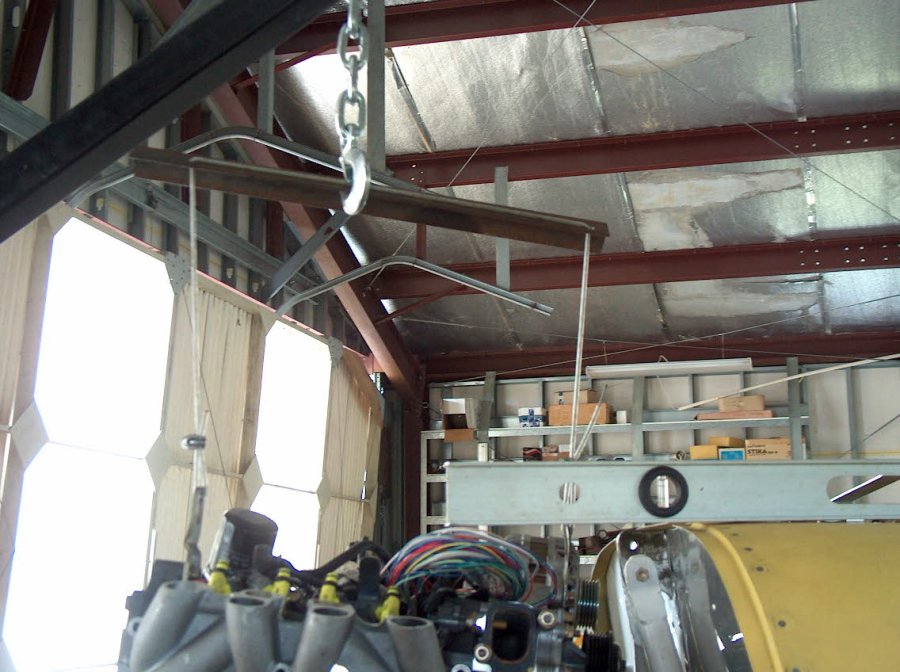
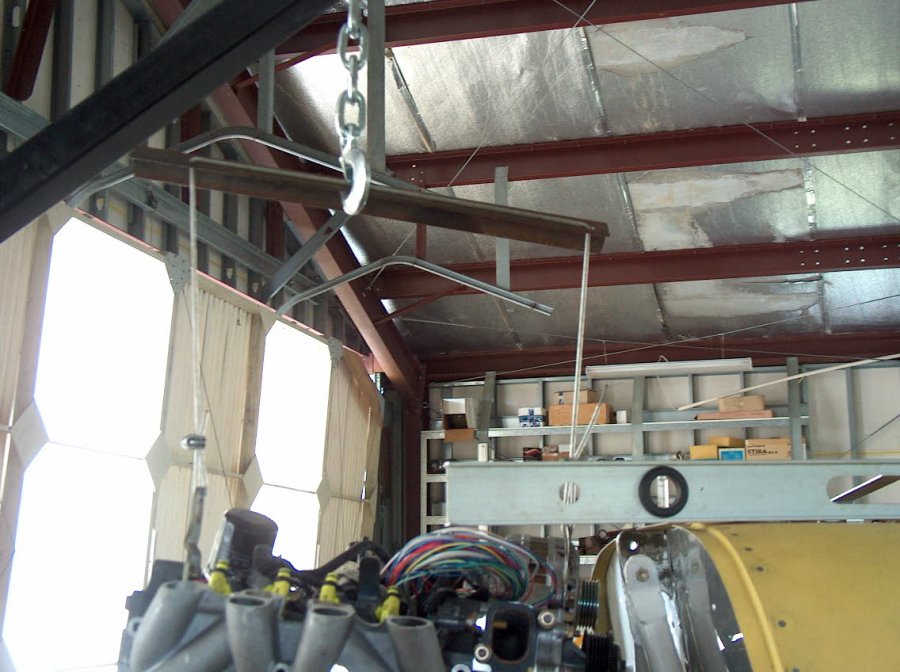
Cheaper and better. You can also make a sling out of 100 mm
square lumber about 3 meters long horizontally placed above the
aircraft. Tie a rope to the prop shaft and use a nylon strap
just behind the cockpit. Then host the entire rig at a point
on the lumber where you think the CG is. If the airplane pitches
nose down the CG is forward of the point you hoisted it from.
Move the point and try again until the aircraft is hoisted
without pitching.
Paul Lamar ...No rotor no motor.
The Rotary Engine NewsLetter. Powered by Linux.
ACRE NL web site.
http://www.rotaryeng.net
Copyright 1998-2006 All world wide rights reserved.