Paul,
With all the recent discussion about P-ports and intake manifolds, I
thought I would ask some basic questions about the various engine
versions and how they stack up for different aircraft requirements.
I'm not sure I understand things correctly, but it seems some engines
have four intake ports and others six. Do the turbo versions use the
four ports? I assume the six ports are for better drive ability and
torque at lower rpm?
What about the Renesis, how many ports do these have? I understand the
Renesis also has switched to exhaust ports on the side castings, instead
of P-port exhaust as on the 13B?
If so, it would seem that the 13B engine would be a better starting
point for a turbocharged or turbo compound engine, since the P-port
exhaust would be more energetic?
However, if one wanted a normally aspirated engine of up to say 180
horsepower, perhaps the Renesis would give better fuel specifics, and
maybe a little quieter exhaust? If you need 200hp or more, you would
probably want to go for P-port, whether Renesis or 13B.
It seems that making a manifold is pretty much required as the stock
manifold, besides being a heavy casting, will not easily fit under a
cowl? So if you are making a manifold, it would seem that making a
P-port with only two tubes would be the easiest from a fabrication
perspective. Making a six-port manifold would be the most work, it would
seem.
Regards,
Gordon.
Yes all Mazda turbo engines use the four ports.
Correct on the six ports. The high power RX8 engine is six ports.
True on the work involved. A six runner low profile manifold long
enough to work at 6500 to 7500 RPM is not easy to make.
The stock RX8 6 port manifold is not that heavy but it is way too
tall to fit under a cowl. I think the fuel specifics would
be about the same. Side port or P-port. After all Mazda won
Lemans with the same fuel allocation as the piston engines
and used p-ports.
Mazda is always trying to squeeze a quart of low RPM torque
out of a rotary pint pot. That is why they use the six port engine.
Very long, small diameter runners give more torque at low
RPM.
BTW The 2.6 L 13B engine has not been increased in displacement
since 1973 while the power has gone from 120 HP to 240 HP.
Mazda is now forced to compete with 240 HP 3.5 L all aluminum V6
engines from Honda, BMW and Toyota with lots more low RPM torque.
When it comes to low RPM gas engine torque there is no replacement
for displacement.
However the RX8 still has a 500 pound lower weight advantage
despite the cast iron end housings. That helps somewhat to make
up for the lack of low RPM torque. Car empty weight closely
tracks engine weight. In other words there is an approximate fixed
ratio of engine weight to car empty weight. About twelve to one with
todays crash standards and a four passenger car. In other words
if you add 100 pounds to the 250 pound rotary engine weight the
car weight would be about 3600 pounds instead of 3000 pounds.
3600 pounds is about right for most 350 pound 240 HP V6 engine
powered cars. If you removed 50 pounds from the rotary engine
weight the empty car weight would be about 2400 pounds. The ratio
is smaller for 2 passenger sports cars. Say ten to one.
Incidentally cars cost by the pound to manufacture
All other things being equal such as materials.
Hopefully the 16B is real.
Paul Lamar ...No rotor no motor.
Thanks, Paul.
Is there such a thing as a 4-port Renesis?
Regards,
Gordon.
Yes there is but as of 2007 it has been discontinued.
It was used with the 2004 to 2006 RX8 auto TX cars.
It was initially rated at 210 HP at 7200 RPM but then was de rated
to 198 HP.
Paul Lamar ...No rotor no motor.
Paul,
The reason I ask is because the four-port RX8 engine might be a good choice
for someone who wants a normally aspirated engine in the 150 hp to 180 hp
range.
I would think that the side exhaust would be slightly mellower and less hot,
so fabricating the exhaust would not be as critical, in terms of material
choice, cost, etc.
And perhaps a four-port intake could be built from simple tubing, either
aluminum or even mild steel, with the four runners going into a log type
plenum with butterfly throttle on the front. Perhaps the stock throttle
could be used as well as some sensors.
For someone whose airplane does not need the high power levels of the p-port
or the altitude performance of turbocharging, this might be a simple,
straightforward way to go. If you can get a good low-mileage engine, you
wouldn't even have to bother tearing it down.
Regards,
Gordon.
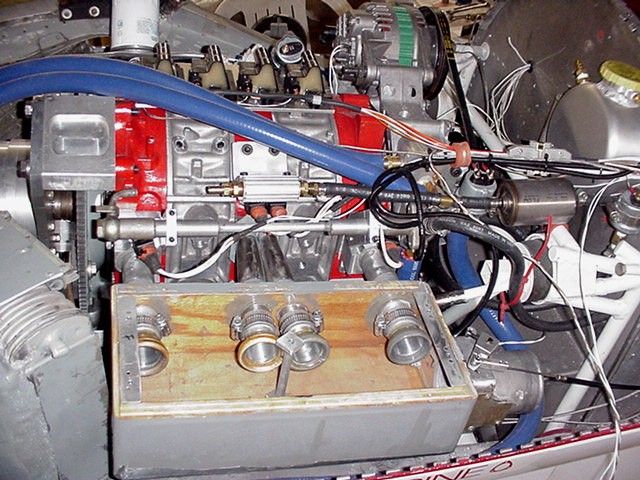
It is not a bad way to go if you happen to have a four port RX8 engine.
Tracy is getting about 200 HP out of a RX8 four port with something
exactly as you describe with the exception of it being street ported. It
also uses a 2.85:1 gear box to take advantage of the 7500 RPM.
I understand the pipes are now longer than shown in this
picture.
Paul Lamar ...No rotor no motor.
The Rotary Engine NewsLetter. Powered by Linux.
ACRE NL web site.
http://www.rotaryeng.net
Copyright 1998-2006 All world wide rights reserved.