Paul,
Thanks for those pictures. That's similar to what I had in mind, but I was
thinking of curving the runners over the top of the engine to the other
side, like in some of your drawings. This would give the added length for
proper tuning and would make the package more compact.
I was just looking at that power chart for the 4-port RX8 and am surprised
that this engine makes as much torque as it does. At 3000rpm it makes about
144 lb/ft which is not bad for an 80 cubic inch engine.
This got me wondering whether a direct-drive rotary would be feasible. I
know it sounds silly on the face of it, but if you were to boost the engine
enough to double its power output at 3000rpm, you would have 160 hp. The RX8
makes just over 80hp at 3000 rpm, stock; the boost required to bring it to
160 hp at 3000 rpm would only be 8 psi.
If your airframe is fairly slick and can use a shorter prop, you could even
spin the engine to 3500 rpm. Here the stock engine is making just under 100
hp; the boosted version would be close to 200 hp. Not bad for direct-drive.
What I'm thinking is a positive-displacement supercharger, preferably the
efficient twin-screw type, rather than the Roots-type. The beauty of the
positive-displacement blower is that it is like adding cubic inches -- the
blower actually has an internal displacement, so every revolution pumps the
same amount of air, unlike the centrifugal compressor which makes a lot more
compression at high rpm and very little down low. I've driven a
four-cylinder Mercedes with the "compressor" engine, which is the Eaton
Roots-type, and it feels just a like a V-8 right from off-idle. You would
swear you have twice the cubes under the hood. The power is completely
linear and seamless.
A turbocharger or even a belt-driven centrifugal compressor would not work
here because its boost at low rpm is not enough. With a
positive-displacement blower you get the same boost at idle as at red line
--
if you want 8 psi, you have it all the way through the operating range.
The twin-screw is very compact and lightweight -- about 10 to 12 pounds --
so you could actually have a 160 hp to 200 hp direct-drive rotary engine
that weighs less than a normally aspirated engine with gearbox. Also the
twin-screw has very good adiabatic efficiency, thanks to its refined
aerodynamics, so an inter cooler would not be required at boost up to about
9
or 10 psi.
I've included a couple of pics of a Long-EZ with a supercharged rotary,
although the blower appears to be an Eaton Roots-type. It appears this setup
is designed for altitude boost, or normalization, because there is a bypass
valve visible that is operated by a diaphragm that is probably referenced to
atmospheric pressure. There is also an inter cooler. This engine is geared.
What I'm talking about is straight-boost, no bypass to vary boost levels at
different flight conditions. At about 8 psi, this would be, in effect,
doubling the displacement of the engine. As it gets higher, power would just
drop off the same way as NA.
What do you think? Is direct-drive even feasible, in terms of the thrust and
side loads on the e-shaft? The other thing is that you would be increasing
substantially the combustion pressures, but I believe in that regard the
rotary is quite robust?
Regards,
Gordon.
Well even though they claim 30% more eff. It is still 20%
of the gross power coming out of the e-shaft to drive the super
charger. The biggest problem is fuel consumption and superchargers
are not the way to go for low fuel consumption. ALL power
to drive the supercharger comes from the E-shaft.
In other words a net 150 HP to the prop means engine is generating
about 180 HP gross and burning a 180 HP worth of gas. This adds to
the engine cooling load. A turbo charger on the other hand obtains
all of the HP to drive it by using the otherwise wasted kinetic
energy in the exhaust. Yes there is some back pressure which extracts
HP from the engine but it is very little compared to any mechanical
supercharger.
To double the HP you will need 15 pounds of boost or more
to drive the supercharger. That is going to require a good inter
cooler. Also the bearing loads on the rotor will be very
high at low RPM. Perhaps catastrophically high.
With the weight and cost you might as well buy a gearbox.
BTW That reminds me.
I know Kenne Bell. Car and Driver was testing one of his blown
Pontiac Firebirds on Mrs. Orcuts driveway. They were attempting
to break 200 MPH. I think Csaba was driving. Maybe Don Sherman
was driving. I flew my C182 out with my girl friend Ronette and
landed it on the driveway. Scared the heck out of all of them
when I buzzed them on the way home :)
--
Paul Lamar ...No rotor no motor.
Paul,
Yes, I made a mistake with the amount of boost required. To double the power
would require 15 psi or 2 bar -- and that would require inter cooling.
As for the power required to drive the blower, I don't think it would be 20
percent of total engine power -- I think closer to 10 percent, according to
info from the blower manufacturers.
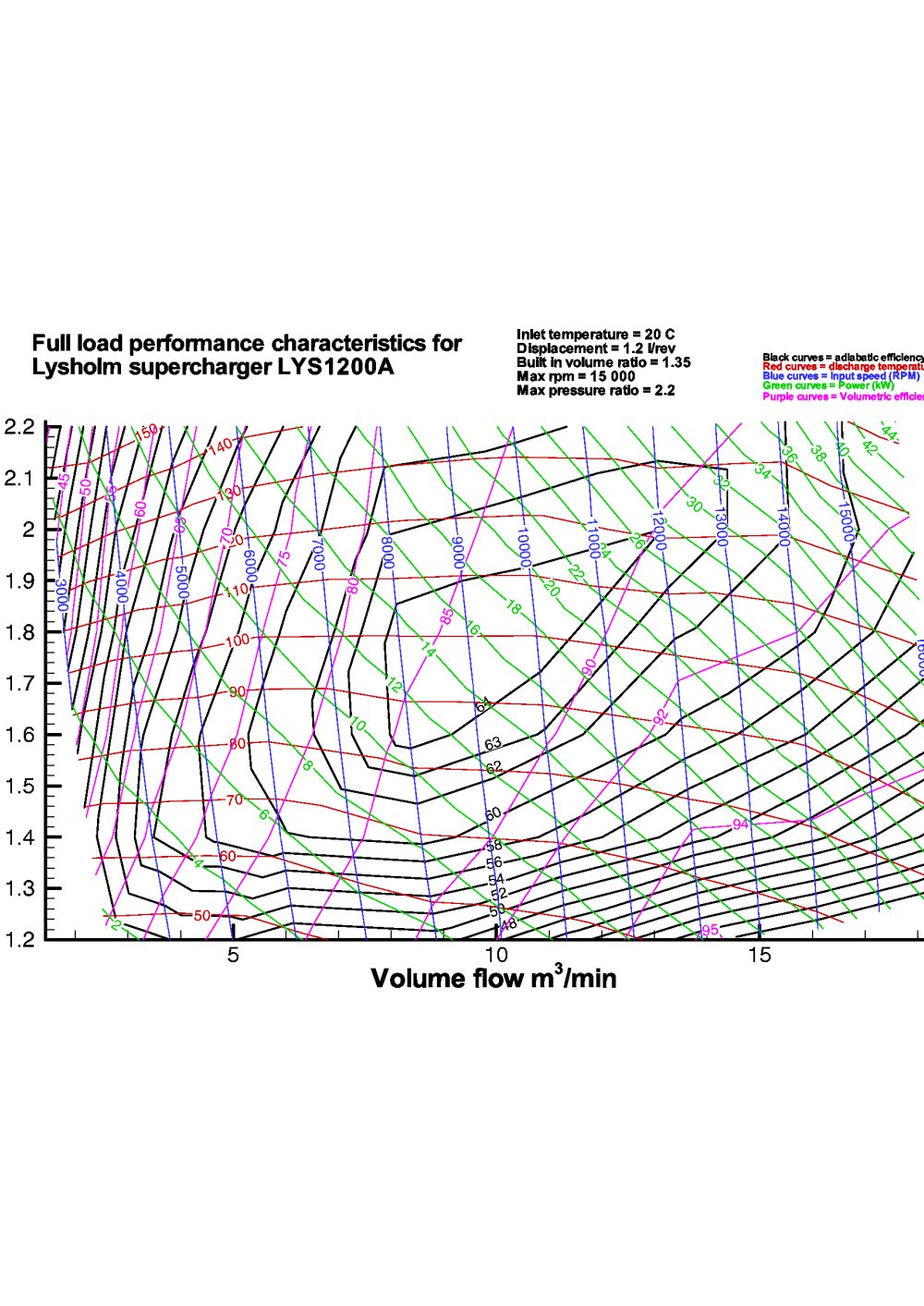
Here is a flow map for a Lysholm 1.2 liter twin-screw supercharger, the
smallest they have. You can see the power lines in green.
Let's say you have an RX8 four-port engine that makes 100 hp at 3500 rpm,
and you want to add 10 pounds of boost. That's a pressure ratio of about 1.7
and will give you about 170 hp gross, not counting the losses to drive the
blower.
If we know how much volume of air we are moving, and our pressure ratio, we
can see how much power it will take to drive this blower. Since our engine
is 80 ci, and there one intake event per e-shaft revolution, we can
calculate air flow using the formula: cid x rpm / 1728. This gives us 162
cfm for the stock engine making 100 hp at 3500 rpm. (Assuming 100 percent
volumetric efficiency, but close enough).
If we boost that by a pressure ratio of 1.7, we get a flow of 275 cfm at
3500 rpm. That equals about 7.8 cubic meters per minute, so we see on the
chart that it takes about 12 kilowatt of power to drive the blower to this
level. That equals exactly 16 horsepower, or a little less than 10 percent
of our gross power figure of 170 hp. We are left with net power of 154 hp.
Let's call it 150 hp and it's still not bad. We are only adding 10 pounds of
boost so inter cooling is not needed. The fuel consumption would be a little
higher than a normally aspirated engine of the same power, but only by the
16 hp it takes to drive the blower. But on the other hand you won't have the
friction losses of the gearbox, which are probably about three or four
percent. So maybe the net difference is going to be about five or six
percent.
So yeah, the 200 hp direct-drive engine obviously does not make sense, but
perhaps the 150 hp direct-drive engine could be feasible.
You might ask, "Why bother? Why not just get the gearbox?" Well, there are
certain advantages of the lower-revving engine, including engine noise, wear
and tear, etc.
It is also cheaper -- the small twin-screw blower costs less than half of
what a gearbox costs. You also don't have any worries about torsional
vibration. The only question is the bearing loads, but at 10 psi boost it
should be okay.
Regards,
Gordon.
PS: Thanks for the anecdote, but I hope the FAA isn't lurking around here.
Is there a statute of limitations on buzzing?
---------------------------------------------------------
"Well, there are certain advantages of the lower-revving engine,
including engine noise, wear and tear, etc."
Assuming you don't overload the rotor bearings. The best cruise
RPM for a rotary is 6000 RPM bearing load wise. True if you load
it down at 3000 RPM the BSFC may be better due to lower engine
friction HP loss. You can do this with a variable pitch prop
however.
As you lower the RPM of the rotary you rapidly lose the power
to weight ratio advantage. BTW GM attempted to make a large displacement
light duty rotary engine and failed for unknown to me reasons.
The best low RPM engine is a piston engine as bearing loads
are minimum around 3600 RPM the displacement can be increased
and the structure made just strong enough for the power out level.
AKA an air cooled aircraft engine.
For this super charger it is 12KW (16 HP) to 24KW (32 HP) depending on where in
the 64% efficiency island you happen to find your self.
10% worse BSFC is .47 to .52. 20% worse puts you up at .56.
BTW two things. Please quote at the end of the old message.
Less work for me. We had a poll and people like messages in
chronological order.
I don't suppose you have any programs to convert one page pdf's
to jpg's do you?
Paul Lamar ...No rotor no motor.
The Rotary Engine NewsLetter. Powered by Linux.
ACRE NL web site.
http://www.rotaryeng.net
Copyright 1998-2006 All world wide rights reserved.