Gordon,
You lose the weight of the gearbox but gain the weight of the
SUPERCHARGER and all it's plumbing and mounting hardware. I'd bet it
would be close to a wash on weight, and the wear aspect would be MUCH
higher. Paul hammers on this all the time but I'll take over this time.
The rotary is NOT a piston engine! There is no reciprocating motion, and
higher e-shaft RPMs are NOT a wear problem. As has been said many times
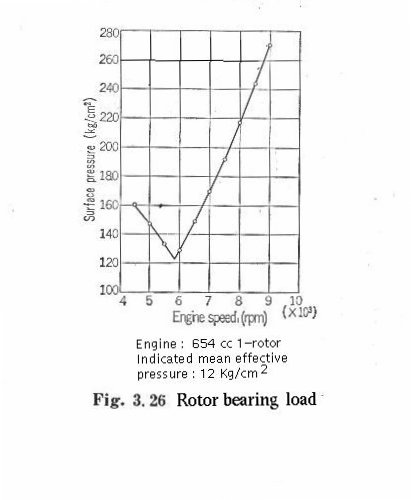
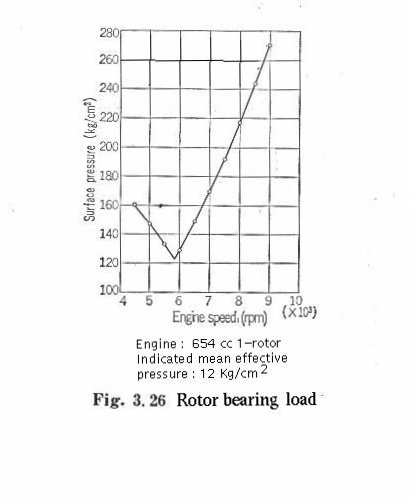
Mazda instrumented the engine and found that bearing load at 6000 RPM
was NIL, ZERO, NADA, NOTHING. The compression and power loads balanced
out. I plan to cruise at or slightly below that figure using a 2.85:1
PSRU.
Secondary item: Paul the figures on the screw Lysholm supercharger are
true. The efficiency improvement lead to the NHRA banning them at one
time. I don't know it that is still true or not.
Bill Jepson
Hi Bill,
Regarding the 'no bearing load at 6000 rpm' means that the inertia force of
the
pistons equals the force generated by the combustion pressure. The pressure
curve
at combustion has a very sharp, short duration peak and falls off quite
rapidly
at both sides of the curve. Also keep in mind that at the other side, when
the
eccentric is at the 'bottom' meaning at the side of the ports, the full
inertia
load of the piston is loading the bearings, similarly to an RPE at BDC or
rather
at TDC during open valves.
There are always bearing loads, no matter at what speed the engine runs. Of
course, running near 6000 rpm reduces the bearing load near TDC, again,
similar
to an RPE. (Just don't want to get the wrong impression out there.)
Rolf
Rolf,
Thanks for that piece of technical insight. I always wondered about the
rotor's inertia with that elliptical orbit -- besides the circular motion,
there is an up and down movement from one end of the oval to the other that
no doubt generates sizable inertia with that big rotor.
As you correctly pointed out there are always bearing loads at any rpm --
but it's clear that they go down to their minimum at just under 6,000 rpm,
and then go back up from there.
Still, looking at that graph, the difference between 4500 rpm and 6000 rpm
is not that great, about 25 percent less (160 kg/cm2 to 120 kg/cm2). The
graph doesn't show a data point at 3500 rpm but if we assume that it
continues in a straight line, we can interpolate about 180 kg/cm2 at 3500
rpm. So the bearing load at 6000 rpm is only 33 percent less than at 3500
rpm.
Hmm, maybe I was too quick to throw in the towel on the direct-drive
supercharged engine.
Still, as Paul pointed out, the thrust bearing might not be able to take the
propeller loads.
Another thing is the side loads from the prop, especially if you need to
have a long prop hub. And even if you use a short prop hub, your engine will
be farther forward, thus moving your CG forward as well.
So yeah, there are problems with this approach, like I said. Still maybe
this discussion will have been of benefit if there are some who might be
considering a direct-drive option. At least they will have some points to
consider.
Regards,
Gordon.
NO elliptical orbit Gordon. Pure circular.
NO up and down motion.
http://www.rotaryeng.net/How-wankel-works3.txt
The peak loads shown in the graph are for an NA engine.
If you double the pressure with a super charger the peak loads will
double. That means the 160 Kg per becomes 320 Kg per which
exceeds the max peak loads at 9,000 RPM!!!!!!!
Further more since the RPM is way down so too may be
the oil pressure feeding the rotor bearings.
Paul Lamar ...No rotor no motor.
The Rotary Engine NewsLetter. Powered by Linux.
ACRE NL web site.
http://www.rotaryeng.net
Copyright 1998-2006 All world wide rights reserved.