It is not really an oval housing either. It is a trochoid
housings.
> Paul
-------------------------------------------------------------
I think there is some linear momentum there as well, as the mass of
the rotor accelerates from the bottom of the oval to the top, then back
down, etc.
Gordon
---------------------------------------------------------------------
No it does not. The center of gravity of the rotor travels
in a pure circle. There is absolutley no linear momentum.
Many engineers and mechanics that should know better still think the rotor
translates, reciprocates or wobbles in the rotor housing. Nothing could be
further from the truth. The key is to think only of the center of the
rotor.
That is the center of gravity of the rotor and what that does is all that
counts. It rotates around the center of the output shaft pure and simple.
The wankel is a subtle engine. This is motion very important when it comes
time to balance the engine. Since there are no reciprocation parts what so
ever it is possible to completely balance the Wankel engine just like a
turbine or electric motor and unlike any piston engine despite some claims
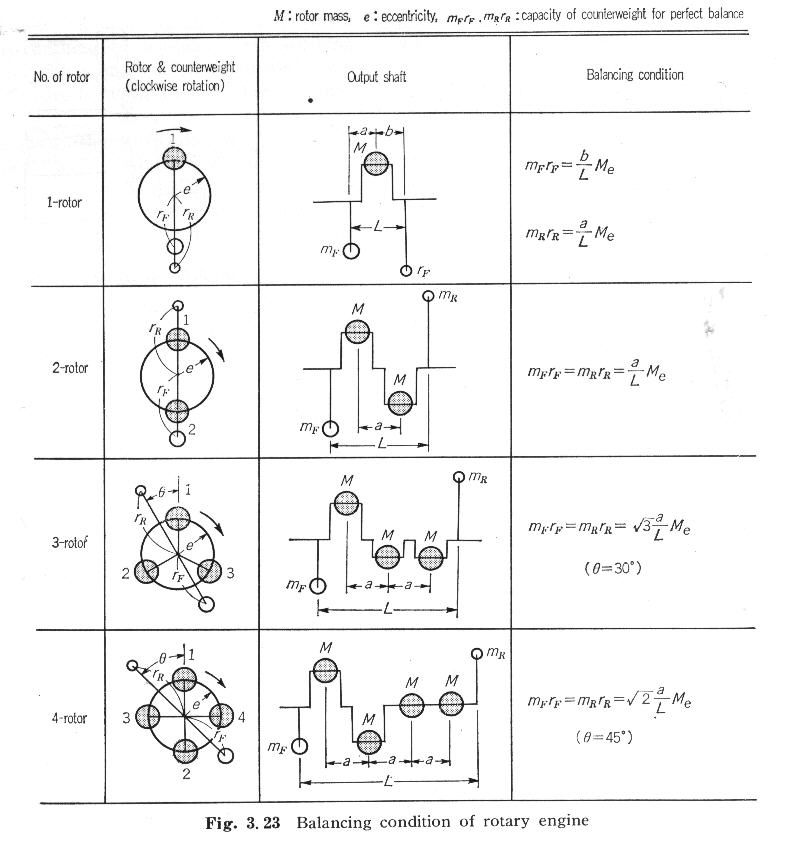
to the contrary. The rotor is balanced around it own axis. The front rotor
balances the rear rotor as they are 180 degrees apart on the output shaft.
That leaves a small couple which is finally completely balanced by the
counter weights.
> Paul
-------------------------------------------------------------------------
Country boy question?
If everything rotates evenly around center, what is there to balance? What
is and where is this "couple"? And, doesn't compression actually alter
engine displacement?
jofarr, soddy tn
------------------------------------------------
There are two kinds of balance. Static balance and dynamic balance.
http://www.dynamicbalancing.co.uk/index2.html
Edited by me.
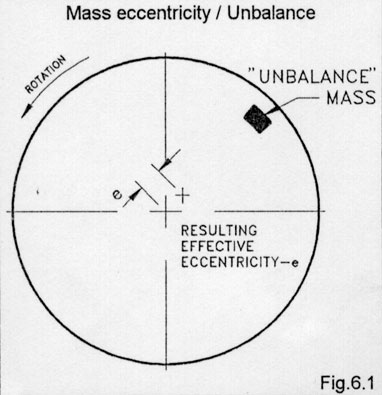
"The process of reducing the out-of-balance forces that cause vibration in rotating
machinery is called "Balancing". The unbalance is caused by an effective
displacement of the mass center line from the true axis caused by some mass
eccentricity in the unit.
Fig 6.1
The process of "Balancing" is the removal or addition of weight to the unit such
that this effective mass center line approaches the true axis.
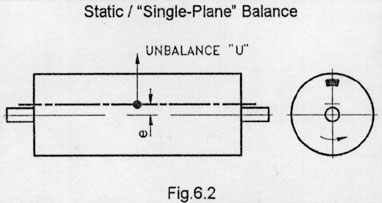
The simplest form of, "Static", balance involves placing the unit on low friction
bearings and allowing it to rotate and "settle" with the "heaviest" point falling
to the bottom. Material is then removed from this point (or added at the top point)
and the unit gently rotated until, when stopping, the new "heavy" point again falls
to the bottom. This process is then repeated until no obvious "heavy" point seems
to exist. If one considers correction at a single position along the length of the
unit, the balance is said to be "Single-Plane". [static balance]
Fig 6.2
If the unit being balanced is very short in relation to it’s diameter
Single-Plane Balance will, normally, be very acceptable. However, if the unit
has any appreciable length, correction at a single plane, say in the center of
the unit, will probably give a dangerously false correction. If you consider a
shaft with two rotors. The two "heavy" points [rotors] will not fall the same
angular position and thus the displacement of the mass center
lines from the true axis will be a different orientation in both ends.
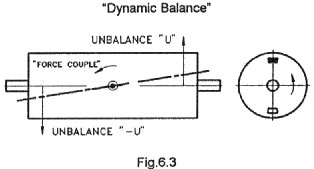
If the unit is now being balanced by the Static or Single-Plane method, as it
can easily be, the overall effect would appear to be correct but, in high speed
rotation, since no account has been taken of the vibration between the two ends,
a "Force Couple" will exist which will again introduce vibration.
Fig 6.3
To overcome this problem, a "Multi-Plane" or "Dynamic Balance" must be performed.
In this case the balancing machine will have both sets of bearing pedestals
connected to sensors and the unbalance at the two planes can be independently
identified and, thus, corrected."
True. Real air mass displacement depends on the pressure or external compression
and volumetric efficiency.
But "Displacement" in engine speak is defined as that amount of combustible air
an engine will take in at atmospheric pressure in one revolution of the output shaft
at 100% volumetric efficiency. No losses or external pumping.
Paul Lamar
The Rotary Engine NewsLetter. Powered by Linux.
ACRE NL web site.
http://www.rotaryeng.net
Copyright 1998-2006 All world wide rights reserved.