Hello All,
Here’s a question to the group for those who own a Ross PSRU. I own a
Ross 2.17 to 1, and I am tying to solve one of the issues regarding the
“drive shaft” from hitting or bouncing off of the thrust bearing – I’m
sure people who own such a unit knows what I mean. I found some
solutions on the net but I’m wondering if anyone else in this group has
a suggestion, possibly a simpler solution.
I’ve heard comments of “just sell the unit and get another one” but I’m
not sure that I need to go to that extreme. My primary two reasons are
1 – The unit is an integral part of my engine mount and 2 – A
replacement would probably cost me two to three thousand dollars (if not
more to redesign my engine mount) – just to note, I purchased the plane
from someone else, so it’s not my original idea….
I’ve included a few pictures of my setup.
Cheers,
Burck Hantel
FYI:
A fellow named Phillip Johnson explains what is going on a little better
then I can so I am reiterating his explanation here:
http://www.canardzone.com/members/PhillipJohnson/Engine/psru.htm
“Breaking open the PSRU reveals the working parts, namely the planetary
drive. Under load conditions the input shaft is drawn towards the output
shaft to which the propeller is attached. A thrust race, takes this load
quite satisfactorily. When in a decent the propeller drives the engine
and the input shaft is forced to move in the direction of the engine.
The ROSS design does not provide a true thrust bearing to support this
load, moreover the load is taken by a conventional sealed ball race
contained within the lightweight flywheel. This bearing is there to
accommodate the slight differential rotational rocking motion
encountered as a result of the torsional isolator mounted on the
flywheel. A resonant condition is set up when operating near idle when
the engine drives the propeller followed by the propeller driving the
engine. There is considerable chatter at that point and the input shaft
is hammered back and forth between the thrust race illustrated below,
and the conventional bearing previously described. The bearing begins to
break down and the end movement increases only exacerbating the problem.”
---------------------------------------------------
Burck,
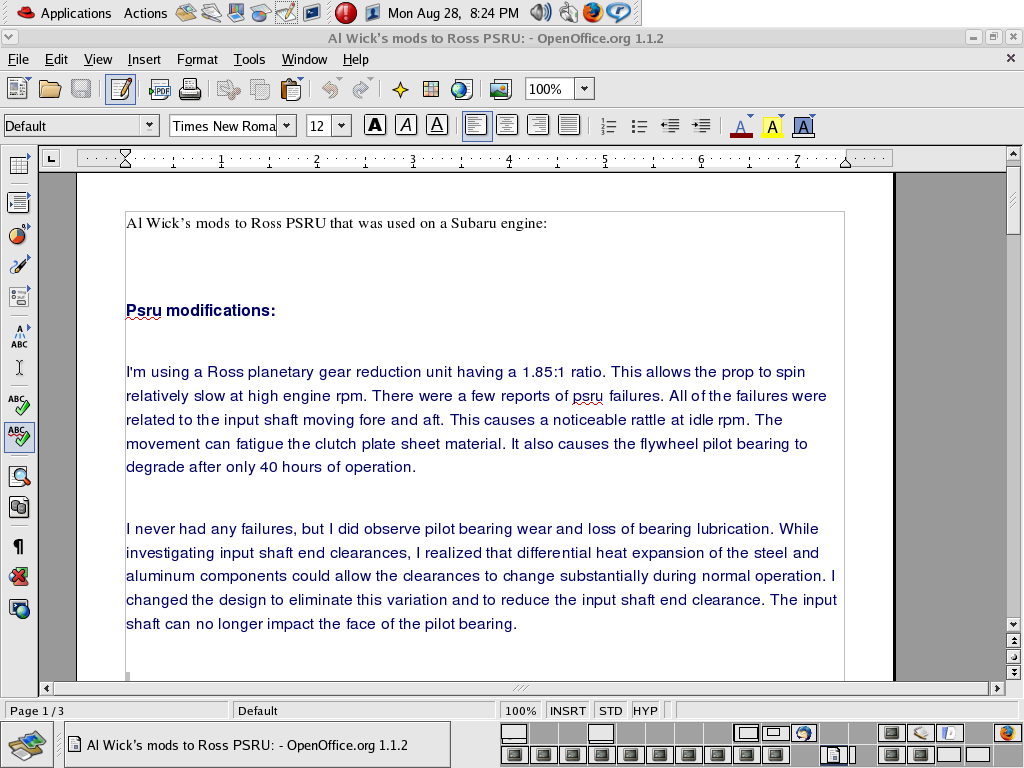
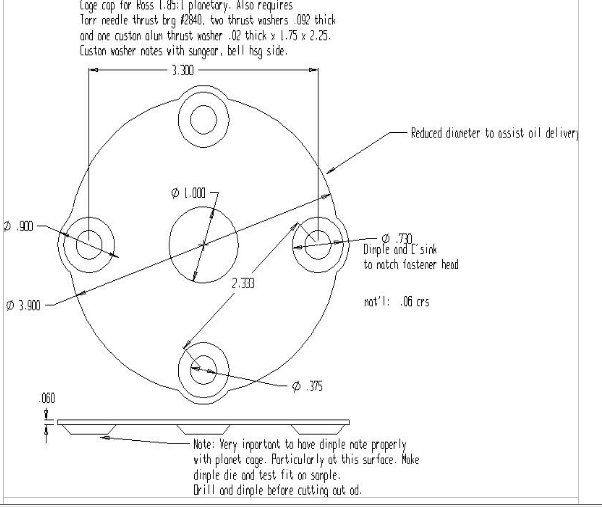
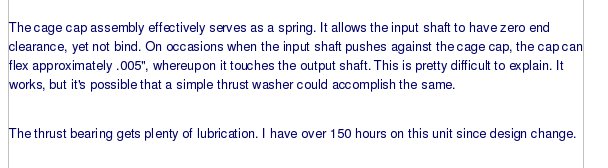
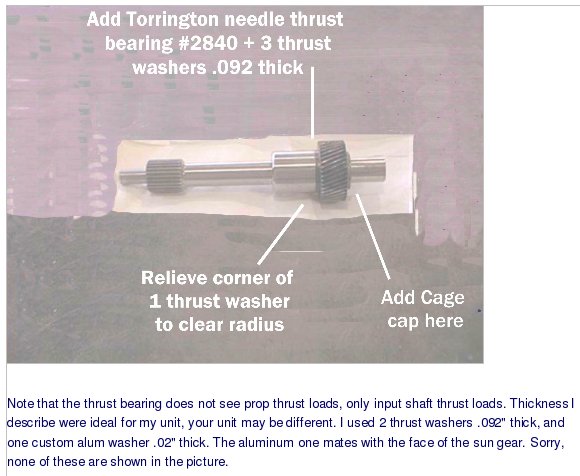
Here is another solution that Al Wick described at some time in the past
on his web site. His Ross PSRU is a 1.85:1 unit on a Subaru engine. He
fabricated a zero clearance bearing cap that acts as a spring to load
the input shaft thrust bearings.
I agree with you that the Ross PSRU is a viable unit to use. I would
guess that the Ross units have collectively accumulated a lot more
flight hours than any other type. The most notable example is the
Maynard gyrocopter with the rotary and the 2.85 Ross that logged more
than 2500 trouble free hours as a training vehicle. One other
modification that I have considered making to the Ross installation is
to design a resilient drive plate similar to Tracy's. The operating
history, at least as far as I know it, of the Ross units would suggest
that this modification is not mission critical, but, it may reduce
vibration. Or, it may not.
Aubrey
Aubrey we don't do .doc :) Please send as jpg and txt.
Not everybody has office. Worst comes to worst as a pdf
file as pdf viewers are free on all platforms.
Paul Lamar
The Rotary Engine NewsLetter. Powered by Linux.
ACRE NL web site.
http://www.rotaryeng.net
Copyright 1998-2006 All world wide rights reserved.