I really don't know. My guess is take off at 300 HP and
back off to 200 HP for cruise. Then you have the cooling
problem. 300 HP takes a heap of cooling.
--
Paul Lamar ...No rotor no motor.
My 2-cents worth on this point:
- Getting 300hp on the prop shaft out of a mechanically supercharged engine
means developing 320-330 hp (we never managed to get more than 300hp out of
a 2-rotor... but we also never tried!... blowing up engines gets expensive
very quickly!)
- While it is possible to boost a 2-rotor to 330 hp, it is much harder to
keep it out of detonation with "regular" gas (i.e. non-racing fuel). It
takes a lot of boost to get that much power (typically >60 inches MAP), so I
would insist on very efficient inter cooling to keep intake air temperature
below 50°C [122 F] if possible, certainly below 60°C [140 F].
- Next, water cooling problems: you must avoid localized boiling spots.
It's generally OK if it's only a short duration power surge (like in drag
racing), but longer than that, things can get out of control real quickly.
- Metal apex seals won't last long. 3mm ceramic seals are probably a must.
- Last thing: be prepared to open up the block and change parts quite often
during tuning! Also, fuel consumption will be unacceptable for cruise above
200-220hp.
My opinion: unpractical and unwise for any other purpose than racing...
cars or aircraft. If you need that much power, go with a 3-rotor, you will
have none of the above-mentioned headaches!
Francois
Hi Francois,
Thanks for those intake air temperature numbers. Been looking for that data
for a long time. Back in the 1940's 50's & 60's large radial aircraft
engines, both
supercharged and turbo charged, routinely used anti detonation fluid for
take off.
It is also common practice at Reno air racing. I suggest anybody looking for
above
300 HP for take off out of a turbo charged two rotor think about using it.
Also read this C&D article on how PTP obtained 360 HP out of a turbo
charged RX8 engine with ten to one compression ratio rotors using intake
air triggered anti detonation fluid.
http://www.rotaryeng.net/Turbo-RX8a.jpg
http://www.rotaryeng.net/Turbo-RX8b.jpg
Here is a power to weight ratio chart I have been working on. Still a work
in progress. For normally aspirated only and no psru.
Paul Lamar ...No rotor no motor.
Francois,
Thanks for your input.
The intended use for this hypothetical engine is in a fully aerobatic
single-seat monoplane that would be designed with the high power-to-weight
ratio of the rotary in mind. If we can get a better power-to-weight ratio
than with a piston aircraft engine, we can have a lighter airframe, a
superior thrust to weight ratio and a more capable airplane.
Fuel efficiency is secondary to power-to-weight ratio, hence the choice of
supercharger. Also a turbocharger is useless in an aerobatic plane where you
need instant power response to punch out of maneuvers. For this application
the positive displacement twin-screw supercharger would be optimal as it
makes even boost throughout the range.
300 horsepower at the prop is the figure I'm shooting for. If we can have an
engine weight of 300 pounds, I believe it would be possible to build a
+10g/-10g airframe of 500 to 600 pounds, for an empty weight of 800 to 900
pounds, and a full-up weight of maybe 1200 pounds. This would give a power
loading of 4 pounds per hp, which is outstanding -- and a thrust to weight
ratio of better than 1:1.
The supercharger is going to eat up about 20 to 30 horsepower as you pointed
out, so to make 300 at the prop, we need 320 to 330. However, I'm surprised
that would take 60 inches of manifold pressure. I had figured 48 to 50, or
8.5 to 10 psi boost. My thinking was that if a normally aspirated Rx8 makes
200 hp at 7000 rpm and a P-port makes 240 hp, it would seem to require
modest boost to reach 325 hp.
The cooling is the issue that I'm concerned about most, namely the point you
made about localized hot spots. Assuming you have a radiator and properly
designed ducting that can reject the amount of heat necessary, is the engine
case up to it? Can it flow enough coolant and is there enough material cross
section in critical areas to conduct heat away quickly enough?
I'm thinking probably yes, considering that the Le Mans engine was making
much more power per rotor and was able to reject the heat. But I don't know
if that was with stock or custom engine cases?
Regards,
Gordon.
PS: Paul, thanks for that chart, it really shows the rotary's advantage --
getting close to that small Garrett turbine.
-------------------------------------------------
Here is a improved version with more engines added.
PSRU weights are included but no turbo charged engines.
The power to weight ratio of a turbo rotary takes a big jump
while the aircraft engines do not due to the necessary flat rated
nature of a turbo charged aircraft engine. The air craft engine's
structure is not up to any boost at sea level.
BTW you cannot extrapolate a NA RX8 engine to 300 HP boost
wise due to the 10:1 compression ratio. Now if you are
willing to inject detonation fluid as need you might get
300 HP with less boost than Francois mentioned.
You should have said from the get go you wanted instant
throttle response. That changes everything :)
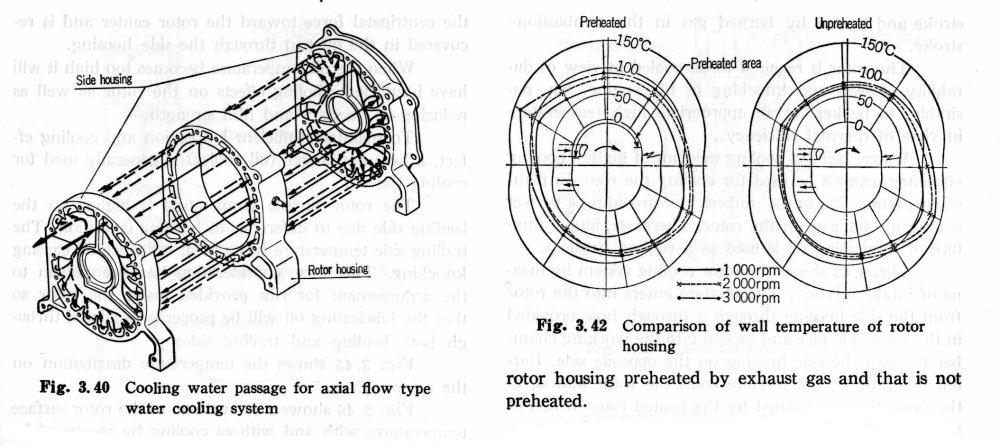
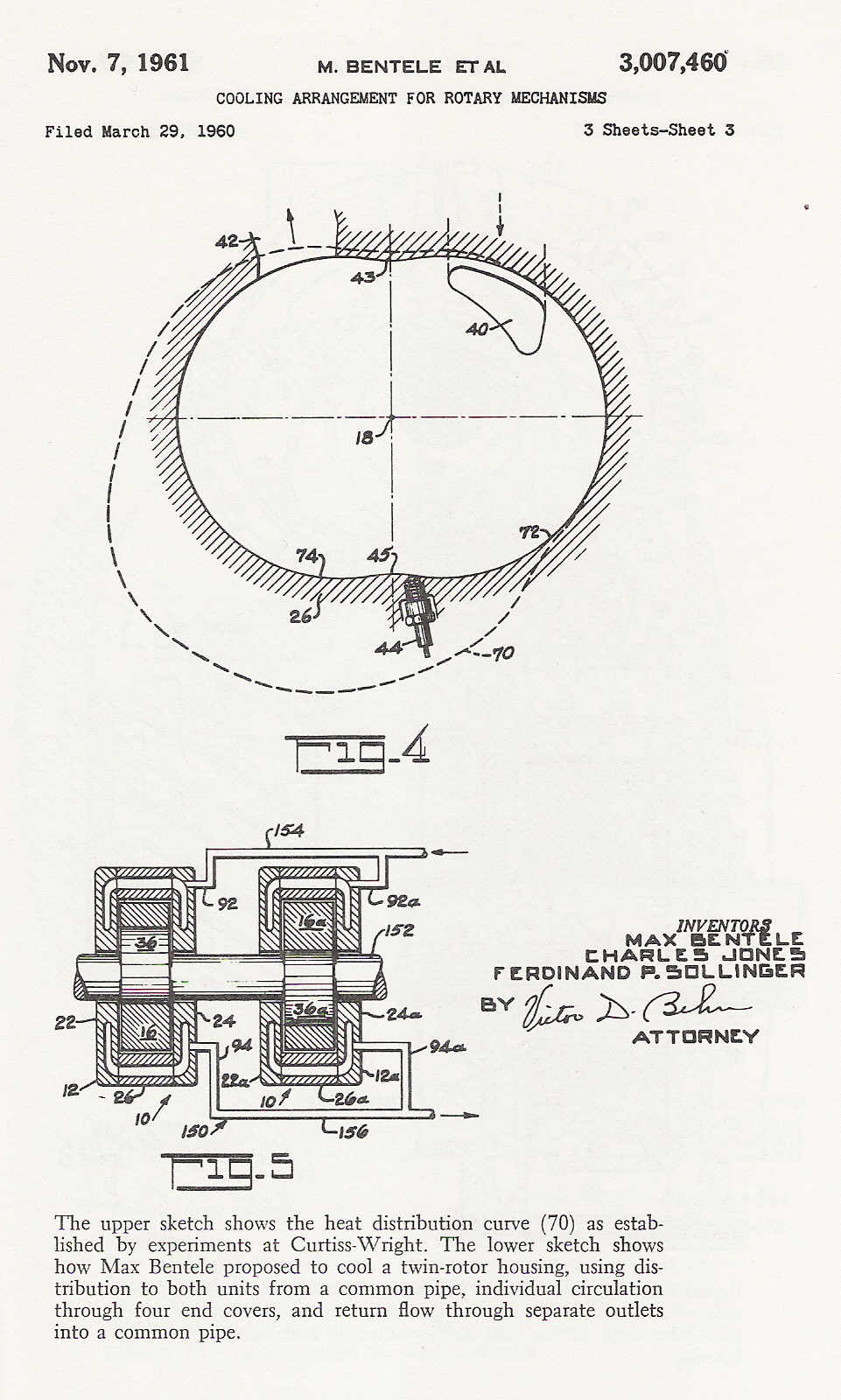
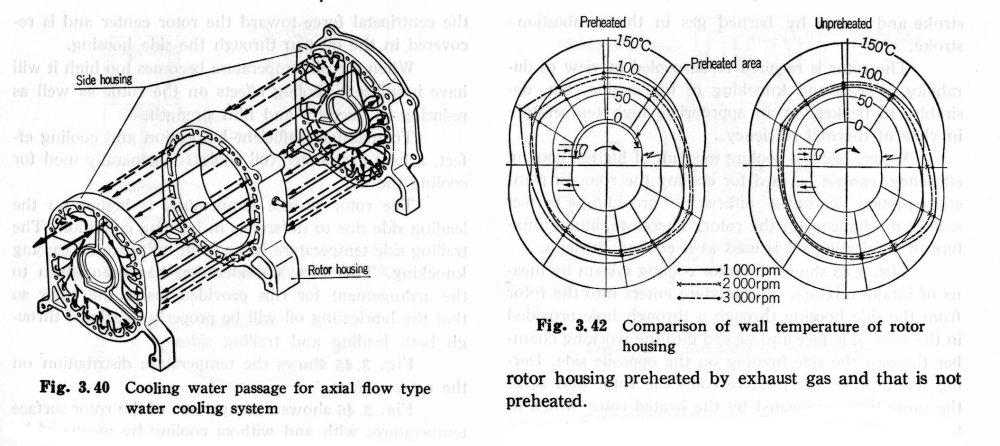
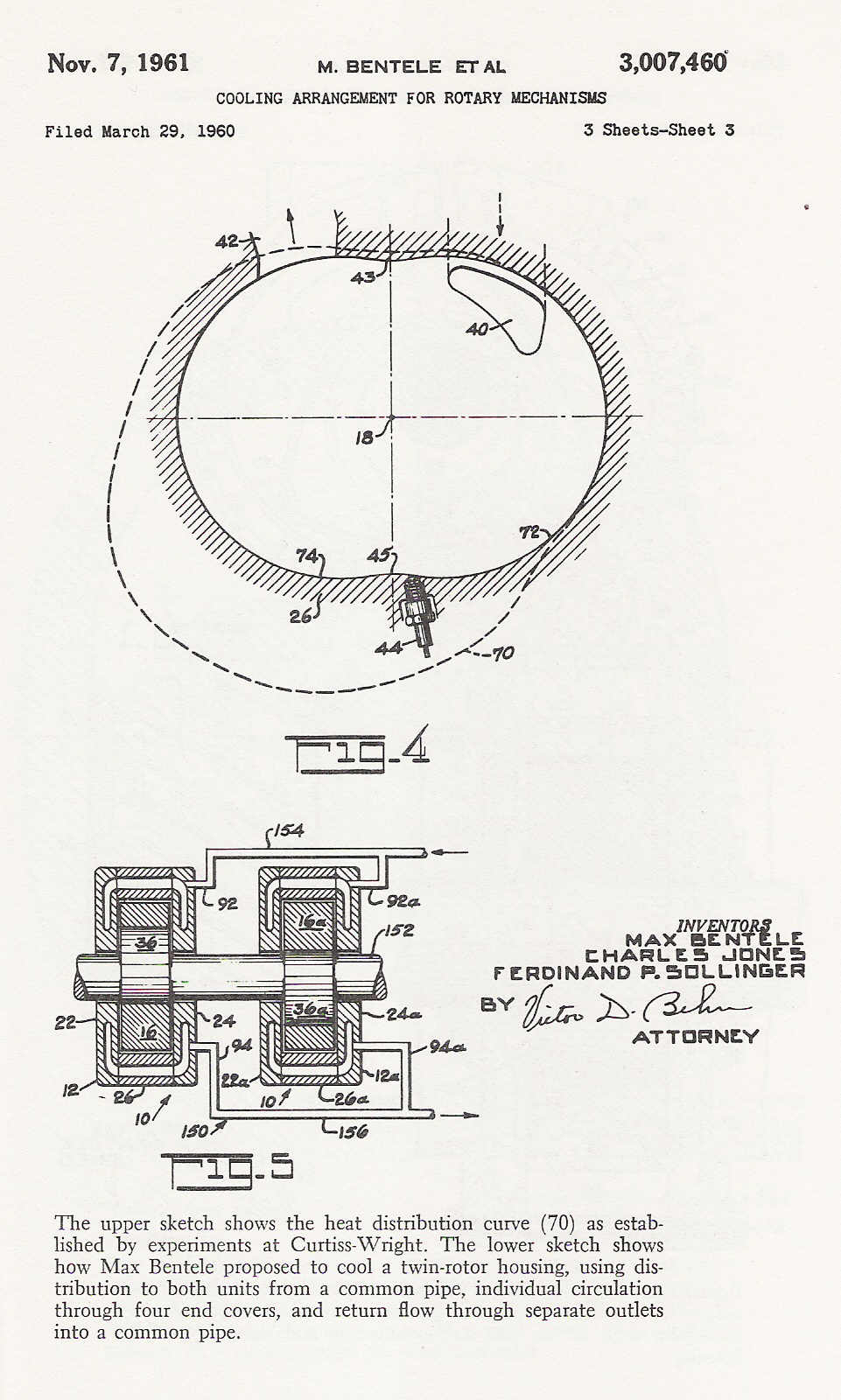
The cooling limitations Francois mentioned should be checked
with a "cylinder head" temperature probe near the lower spark
plug. Modification can be made to the rotor housing cooling passages
in this area to improve the situation. See the attached jpg's.
Also read
http://www.rotaryeng.net/how-to-cool12.html
BTW the answer to vertical penetration is a larger prop and
a higher gear ratio. The geared Russian and East European
GR-360 engines are prime examples.
Paul Lamar ...No rotor no motor.
Hi Gordon,
Firstly, Paul is absolutely correct that you cannot extrapolate RX-8 or
other normally aspirated engine data to high-boost because of the change in
compression ratios. Also don't forget to increase boost to compensate for
high intake air temperature, later than optimal ignition timing and richer
than optimal mixture (both for detonation protection), etc
Secondly, my boost-level guesstimate was based on 13B geometry and 6500RPM.
I have no personal experience with P-ported engines so will not take make
any estimate or comment on these engines. But I agree, I may have been
pessimistic...
Turbochargers won't take the punishment of unlimited aerobatics, neither
will (probably) high-spinning centrifugal superchargers. I do not know about
twin-screw chargers...
Finally, an unlimited aerobatic airplane needs full power for very limited
periods and only makes short flights (except for ferrying). Various
solutions that Mistral doesn't even consider for its applications may
therefore be open. I shall not comment on things I only know second-hand.
Francois
Thanks, Francois.
That's a good point about the g-loads on the supercharger. The Russian
radials use gear-driven centrifugal blowers and they seem to be pretty
robust.
http://www.russianaeros.com/Future%20for%20M14P%20engines.htm
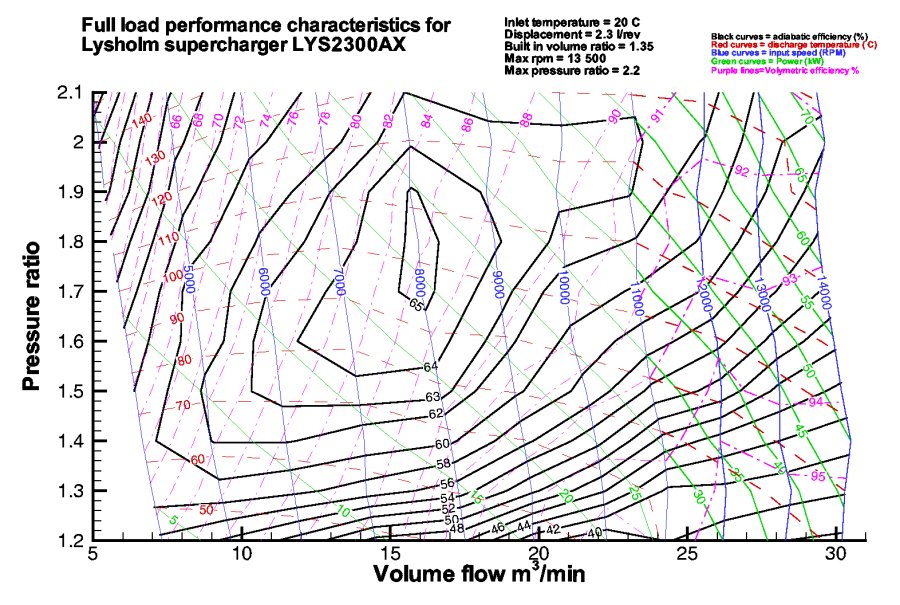
I don't know how the screw compressors will stand up, but they spin much
slower, so centrifugal force is much smaller to begin with. The Lysholm
blower sized for this engine output would spin at about 8000 rpm. Drive
ratio from the engine would only be about 1.2 to 1. Hopefully it should not
be a problem as these units are pretty robust, with large bearings, etc.
I agree the challenge will be juggling compression ratio, boost, intake
temperature, fuel octane, etc.
Ideal fuel would be ethanol, which has almost three times higher latent heat
so evaporative cooling would be much better. It also burns cooler, so total
heat produced would be less. Not to mention much higher octane, so higher
compression and better power. Hmm, I think I've convinced myself ... I grow
a bit of corn on the farm anyway...
But the thing is where do you get ethanol at an airport?
There is an interesting option, using ethanol injection for knock
suppression. I've attached a paper that gives great info on this. Their
objective was from an automobile fuel-efficiency standpoint using smaller,
highly boosted engines. It requires only a small tank for ethanol. I don't
think I would try to scratch-build such a system myself, but if someone
where to come up with a bolt-on product, it would sure make things
interesting.
My approach with a draw-through, carbureted engine will still give good
results, I believe. This is the approach used on the Russian radials --
although some of the high-power versions now have EFI.
At stoichiometric ratio, the evaporative cooling at the carb is a
temperature drop of about 40 F. That means that on a 72 F day the intake
charge coming into the compressor will be 32 F. At a pressure ratio of 1.7,
the charge temperature coming out of the blower would be 160 F (71 C.)
I think that's doable on 100 LL and reasonable ignition timing. I think this
boost ratio (1.7, or 10 psi) is probably the maximum. That would be a
manifold pressure of about 51 inches.
The question is will that give 300 hp net? Maybe not, as you mentioned, for
reasons of higher intake air temp, less ignition advance, etc. The Lysholm
blower will draw about 33 hp to make that boost.
Btw, I am not thinking P-port because what's the point when you have boost?
Plus it looks to interfere with coolant passages.
Also I would prefer the RX8 engine because I think the side exhaust is
better for cooling too. I could be wrong on these points, as I am just
guessing.
Regards,
Gordon.
I miscalculated a bit on the compressor outlet temperature, above. It would
be 145 F (63 C) with 10 psi boost, not 160 F.
I'm assuming an ambient temperature of 72 F, a temp drop of 40 F at the carb
throat due to evaporative cooling, a compression ratio in the blower of 1.7
to 1 (which is 10.3 psi boost), and a compressor adiabatic efficiency of 65
percent, which is what the Lysholm blower claims.
Regards,
Gordon.
The P-port is in the coolest part of the rotor housing.
In fact Mazda attempts to heat that part of the housing
to keep the engine from distorting into a banana shape.
That is why the coolant goes in the hot side first and
than comes around the cool side and thence to the rad.
It is called axial flow cooling. Widely used on almost
all car engines.
It is also not perfect as the rear rotor gets hotter
than the front rotor. That is also why you will always
have problems with the rear rotor first.
Everett Hatch attempted to address this issue by feeding
cool water into the center housing and have it divide
into a front and rear flows. This is called parallel cooling
and is used on most liquid cooled aircraft engines.
Max Bentele patented it for CW.
Also NSU used parallel cooling on the RO80 engine.
Orenda also modified the big block Chevy to parallel
cooling when they attempted to convert it into a liquid
cooled aircraft engine.
Paul Lamar
The Rotary Engine NewsLetter. Powered by Linux.
ACRE NL web site.
http://www.rotaryeng.net
Copyright 1998-2006 All world wide rights reserved.