I ran across this BSFC chart for the a Curtis Wright rotary
similar to a 13 B engine in the Norbye book. The chart is fifty
years old of course and the RX8 engine BSFC is probably somewhat
better than this but not by much.
Unfortunately I don't have a complete BSFC map
for the RX8 rotary as a function of RPM and MAP. The best BSFC we
have seen for a rotary is about 0.47. Most aircraft engines are 0.45
and some as low as 0.43. The CW rotary engine is 0.48 or 0.49.
BTW BSFC is the amount of fuel burned in pounds per hour
per HP generated. One gallon of gasoline weighs about six pounds.
Never the less I wanted to see what would happen if I changed
the rear axle ratio on the RX8 from 4000 RPM at 80 MPH to
3000 RPM. This is similar to using a constant speed prop
and lowering the RPM while increasing the pitch.
The red line on the chart is the HP required by the RX8
as a function of MPH. Read the MPH off the right side of
the chart and draw a line from the right axis to the
red line to determine the HP required for the RX8 to
maintain that chosen MPH.
I did that for 80 MPH because I know the RX8 engine runs
at 4000 RPM in sixth gear at 80 MPH. I calculated the
fuel burn given the .67 BSFC at about 30 pounds of fuel
per hour. That is about 5 gallons an hour or about 16
MPG. Not far off what an RX8 will really do at a steady 80 MPH.
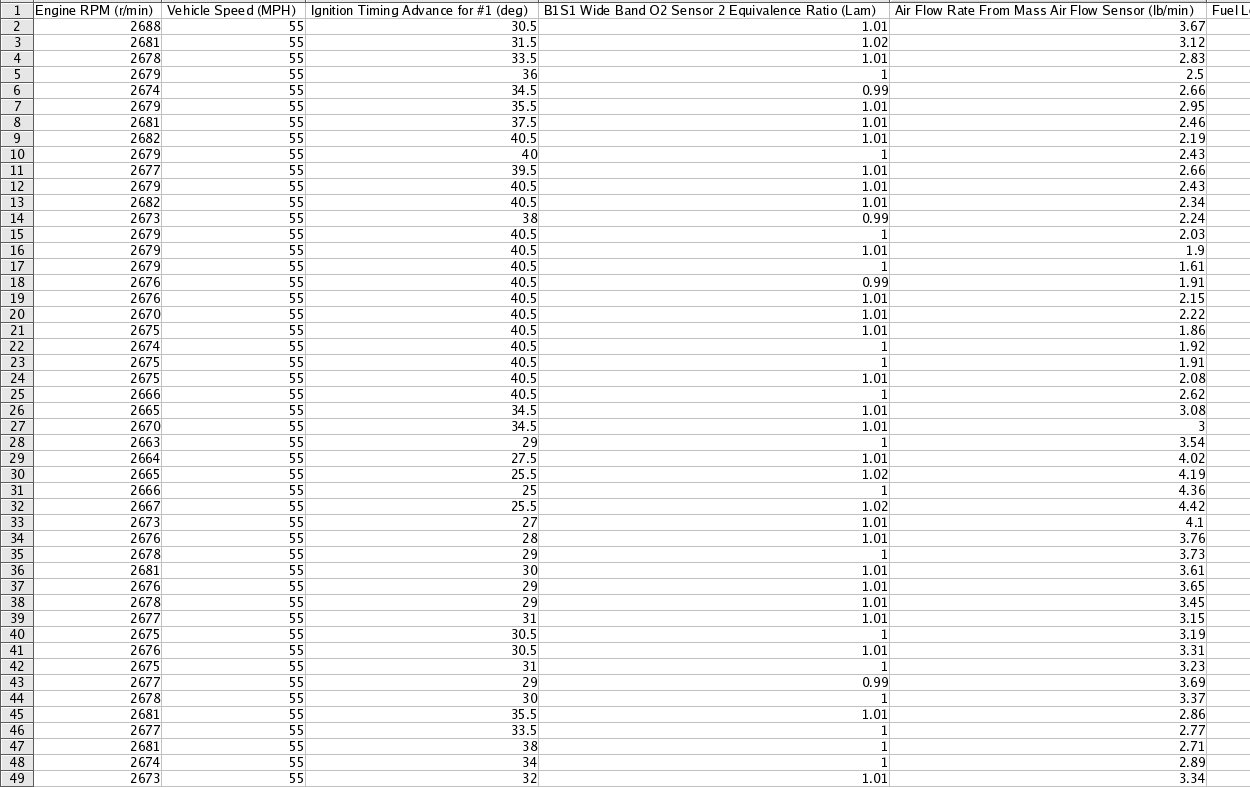
My measurements using the real time OBD II data indicates
the RX8 will get roughly 20 MPG at a steady 80 MPH.
You can calculate the pounds of fuel burned by dividing
the OBD II mass air flow data by 14.7. 14.7 is represented
as one in the OBD II charts. I have included some for
reference.
Not bad correlation for a 50 year old rotary engine BSFC map.
If you changed the RX8 rear axle ratio for 3000 RPM at 80 MPH
the BSFC would drop to 0.57. Fuel burn would drop to
15.6 pounds per hour or 4.3 gallons per hour and MPG
would jump to 18.6. That is about a 16% improvement
in steady speed MPG.
All car engines have this poor low power BSFC problem and
that is why you are seeing a drop in cruise RPM's in modern cars.
It is also why a smaller, lower HP engine, gives better MPG.
I also made a few assumptions about the rolling and aerodynamic
drag of the RX8. These are educated guesses. I assumed the
frontal area (FA) was about 29 square feet and the drag coef
(Cd) was .3. Rolling drag is a direct function of MPH and I
assumed the rolling drag coef was 1.123.
Here is the Quick BASIC program I used to calculate the
total drag of the RX8 as a function of MPH.
'RX8 drag HP
FrontArea = 6 * 6 * .8
Cd = .3
AirDen = .0026
Weight = 3200 '200 pound driver
'rolling drag at 50 MPH = 56 pounds
RollCoef = 1.123
CLS
OPEN "rx8drag.txt" FOR OUTPUT AS #1
FOR MPH = 5 TO 100 STEP 5
PRINT MPH,
RollingDrag = RollCoef * MPH
AeroDrag = FrontArea * MPH ^ 2 * Cd * AirDen
TotDrag = RollingDrag + AeroDrag
PRINT USING "####.#"; TotDrag;
FPS = MPH * 88 / 60
HP = (TotDrag * FPS) / 550
PRINT USING "#########.#"; HP
NEXT MPH
END
Paul Lamar ...No rotor no motor.
The Rotary Engine NewsLetter. Powered by Linux.
ACRE NL web site.
http://www.rotaryeng.net
Copyright 1998-2006 All world wide rights reserved.