A picture of the inside of the rotor housing would not do you much
good unless it was taken exactly aligned with the port center line.
That would take a camera that could focus in a few inches. Most
cameras need at least 1.5' to focus. With Paul's style of ports
there
is no dog leg so you could take it from outside the housing.
The hole comes through a curved surface. With an off axis picture
the shape would not be telling of what is really there.
Purely speculation, but I bet that the hole is round and the
optical illusion created by the intersection of the hole with the
curved surface is what make people think it is not round. Of
course I
wouldn't bet much.
This thread has pics (bottom of the page) of some Mazda Factory
Racing
housings - both rectangular and D shape.
What Lemans used is anyone's guess.
http://www.rx7club.com/showthread.php?t=144200&page=26&pp=15
Cheers
Cary
Thanks Cary,
I will forward them to my Mazda friend and see what he has to say. His
research notes he once gave me stated the intake port as having a
200mm2
area. A 2" ID works out to 203mm2 or 1.998" The entrance to the
housing
area is given as 51mm or 2.007"
Yes Paul I am splitting hairs:) I realize we don't need a engine
to rev up
to 9,500 rpm. which was the ultimate design limit of the that
engine at the
time.
Academically speaking though and for the those 4 rotor Reno racers
wanna-bes
out there, if I am looking at it correctly, the D shape shown in
the picture
opens slowly but closes abruptly.
The D port shuts like one would expect a compressor valve to
shut. That is
suddenly. I have designed PSA oxygen generators in my past life
before I
became a rotorhead and accurate timing and speed of valve closing was
paramount between getting 98% purity or only 90%. The compressor, the
reaction chamber volume and zeolite medium were the same in both
cases.
As for opening characteristics in the D shape, it would be the same
as a
straight in oval shape which I guess minimizes the overlap?
About the advantage of the rectangular port I haven't a clue. I
only heard
the D shape was used for track racers over here so you would think
the local
Japanese learned it from their mentors.
Doug Fir
Once the opening and closing events are established the only way to
increase port size is to make the port wider which imparts a
rectangular shape. Jerry
Jerry
Short answer is ....Partially true. It could be any number of shapes but
because of width restrictions it would probably be rectangular or D shape.
The long answer is for the new guys so bear with me. You can play with the
shape and roughly calculate the areas with a compass and mm ruler. First I
would like to correct the last post. I meant to say 2000mm squared is the
area of the Lemans port. It is easier to work in metric as I often get the
decimal place wrong going back and forth. No excuse but there you go...an
ex pat. who has gone native.
The drawing we are working from shows the port opening and closing events in
a two dimensional side view with slightly slanted passage ways. It is not an
accurate technical drawing, it is an illustration. However we do know the
accurate IO and IC data of the port and with some basic geometry we can
calculate the port height which appears close to the illustration. I believe
Rolf provided that info as 49.5 mm.
We know the port edge will need a radius around the perimeter to make sure
the apex seal rides smoothly over it. We don't want to radius the edges to
make the port wider than the exhaust port of 51mm so that means with Paul's
47.6 mm ID Aluminum pipe insert we must radius them less than 1.7mm each
side.
Mazda's number of 2000mm square area comes from the cross sectional area
inside the port housing itself which is still circular at that point and
that number correlates to the area of a 51mm or 2" ID diameter hole. BTW the
only number I've seen less than 51mm dia. is the hole in the throttle plate
and the curved section that connects the slide throttle to the port at the
outside housing. Those two numbers are noted as 50mm. dia.
I calculated a squarish rectangular port with generous corners and came up
about 15% over the inner port area number or 2300mm2. Paul mention it would
seem strange to increase the final opening and lower the velocity at the
last moment so a rectangular port would have to be long and narrow. A
rectangular port of 40mm by 49.5mm with large radiused corners could be
2000mm2. Ditto on a straight side D-port depending on how the upper and
lower curves are plotted.
BTW the present P-port pipe has a 47.625mm ID with a total cross sectional
area of 1784mm2 or 11% less. Does size matter? Errr Ahh.... Well if the
little port being feed by the little pipe is happy then why not? The
trouble comes when you have too big a .... Aw! forget it:)
I'm looking forward to seeing Mark's engine dynoed with fuel injectors and
Tracy's engine controller. When it consistently shows 216Hp. at 6,000rpm
240hp at 6500rpm and about 280 Hp at 7700rpm redline then it time to
celebrate a major milestone. Paul hit the first two numbers but it was on
carbs and without the benefit of an adjustable manifold. Still that was
pretty darn good for a quick and dirty test.
Compared to the Lemans four rotor, the 13B probably loses 10% efficiency
because of worse balance, less compression, one less plug, and manifold
considerations.
However if we are trying our best to understand the Lemans engine and hope
to equal it, and someday I think exceed it, then the performance gains will
be in the details. The next frontier will be in ignition systems. For
aircraft this mean four plugs per rotor. Two leading plugs angled inwards
side by side and a trailing and far trailing plug in their normal Mazda like
configuration. Eight plugs. Oh my!!! So what? A 300hp Lyc. has 12. and
when one is bad you know it. For our rotary A magneto mounted where the
distributor or CAS normally lived comes alive after start and powers one of
the leading plugs and the far trailing plugs. A high energy capacitive
discharge system powers the other two. Then we have our double fail-safe
ignition system. One battery powered, one mechanical electric.
Time to get back to reality. Wife will be home soon. Only 70 more bricks to
go.
DougFir
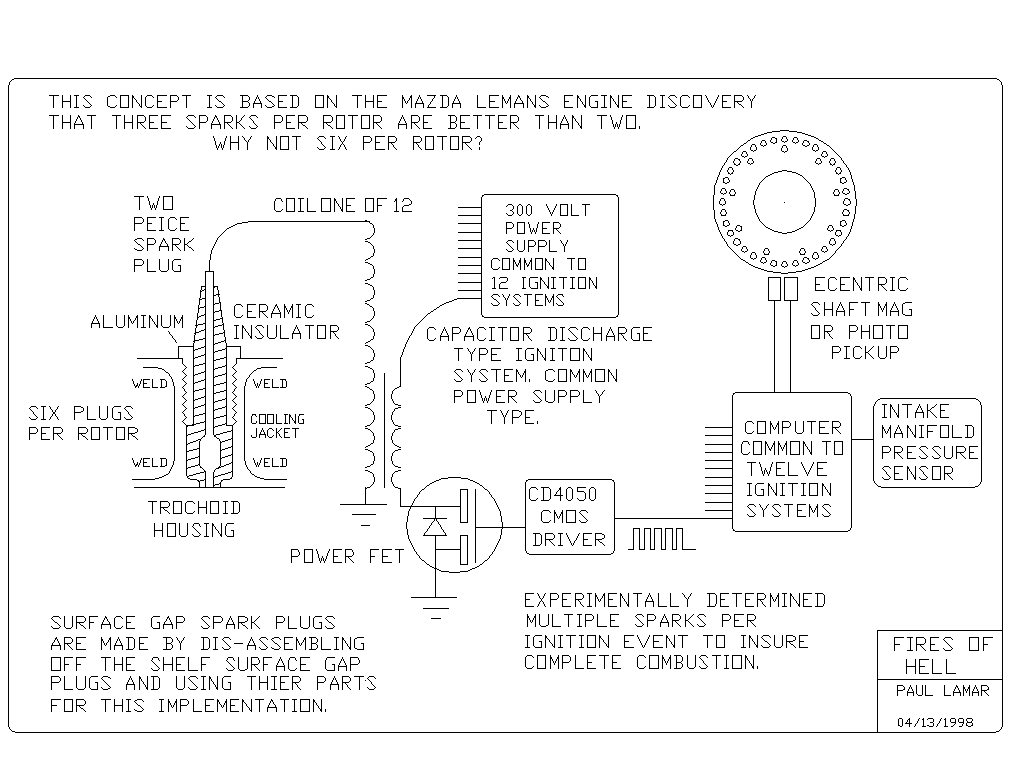
The third plug was only good for a couple of percentage points.
In fact Jim Mederer just told a me a few days ago he could
not find the advantage on his dyno.
http://www.rotaryeng.net/ignit.gif
You might get your wish on Marks engine. I might have to
have it disassembled and reassembled by Mazdatrix. We might
as well stick it on the dyno again with Tracy's ignition
system while we are at it.
Paul Lamar
The Rotary Engine NewsLetter. Powered by Linux.
ACRE NL web site.
http://www.rotaryeng.net
Copyright 1998-2006 All world wide rights reserved.