Doug,
Jerry is correct if somewhat over simplified, sometimes it's
difficult to
put everything down in one go.
No matter where you put the P-port or side port there will be overlap
and
back-pressure on the inlet charge- unless you go the RX8 way. Which
IMHO is
overly complex.
Most engines have and tolerate some overlap, so eliminating it entirely
isn't a high priority, limiting the overlap to that of the standard
configuration for idle considerations only is a nicety.
The real answer for he rotary is direct ( high pressure) injection
past TDC
and perhaps making the exhaust opening where the current inlet
opening is.
This will give a longer time for a more complete burn.
Following the Leman's configuration for max power at very high RPM is
not my
priority, I follow the same path as Jerry in port sizing. The ideal port
shape however is not the D shape as may use but the wide rectangle with
radius edges -especially the leading edge which has a much larger
radius (
much like an aeroplane wing) which acts much like the D shape by
allowing a
more gradual opening event with the added advantage of creating a low
pressure area to help with sucking the initial incoming charge.
This works for the exhaust as well ( in reverse).So in my mind the shape
itself does not define the performance. Even the short wide rectangle
has
problems if you go too far, as this imparts too much flex in the apex
seal.
This is overcome by putting in a bridge in the centre to support the
apex
seal- often referred to as windows.
The question is how much of this do we need at our power and RPM
settings -
how far do we go. After much consideration measuring, calculating areas,
contemplating benefits, I've come to the conclusion- stick to Paul's
recommendations of a round hole.
You can play with the timing event i.e. early or late it's not going
to make
much difference in our application-you could be .5" different to someone
else in the placement of the port height and it going to make bugger-all
difference.
George ( down under)
George,
Please understand I am trying to copy the Leman configuration as
close as
possible on a test stand. Having the engine run at 6,000 rpm, which
would be
my cruise speed, at hours on end doesn't appear to be an issue or even
'high' rpms. Mazda has been proven that it works consistently. The
challenge in the airplane will be in cooling but that is another
topic. For
P-ports of course I am not trying to eliminate overlap I just wish to
know
exactly how the intake port shape looks. All other discussion about what
might or might work is interesting but beside the point of this post. The
Leman engine performance is very well documented and IMHO it would make
sense to copy what works and then go from there. If someone has been down
this path before than I want to met him or her.
DougFir
My point is we are getting very very close to the Lemans engine
HP at 6000 to 7000 RPM with a simple round port and a carb no less.
I have uploaded the dyno curves many many times. All one need do is
compare them. Here they are again.
Note the Lemans engine got 120 HP per rotor at 6000 RPM with a slide
throttle.
We got about 115 HP per rotor at 6300 RPM with a carb and butterfly
throttle. When we get the slide working there is no doubt
in my mind we will get even closer.
IMHO the pipe length, diameter and flow restrictions has far far
more to do with it than the exact shape of the hole.
Paul Lamar
Paul,
In the hierarchy of an airman's needs, reliability ranks higher than
horsepower. I think the round port will be much easier on the apex
seals than the more rectangular variants. So, I concur with your and
George's conclusion that the best approach is to leave the hole as it is
when it is bored.
Now, that leaves us with the task of optimizing power by tuning the flow
through the engine at around 7500 RPM. Horsepower output pretty much
tracks volumetric efficiency. What would happen if we powered the
engine on one rotor and let the other rotor idle as an air pump. We
could then experiment on the idling rotor with different intake and
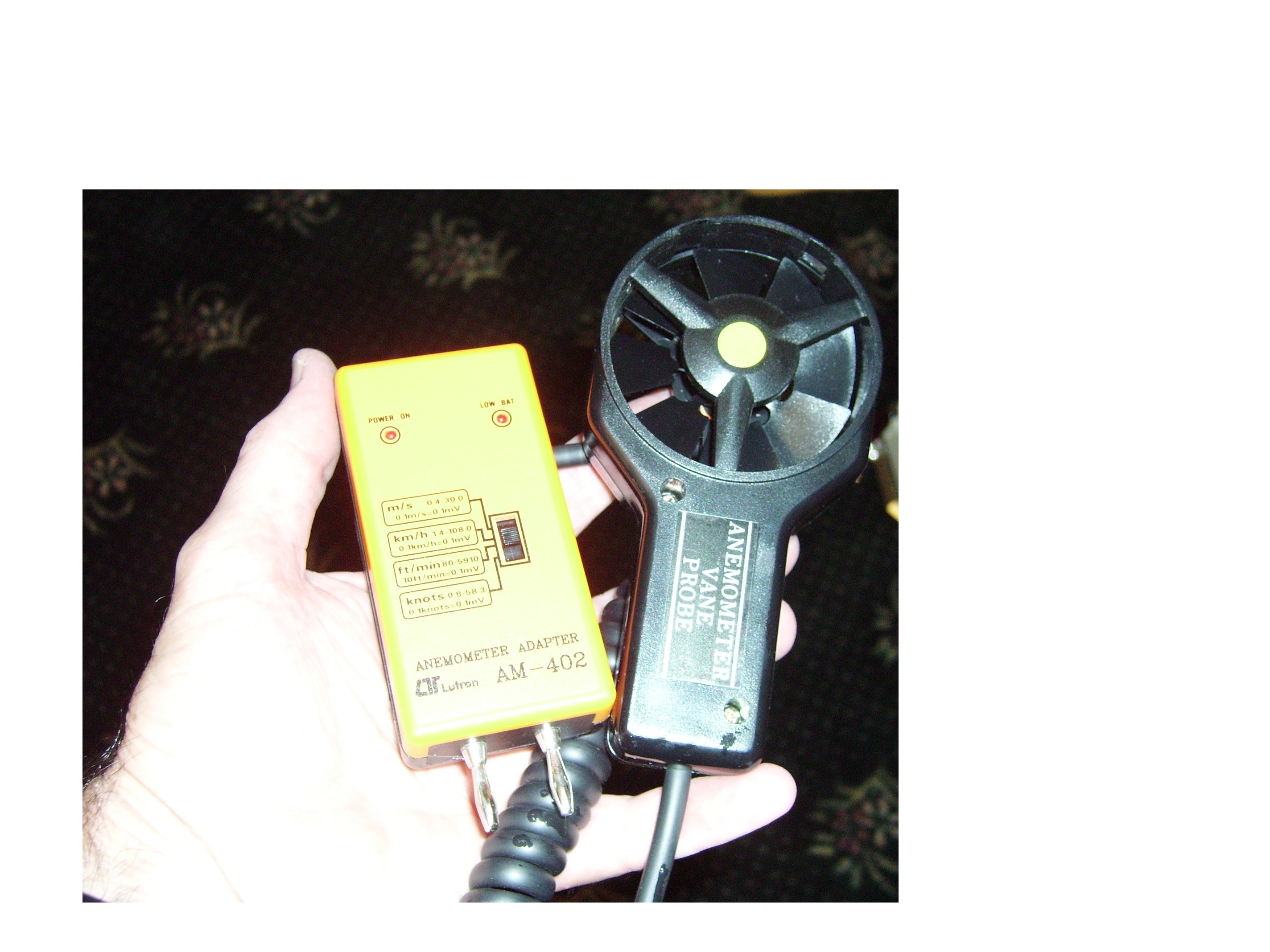
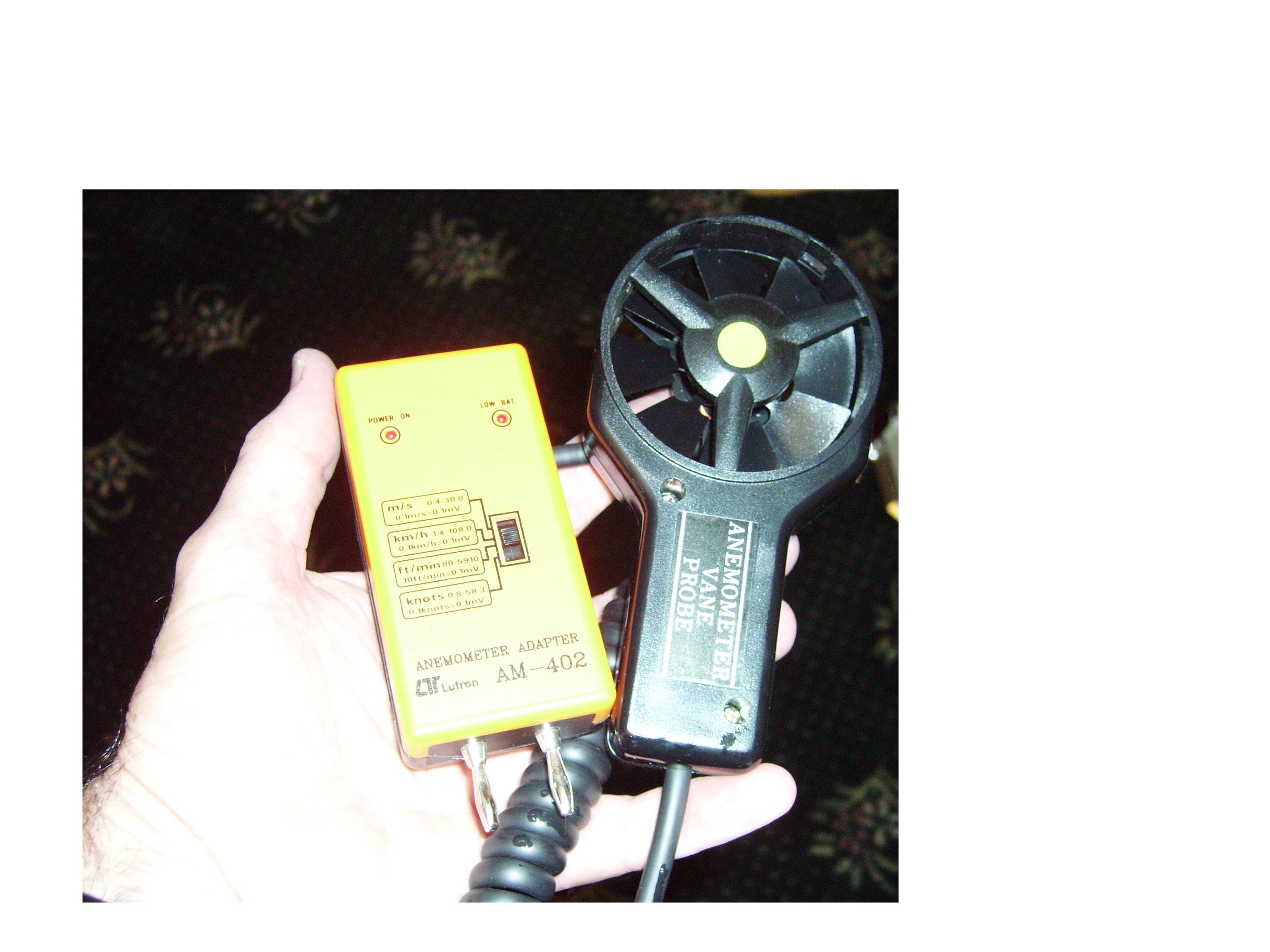
exhaust configurations using an inexpensive HVAC anemometer like the one
below to measure and maximize the air flow. A dynomometer wouldn't be
necessary if we were careful not to over rev the engine. Obviously the
exhaust gas density would be quite different under power. But, I think
we could adjust for that if we could identify a good configuration.
I've never pulled the ignition off one rotor of my RX-7. So, I have no
idea what it does to the smoothness of the engine. I do know what may
happen to the turbos and catalytic converter, so, I don't intend to try it.
Aubrey
I agree that a round hole or an oval hole as in this case is
going to be apex seal friendly.
The engine runs pretty rough on just one rotor for some strange
reason. Also you have this giant torque pulse once per engine
revolution. That will rattle your PSRU.
Paul Lamar ...No rotor no motor.
The Rotary Engine NewsLetter. Powered by Linux.
ACRE NL web site.
http://www.rotaryeng.net
Copyright 1998-2006 All world wide rights reserved.