Paul and group:
After a little break trying to absorb the hundreds of variables related
to cooling my engine, I've hopefully made a little more progress. I
finally ran out of cardboard making radiator mockups 8-}
A major factor for me is the difficulty vs benefit ratios of different
cooling schemes. Custom vs stock radiators are another. I'm
fascinated by the radiators in the trailing edge flap concept, but this
would have a high difficulty ratio, with wing modifications, 2 custom
coolers, complex plumbing, etc.
It appears that stuffing all the radiators inside the cowling may be
the most workable solution in terms of me actually finishing this
project. Other Goose builders have been reasonable successful with
this approach.
This leaves the following major options:
1. One larger right (hot side) water radiator (about 9x14x2), a
smaller left radiator (total >400 cubic inches) with ducting around the
left side to the oil cooler
- see attached crude drawing, which is a TOP view - (please ignore the
residual trash at the bottom of drawing)
- this may work because the smaller left water radiator can allow
enough space for the oil cooler ducting to sneak around the side (need
about 3"x10" area)
- the oil cooler would have to have a bunch of cowl exit slots in the
upper and lower cowling, which are moderately complex, and a potential
obstruction to exit air flow
- plumbing 2 radiators is always an issue.
- this results in a moderately-wide cowling (about 28")
2. 1 oil cooler up front, and a single water radiator on the left
(cool) side, exiting out the cowling (as per Paul's cooling article)
- this results in a very wide cowl (about 32"), due to the corners of a
big radiator and the size of the duct needed to feed it (about 60 sq.
inches area)
- also requires a bunch of cowl exit slots
- the duct would be right up against the spark plugs
3. Two equal sized water radiators up front, and an oil cooler
somewhere else.
- this give a smaller frontal area for the water radiators (using
9.5x11x2 cores)
- this will work using 2" cores, but if some volume could come from a
thicker core (3" evaporators), then even a smaller frontal rofile is
possible
- oil cooler options discussed below
Oil Cooler
A single oil cooler would work on the left side of the engine, with
some difficulty. Another consideration that seems viable is to place
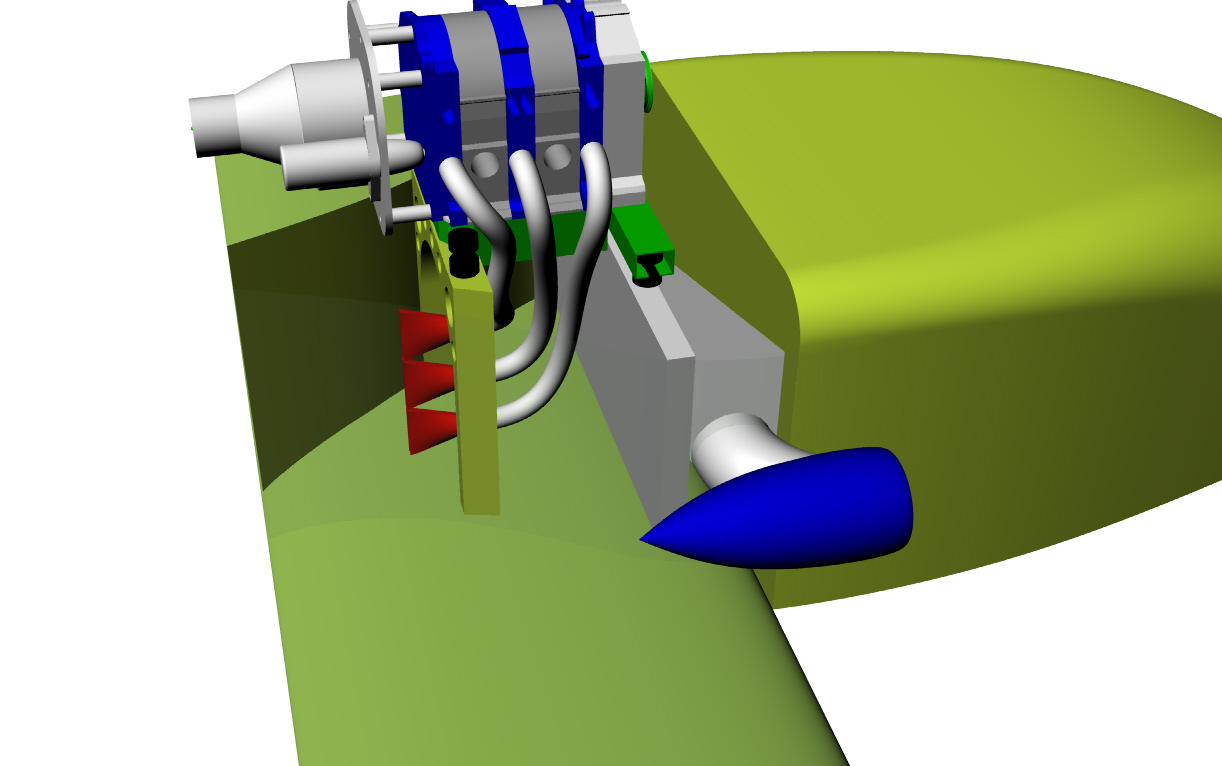
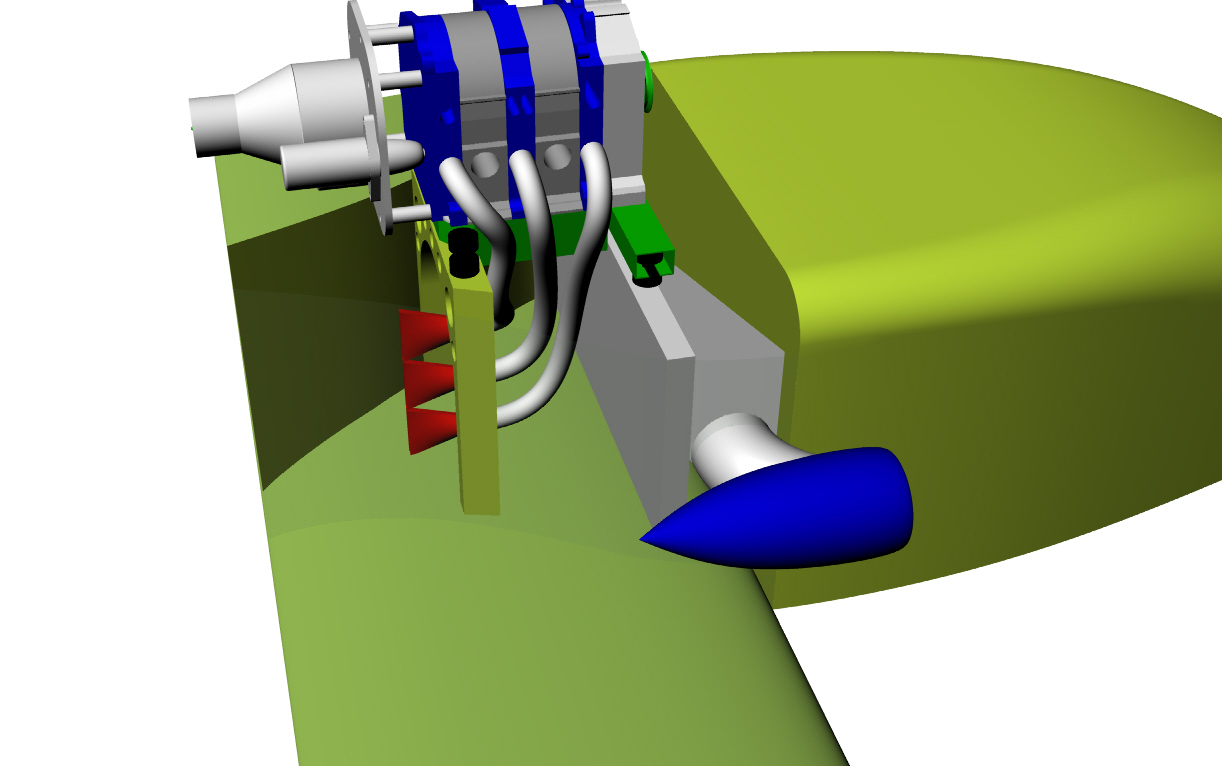
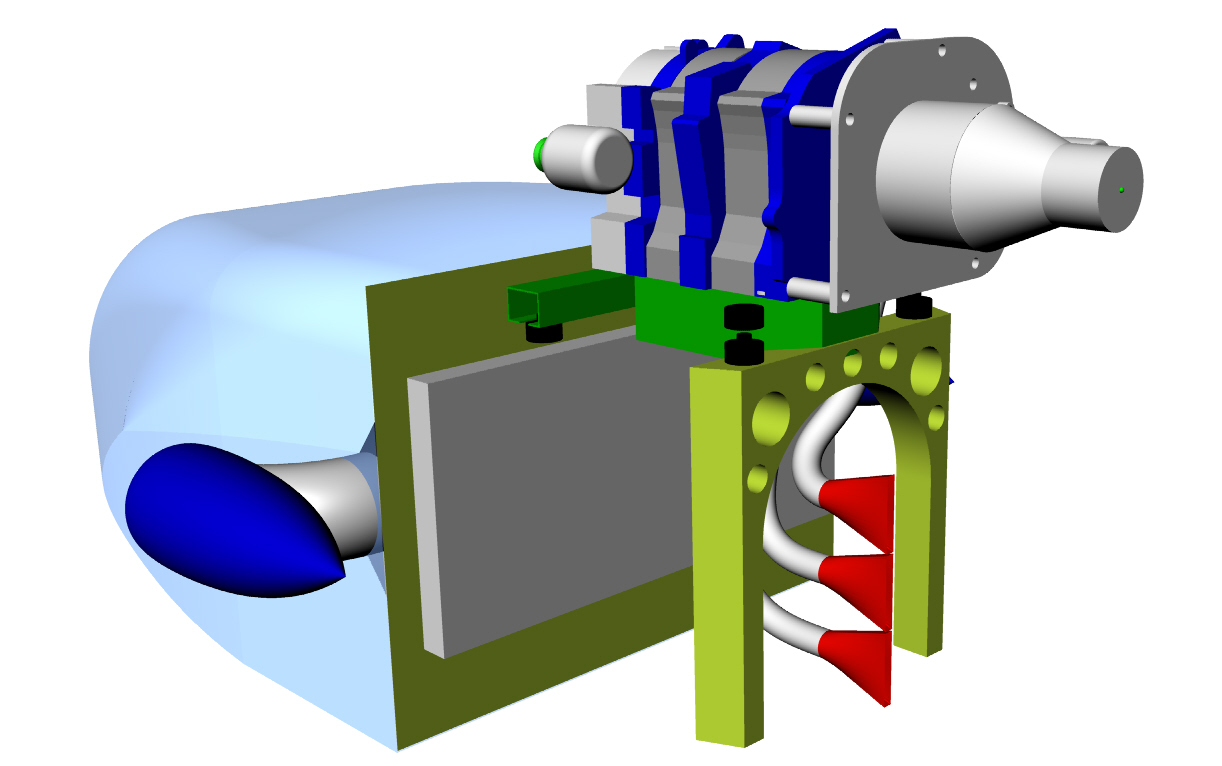
the oil cooler on top of the engine. I can get a 10x11x2" core either
on top of the redrive, or on top of the block, as per the pics. This
could be fed by a separate intake, similar to the implementation
previously posted on the SeaHawker that broke a wing. A long duct from
the very front intake might also work, but would have more resistance
and would have to navigate around obstructions. It would not require a
boundary-layer offset, however.
A top cooler seems to have the advantages of:
- a single, (and off-the-shelf) cooler
- no asymmetry issues
- simple, wedge-shaped ducting
- the exit of the radiator could be open to the air in a low-pressure
area
- small and narrow frontal profile (see pics)
- simple cowling modifications
- note the pictures have a 16" diameter disk at the prop flange,
consistent with Paul's recommendation for cowling exit airflow sizing
(12" prop spinner size not shown)
and disadvantages:
- some complexity of a separate intake duct feeding a wedge diffuser
- the duct intake would have to be elevated up and out of the boundary
layer (1-2"?)
- a front cooler location would have to feed past the alternator (not
shown)
- a location over the redrive would have to duct over Tracy's redrive
plate, and would be closer to the exhaust system
Exhaust
Either of the oil cooler options allows for a side-mounted, 6"
VAM-type muffler, about 8" in length. The factory strongly recommends
the exhaust goes straight up, which would work with a straight pipe or
fishmouth. See the pics of the (very crude) mockups.
The zoomed out view gives an idea of how a side profile of the cowling
might work with a top oil cooler. The front views show where a
top-front or top-rear oil cooler might impact the frontal area.
Hopefully this is progress in the right direction. As always,
comments are greatly appreciated.
Scott Gettings
-----------------------------------------------
I still say this is your best bet Scott.
It will clean things out from under the cowl.
The fundamental problem is an effective cooling system,
considering the diffuser ducts and scoops, is a high
volume system.
The exhaust ejectors along with the prop will suck air
at takeoff and climb when you need it.
The modern large frontal area thin radiator will work
well at low speeds where you need the cooling.
If necessary there is plenty of room for electric fans.
This is the least technical risk cooling system.
It will work from the get go with no expensive changes.
Paul Lamar ...No rotor no motor.
------------------------------------------------------
Scott, Rino has the right idea with that prop extension.
Last picture in the attachments.
This will allow extending the sides of the fuse back
at a more favorable angle.
Also his alternator mounting will reduce the frontal area
of the cowl.
--
Paul Lamar ...No rotor no motor.
The Rotary Engine NewsLetter. Powered by Linux.
ACRE NL web site.
http://www.rotaryeng.net
Copyright 1998-2006 All world wide rights reserved.