Paul
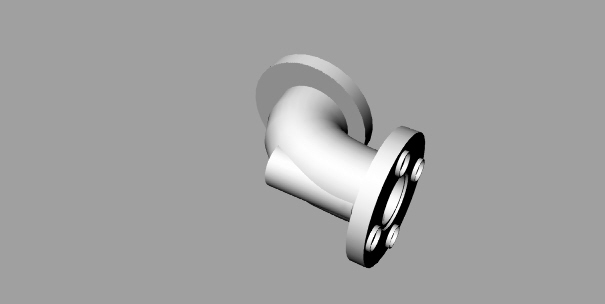
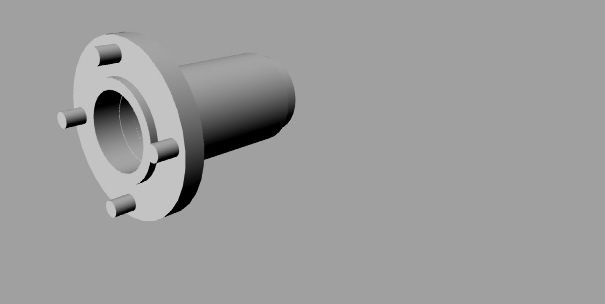
Here is what I was speaking about yesterday. A proper press fit doesn't have
to warp the inner housing. I agree that would be a bad thing. It could be
a light fit if you really want to use JB Weld. Learned how to flow pipes
around a curve today. I'm not always successful in using the Boolean
Difference command as you can see. Making holes should be straight forward.
but atlas no joy:)
DougFir
You are getting much better at Rhino. All it took was a bit
more incentive :) Another problem was how do you support the
rotor housing when you press in the tube? If you just set
it on its side and try to press something in from the other
side you could distort the whole rotor housing. Think about
that.
Also you want to keep the slide throttle as close to the
rotor housings as possible for good idle reasons.
Your sharp radius curved tube is not going to work. You don't
want a sharp radius anyway for aerodynamic reasons. You can't
buy bent two inch tubing with less than a 3 inch center line radius.
It splits if you try a sharper bend.
Now you can make a casting. That is exactly what I did with
my intake manifold intended to fit the stock turbo charged
engine. It was not easy to do or cheap. I was quoted $5000
for the sand cast pattern and core boxes. I then learned pattern
making on my own. They don't teach it at your local college.
Luck would have it my local college did have a stereo lithography
machine I could use if I took the right course. I used
Rhino to design the manifold and fed the file into the
stereo lithography machine and 24 hours later I had the the
first part of the pattern. A month or two later I had all the
necessary core boxes and the other part of the pattern. Now I
had to cast up a bunch. The foundry was not willing to do just
a few. Fortunately I sold about 100.
The last thing I want to say is: it is not practical to
start with a 3.5 to 4 inch dia. rod and machine out the four inch
long tube insert with a 3.5 to 4 inch dia. flange. Way too much
labor on the lathe. Particularly a hand
lathe. Don't forget you must also bore out the two inch hole. You
won't find 3.5 or 4 inch tubing with anything thicker than a
one inch wall. That is not going to cut it pardon the pun.
Not so bad on an NC lathe but still way more expensive
than making it out of tubing and welding on a 3/16 thick
square flange cut out on a sheet metal shear. You can chuck it
in a four jaw lathe chuck and bore the two inch hole if
you wish but a hole saw works fine.
The easy way to do what you want to do is use the sleeve trick.
When I was a young junior engineer working for an aero space company
I was always designing things the machine shop could not make :)
I had to learn all this stuff the hard way. They don't teach it
in engineering school.
My friend Herb Adams, the father of the 1973 TransAm Firebird who
is still working in Detroit, told me recently it is real
hard to find an engineer now a days that actually designed a
part that made it into production :)
Paul Lamar ...No rotor no motor.
The Rotary Engine NewsLetter. Powered by Linux.
ACRE NL web site.
http://www.rotaryeng.net
Copyright 1998-2006 All world wide rights reserved.