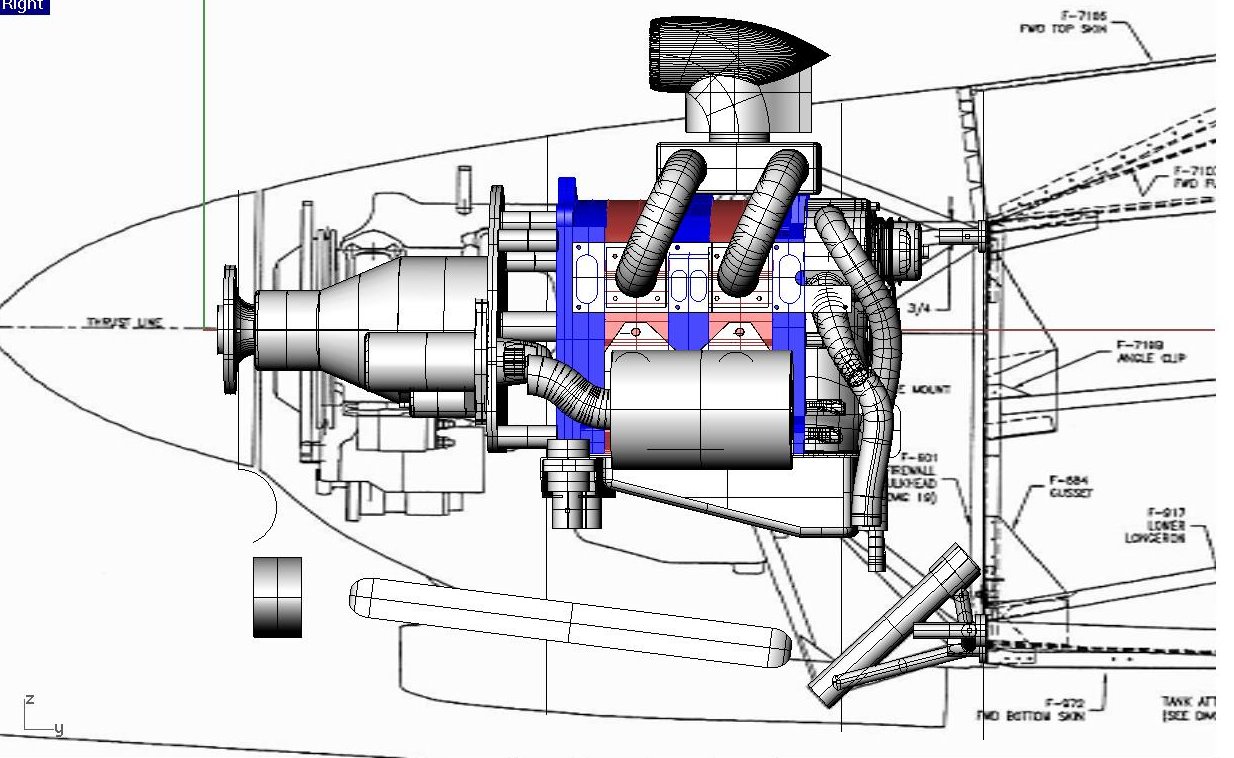
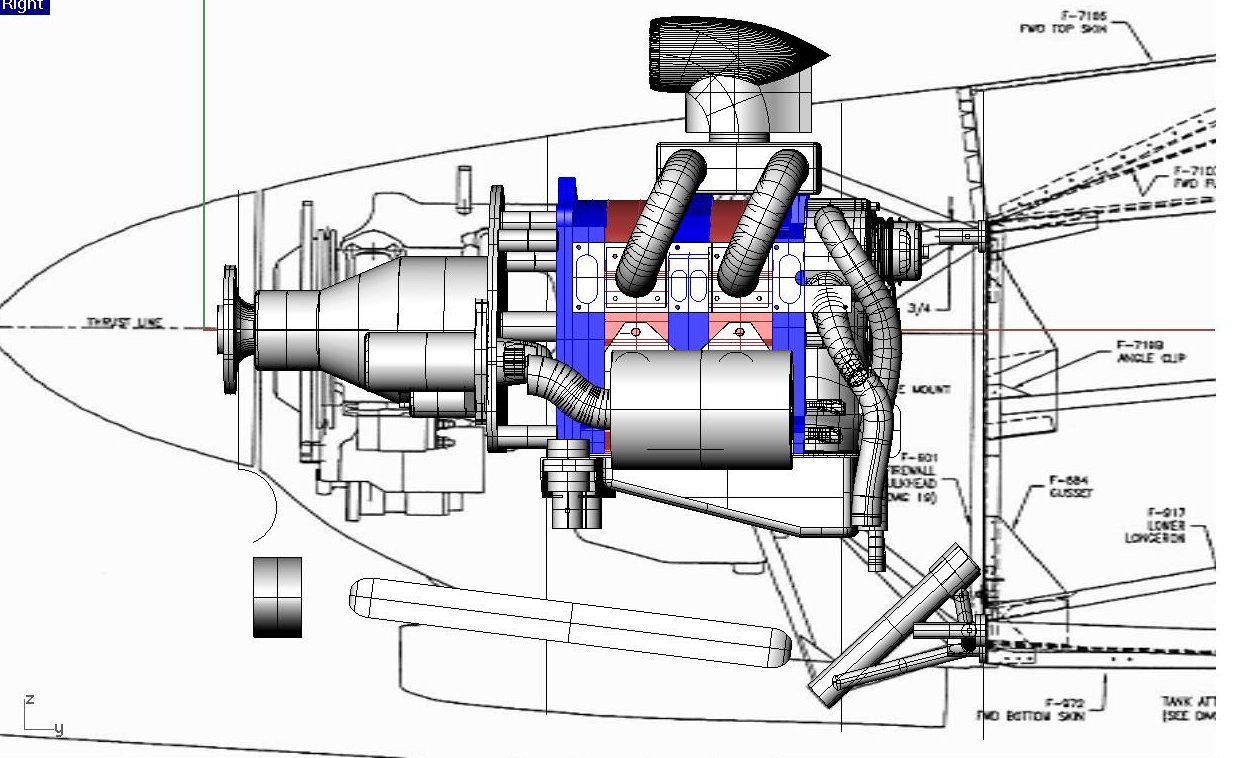
Doc, What do you think of this scoop shape?
Makes the cowl easier to make and provides
a bit more room under the engine for the radiators.
--
Paul Lamar ...No rotor no motor.
The drawings are really nice, particularly the transparent one. The
first one really communicates the shape.
I can see why the scoop on a pedestal is attractive for space reasons.
I still have to wonder about the drag. I can live with the looks.
Looks are important but not as important as efficient function. I
have seen pictures with a rectangular opening(s) with ramps on the top
of the cowl that I assume to be for induction air. What are the
considerations? Is there enough room for a female scoop, if I can call
it that. Is a female scoop less draggy than a male one?
The lower cowling looks rather bulbous. It that why James uses the
shark mouth? Which would be less drag?
Drag goes up with the 3rd power of speed. I am no speed demon, but
less drag means less fuel burned for a given speed. Ahh, that Scottish
blood again! And on a long trip faster is better.
Doc Custer
Retired software engineer and sometime Audiologist
Building RV9-A. Fuselage
The rectangular opening with ramp is probably pretty close to
this Me109-P38 type scoop in recovered dynamic pressure.
I was serious about negative drag at low speeds. The reason
this happens is there is a negative pressure drop on the face
of the scoop that pulls the aircraft along. There is no
free lunch of course so this cost the engine a slight amount
of HP sucking the air in. At higher speeds the dynamic pressure on
the scoop over comes the need for air by the engine so a positive
pressure will develop on the face of the scoop. This is more HP
and slight drag increase of course. Never the less the net result
is thought to be positive by the Me109 and P38 aerodynamic engineers
and our man Dave Leonard. However a ramp is easier to build
and less in your face :)
Unfortunately we need that bulbous shape to accommodate modern,
high efficiency, large frontal area, thin heat exchangers.
This is all explained in Kays and London's book Compact Heat
exchangers. The book was written after 30 years and 20 million
dollars of US Navy money at Stanford University.
Also read this. http://www.rotaryeng.net/how-to-cool12.html
Hang on to your hats. I think I have a breakthrough in cowl shapes.
The next cowl iteration will accommodate and unprecedented volume
of modern thin heat exchanger. 700 cubic inches
of rad core and 250 cubic inches of oil cooler core. It is
a little Hurricane and a little P40-P38 in appearance.
IMHO experimenting with 3D program is the only practical way to find
the optimum cowl shape for the liquid cooled rotary engine.
Paul Lamar ...No rotor no motor.
Assumed space management on my RV (9A): Radiator cooling under, intake
and ignition systems on the right side, exhaust hardware on the left to
isolate heat. Suggestions are welcome. Not sure yet where to place oil
cooler(s)
If designing a cowl from scratch, it might be a good idea to include a
"small" front right-side intake scoop for ram-air induction and cooling
air to ignition coils, and possibly to route cooling air ducting to oil
cooler(s). Leave the area behind the bottom scoop area free for
radiator and air ducting. It might also be a reasonable idea to have a
small left-side scoop for cooling air to the exhaust header and pipes
and "compounding" turbo (Hint... ;-) ) . The big question I have is how
large do the scoops need to be to support ~180hp @ 6000 rpm @ 8-10,000 ft.
Ideally, Id like a bit more room on top of the engine (maybe upper
sides) to allow space for long intake runner tubes. Ive also wondered
how best to find a bit of space behind the radiator, possibly between
the main wheel struts to collect and duct/accelerate outlet cooling air
to an adjustable cowl and possibly to shroud a spintech-type muffler.
The front wheel strut location is a problem.
Mike Parker
The problem with room on top is the slope of the metal in front
of the windshield. If you come stright out with the top
of the cowl it will look strange or kludged.
Paul Lamar
The Rotary Engine NewsLetter. Powered by Linux.
ACRE NL web site.
http://www.rotaryeng.net
Copyright 1998-2006 All world wide rights reserved.