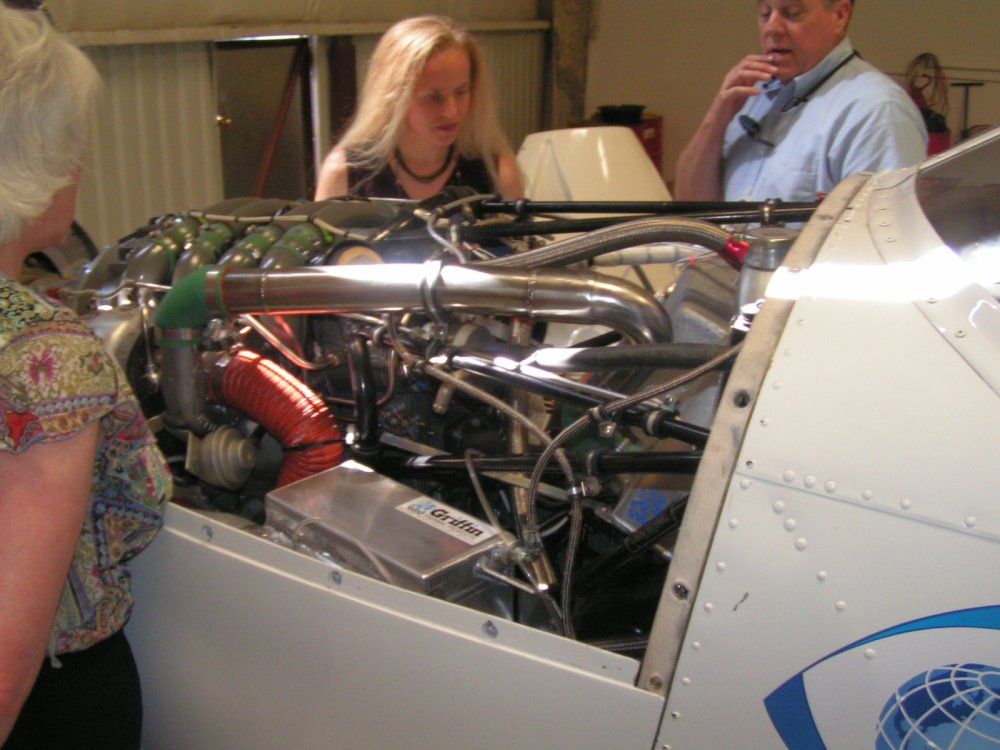
Paul,
That looks good, however I kinda liked Mistral's twin openings in
the fighter jet style.
George ( down under)
-----------------------------------------------
Mistral is NOT using a modern, high frontal area, low thickness, high
efficiency, heat exchanger. We are not talking about style
here. We are talking about functionality. It has got to cool
240 HP at 110 F max angle climb out. It takes more pressure to
force air through a thick rad than it takes to force
air through a thin rad. This is a page from Kays and London
"Compact Heat Exchangers".
Read:http://www.rotaryeng.net/how-to-cool12.html
Paul Lamar ...No rotor no motor.
Paul,
From the styled front I assumed that they might be using rads
each side - I wonder why they are using thicker cores!?
George (down under)
------------------------------------------------------
One side is oil and the other side is water. Two ducts are less
efficient than one. One of the reasons P-ports are better than four
ports and six ports. More surface area for the same intake area.
Simple grammar school geometry.
Obviously somebody that made the decision to use thick
rads did not read Kays and London Compact Heat Exchangers
or
http://www.rotaryeng.net/how-to-cool12.html :)
It could have been somebody at Embry Riddle University or
Griffin Rads. On the other hand its tough to package a liquid
cooling system in a cowl along with a retractable nose gear. The
small size of a rotary helps. Near impossible in a liquid cooled
piston engine.
It took me three or four years to figure out aircraft liquid cooling
systems including listening to many people that made mistakes trying
to cool the rotary and one or two that flat gave up. Not to
mention reading everything I could find on the subject including
a lot of stuff dating back to WW II.
BTW a strong factor (one of many) is climb out speed.
There is SIXTEEN TIMES as much air pressure to force air through
a heat exchanger at 200 MPH than there is at 50 MPH. Many people
that report cooling difficulties or successes do not report
climb out speeds as well as failing to report many of the other
strong factors such as ambient air temperature. One degree difference
in ambient air temperature is a 1% change in liquid cooling ability.
This is why it is so difficult to make sense from the many anecdotal
reports.
Paul Lamar ...No rotor no motor.
The Rotary Engine NewsLetter. Powered by Linux.
ACRE NL web site.
http://www.rotaryeng.net
Copyright 1998-2006 All world wide rights reserved.