Paul, what happened to the little prop dyno that you had mounted on
a trailer? I have been waiting for you to use it, to see what
changes if any you would recommend, before building one for
myself. Could you put Mark's engine on it? BTW, I have no need
for the trailer version. Mine could be solid mounted bolted down to
the shop floor. Jerry
The house project is eating all my spare time.
Extend the bottom legs further up under the engine
to balance it better. You don't need the static thrust
measuring capability as it can be misleading.
Rather than the bathroom scale there are other ways
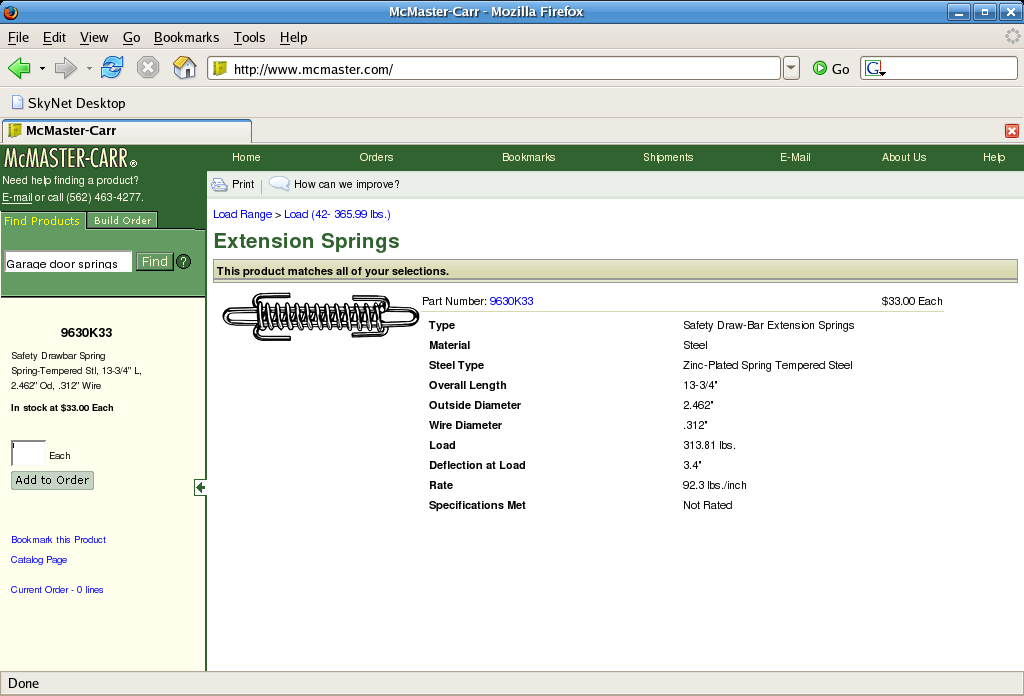
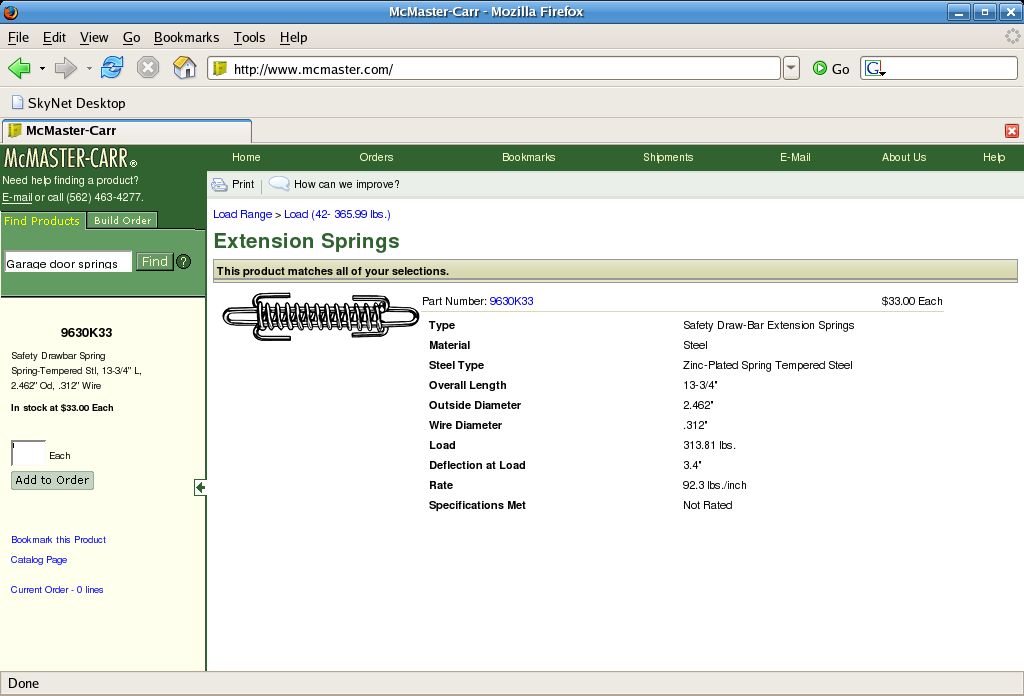
of measuring the torque. A calibrated garage door
spring is one of them. Use a shock absorber to damp
out any oscillation.
Let me know if you need any advice.
Paul Lamar ...No rotor no motor.
I need LOTS of advice. Can I supply resistance without running a
prop? I have heard of driving a pump. Would it be belt driven off
the prop flange? Jerry
Do you have a 200 HP water pump? Takes a lot of v belts to
transfer 200 HP. Do you have a lake on the property?
--
Paul Lamar ...No rotor no motor.
Jerry, you should carve up a couple of test clubs. These are very
simple to make compared to a wood prop, yet provide similar resistance
without having to deal with the thrust. There is a formula for
dimensions as a function of horsepower and rpm. They are actually not
even as big as a prop so you don't need the ground clearance and you're
not vacuuming the ground in front of the prop when you're running it.
Attached is a crude spread sheet example with the formula on the top
(apologies for the MS Excel file). I made this when I was playing with
the formula months ago. Look at the 2500 RPM chart and you can get a
feel for the club size vs. horsepower.
The profile of the club is not clear just looking at the formula. You
make the hub size normal compared to a wood prop of similar horsepower
rating. Then taper the club to the measurements shown in the formula.
(I could be wrong on this but I don't think a stick only 1/3 of an inch
square at the blade root (see 2500 rpm chart) would survive absorbing
100 - 200 HP.) The club has sharp square edges except at the hub.
This is what helps absorb so much horsepower. Static balance the club
before you use it.
Now, using this you don't necessarily have instrumentation to measure
the torque reaction of the motor so you won't have horsepower measured
out to two decimal places. What you will get is a consistent load (at a
consistent density altitude) so you can tell if you are improving or not.
Want to calibrate it? Get a buddy with a fixed pitch airplane who will
let you bolt on the club and see what RPM it makes. You will need to
know what engine he has, what his prop specs are, and what the static
rpm he can get on a static run-up. Start the plane and
*EASE IT UP* to
power. Remember, this is a test run, you don't know what RPM you will
max out at and don't go past redline and trash your buddy's Lycoming.
Now you know a horsepower baseline for your new club.
Want to measure the horsepower absorbed at different RPMs? Put scales
under each wheel on the plane and record the change in weights between
engine off and engine running at X rpm. There's your horsepower meter.
In my opinion this is something all engine experimenters should have and
use while ground testing a newly developed installation. Of course it
does not provide any airflow for the radiators, You'll need fans and
ducting for that.
Well, that got long winded.
Happy testing,
Mike
Mike McGee, RV-4 N996RV, O320-E2G, Hillsboro, OR
13B in gestation mode, RD-1C, EC-2
Yes I forgot about that scale under the wheel trick.
Thanks Mike. It only gives you the prop load HP at less than
max static RPM. Same as the pivot dyno.
The max HP of the engine at lower RPMs will be much
higher. Of course if you have a fixed pitch prop... BSFC at prop
load HP is all you really care about. Here is a chart
from PS that illustrates this relationship. This chart
also illustrates how useless low RPM torque is for an
aircraft engine with a fixed pitch prop.
Looks like we don't need the pivot with the
test stand if it is mounted on a trailer. You might need
two bath room scales under one wheel as the static load
will be around 300 pounds with the engine not running.
300 pounds for the engine and 300 pounds for the trailer
and test stand. 600 pounds total. 300 pounds on each
wheel.
Bath room scales are limited to 300 pounds. Old fashioned
balance bar feed scales go to 600 pounds but they need to
be adjusted which is not practical while the engine is running.
I have not been in a feed store lately so maybe digital
feed scales are now available. High buck digital scales
are used by NASCAR racers. I see Mcmaster Carr has a digital
platform scale for about $800. 5721T86
http://www.mcmaster.com/
Back to the garage door spring :)
Paul Lamar
You are going to see up to 600 foot pounds of torque
so you need a strong spring. With a two foot lever
arm max force on the spring will be about 300 pounds.
You can use a long travel dial indicator with this
as long as you can damp out the vibration with a good
car shock absorber.
This is by far the cheapest way to make a dyno scale.
--
Paul Lamar ...No rotor no motor.
The Rotary Engine NewsLetter. Powered by Linux.
ACRE NL web site.
http://www.rotaryeng.net
Copyright 1998-2006 All world wide rights reserved.