Friends and others,
As you may recall, on the way to Osh on July 23 my exhaust system decided to
depart the engine leaving a lot of melted wires and charred cowling. I got
it tacked back together and raced home to Seattle from western Nebraska.
Once home I began the process of doing a permanent repair of the wires and
developing a new exhaust system. The wires were the easy part. The exhaust
system has been a long arduous process in which I pursued several options.
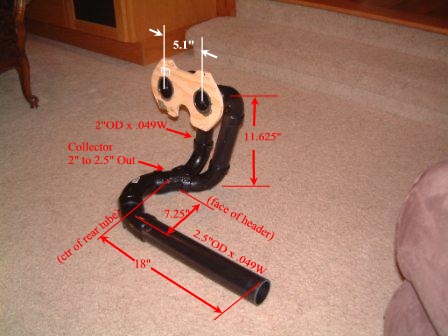
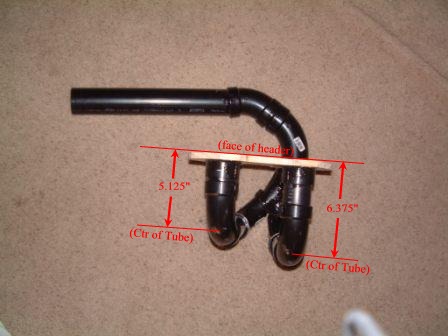
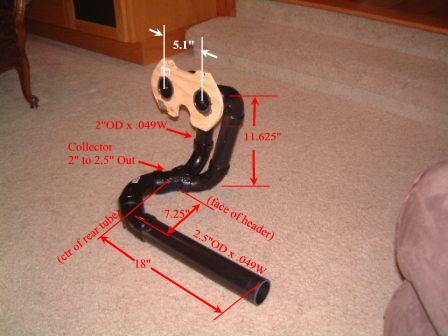
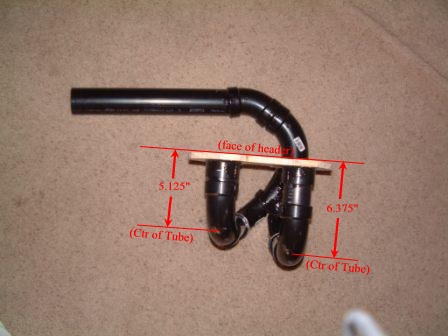
In the end I mocked up a design using 1 ½ and 2 Sched 40 ABS plumbing
pipe; not quite the exact dimensions for 2 and 2.5 ID x .049 stainless
but close enough. I sent the model off to Aircraft Exhaust in Princeton,
Minnesota and a mere 4-5 weeks later I got my finished exhaust system. I had
them put a couple of ball joints in right after the first bend about
half-way to the merge. Also, the model was designed, and I emphasized with
them over the phone, that each leg was to be pretty close to (exactly?) 21
from the flange to the merge (per Lynn Hanovers advice).
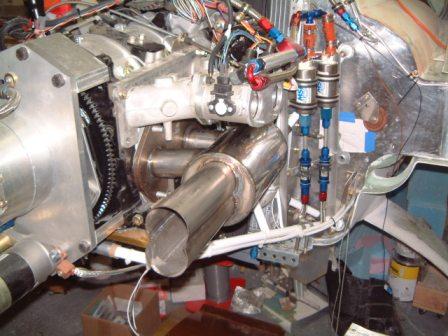
I received the exhaust 2 weeks ago. Getting it on the plane was a breeze.
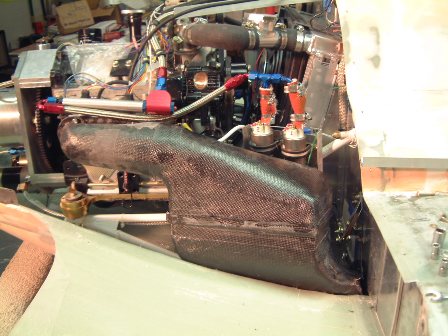
Unfortunately designing and fabricating a support system for it, so it is
firmly braced to the engine, and fabricating a stainless heat shield took 24
or more hours! Since the airport is 50 miles away thats a lot of work and
has taken 2 full Saturdays!
Anyway, my efforts were rewarded late Saturday when I finally got it all
together and began testing. I ran the engine on the ground at low RPM
(1200-2000) while the oil warmed up. After the oil was above 120 deg. I did
a static test and was rewarded with another 200 RPM.
Oh, let me backup a minute. While the engine was down waiting for the new
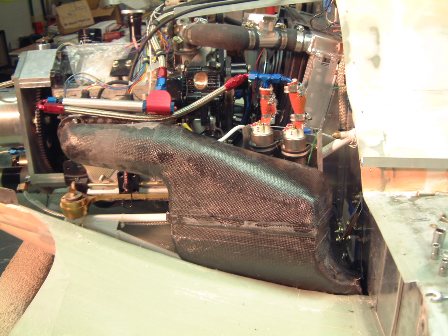
exhaust I decided to re-do my intake manifold. I have the short Atkins
manifold and had a plenum attached directly to the TWM throttle body with
nice sharp edges butting up to the throttle body (hey I didnt know!). So I
created some 11 long intake tubes that flare to a sort-of bell mouth
inside my air-cleaner plenum. I tested that briefly with the old muffler and
on the ground got another 100-150 RPM static and another 200-300 RPM in the
air up to 5400RPM and another 3-5kts airspeed (162kts). So that was a win.
OK, back to the new exhaust I was now getting 4400-4500 RPM static and
after running for 20 minutes or so and checking to make sure everything was
still secure I decided to take to the skies before it got totally dark.
There was a very noticeable improvement in takeoff and climb VERY
NOTICEABLE. So I headed out west of the airport over Puget Sound and opened
it up to see what would happen. It shot past 162kts and settled in around
179kts and about 5950 RPM!! Which is also pretty close to the design speed
of the prop! So, overall it looks like I have some significant performance
gains!!
Around the end of the flight (or actually the cause of the end), I thought I
felt a little change in vibration and it looked like the EGTs went down
so I hightailed it back to the airport at reduced power (of course
descending even at reduced power meant I was still moving at 200MPH) and had
an uneventful landing and taxi back to the hangar. I didnt have time to
pull the cowls but everything I could see from the outside looked OK. So,
I have to see whether the problem was in my head or in the engine!!
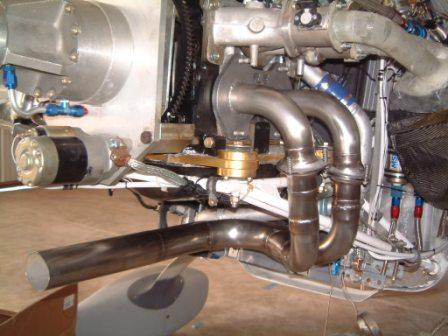
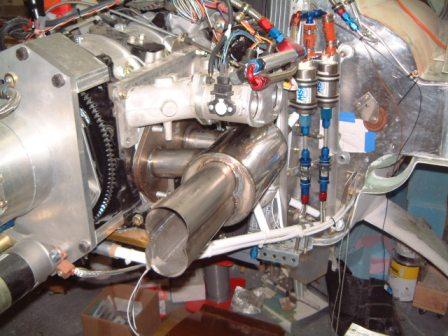
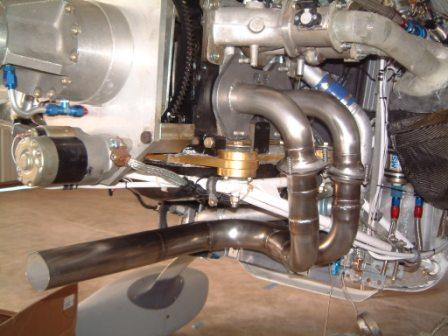
Attached are some pics of the model and the new exhaust. The new exhaust2
picture also shows the new intake in the upper right corner.
Performance Re-cap:
Static RPM Flying RPM Max Speed
Original 4100 5150(max) 157kts TAS
New Intake 4250 5400 162kts TAS
New Exhaust 4500 5950 179kts TAS
Obviously the Tangential muffler sucks (actually blows) when it comes to
performance! WAY too much back pressure.
Regards,
Joe Hull
Cozy Mk-IV N31CZ (65 hrs - Rotary 13B NA)
Redmond (Seattle), Washington
Thanks for the data and pictures Joe. We will drive a stake
through its evil heart :)
Hard to say it was less back pressure or the better intake.
I suspect the intake had a lot more to do with it because
you are running th 2.17:1 PSRU and that can definitely benefit
from longer intake runners.
I see somebody welded the pipes to the flange on the outside
again. Not wise.
Paul Lamar
The Rotary Engine NewsLetter. Powered by Linux.
ACRE NL web site.
http://www.rotaryeng.net
Copyright 1998-2006 All world wide rights reserved.