snips...
I love Wikipedia
http://en.wikipedia.org/wiki/Wankel_engine
http://de.wikipedia.org/wiki/Wankelmotor
<http://de.wikipedia.org/wiki/Wankelmotor>
http://en.wikipedia.org/wiki/Wankel (section on aircraft engines !)
Perhaps the wildest thing I read .....
"Perhaps the most exotic use of the Wankel design is in the seat belt
<http://en.wikipedia.org/wiki/Seat_belt> pretensioner system of the
Volkswagen <
http://en.wikipedia.org/wiki/Volkswagen
<http://en.wikipedia.org/wiki/Volkswagen>> New Beetle
<http://en.wikipedia.org/wiki/New_Beetle>. In this car, when
deceleration <
http://en.wikipedia.org/wiki/Deceleration
<http://en.wikipedia.org/wiki/Deceleration>> sensors
<http://en.wikipedia.org/wiki/Sensor> sense a potential crash, small
explosive cartridges are triggered electrically and the resulting
pressurized gas feeds into tiny Wankel engines which rotate to take up
the slack in the seat belt systems, anchoring the driver and passengers
firmly in the seat before any collision."
*** Looks like this might be covered under SAE *Document Number: *980557
SAE
http://www.sae.org/servlets/index has over 100 very interesting
papers on the Wankel but they are now priced at about $10 each. If I
could just find a less expensive way to get these .... Maybe I could
copy them at a local University ???
Here is a nice animation !
http://www.keveney.com/Wankel.html
All for now .... time for bed.
zzzzzzzz
Toski
Some of that wikipedia stuff is total nonsense.
http://en.wikipedia.org/wiki/Wankel_engine
"A further problem caused by the shape of the seals in Mazda engines is
that carbon particles can become trapped between the seal and the
casing,
completely jamming the engine and requiring a partial stripdown to
rectify.
Such engines should never be started and run unless the engine will
reach
operating temperature; most such instances of jammed engines occur when
a car is started and moved a few yards, e.g. from a garage to a
driveway.
In these situations it is better to manually push the car."
In over a million miles of driving six different Mazda Wankel powered
cars over the last 34 years I have never had this happen. Pure BS.
"Unlike a piston engine, where the cylinder is cooled by the
incoming charge
after being heated by combustion, Wankel rotor housings are constantly
heated on one side and cooled at the other, leading to very high
local temperatures
and unequal thermal expansion. This places high demands on the materials
used."
More nonsense. Mazda heats the cool side of the engine with exhaust gas
passages in the center and rotor housings to equalize the temperature on
both side of the engine.
"In engines having more than two rotors, or two rotor race engines
intended
for high-rpm use, a multi-piece eccentric shaft may be used, allowing
additional bearings between rotors."
Not necessary. Curtis Wright had a center main bearing with out split
housing on a two rotor engine.
"Some studies have indicated that at high speeds, the rate at which the
volume of the combustion chamber increases in the moments after
ignition actually
out paces the expansion of the burning fuel. The result is that, at high
speeds, less useful energy is extracted from the same volume of
fuel, as the exhaust
has to expend time and energy "catching up" to the rotor before it can
accomplish any work."
More nonsense. If that were the case the racers would not be running
them at
11,000 RPM. Notice the "author" did not reference the "studies".
Paul Lamar ...No rotor no motor.
----------------------------------------------
Paul,
The interesting thing about Wikipedia is that it allows anyone to edit
the listings. I guess they check after the fact to see if your
editing is sensical.
I agree with your first point completely.
On the heat issue, I tend to agree with them. Below the minor axix on
the combustion side the rotor housing only sees combustion. Great pains
must be taken with extreme HP engines to keep this area cool.
Generally speaking the recip does not have such lopsided heat problems
to deal with.
On your final comment, they simply have stated this inartfully. That
the flame front does not reach the extreme leading and trailing
portions
of the rotor chamber. I would have to go back and check but this is
discussed in Norbye's book. Quenching is part of the problem. That the
leading section is moving "away" from the spark plug is also part of
the
problem I believe.
All the best.
Bruce Toski
-----------------------------------------
Many of the fixes were applied by Mazda years after the Norbye book
was published in 1971.
Max Bentele is credited with the cooling fix.
His book was published in 1991 but it was mostly about himself
and not rotary engines.
Do you have Kenichi Yamamotos book Rotary Engine?
First and second (1981) versions?
Also about a dozen SAE papers written by Mazda engineers
over the years?
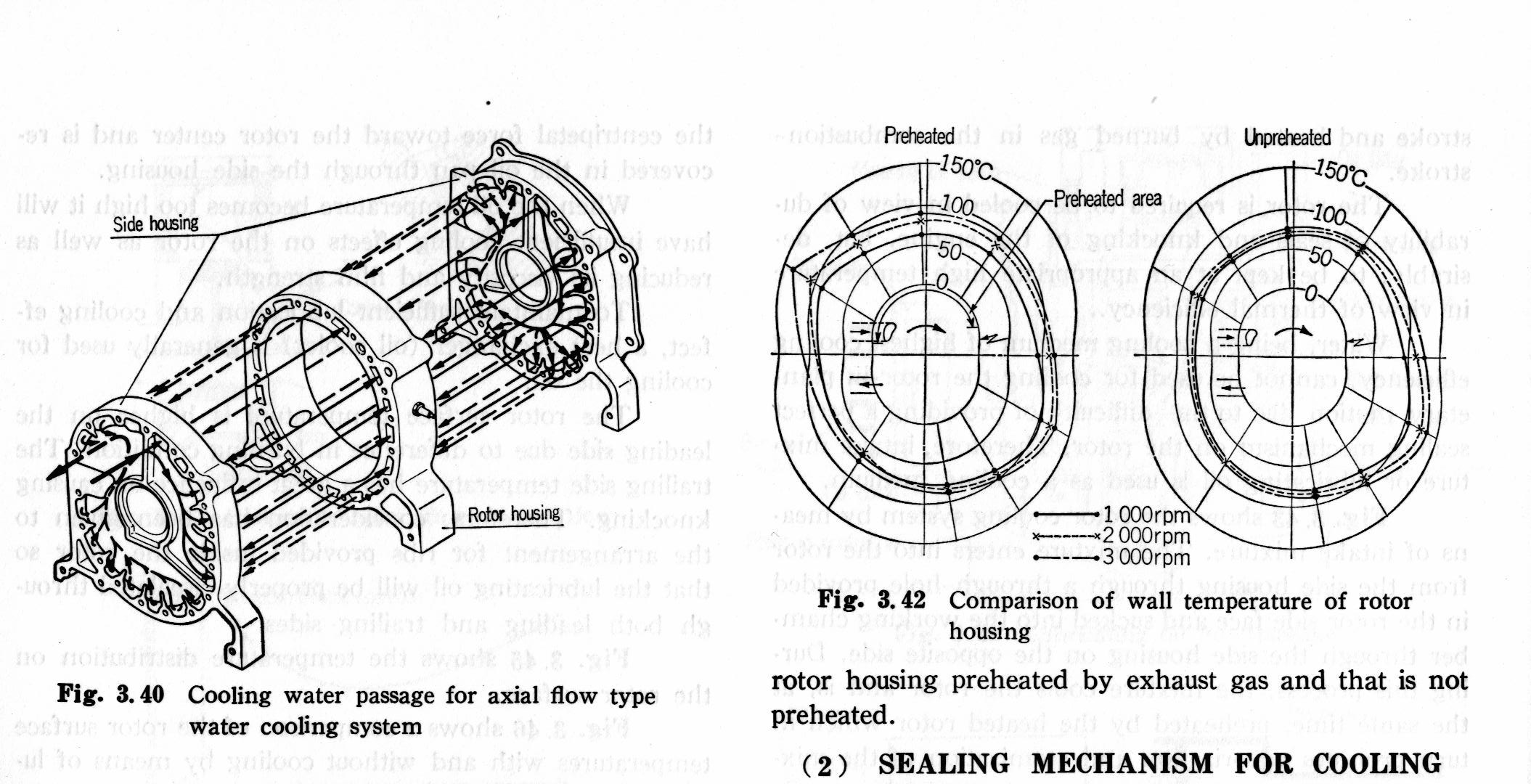
The first jpg does not include the exhaust heat also
distributed about the cool side of the engine. The second
JPG shows a cut away of the center rotor housing. The black area
on the extreme right shows a thin vertical rectangle.
This is an exhaust gas passage that distributes
hot exhaust gases laterally to both rotor housings and
to the intake manifold.
I agree with you on the TRAILING side of the combustion
chamber. Wikipedia specifically said the LEADING side
of the combustion chamber. Last JPG. Note the burning speed
on the leading side is increased by the squish from the
trailing side. Rotary Engine. The RX8 engine has a new
bath tub shape in the face of the rotor. It is wider
and shallower than former bath tub shapes. The coming
16B will have a wider chamber yet.
The rotary engine design is a moving target. My mother told me
to never stand in front of a moving target :)
The whole Wikipedia article was not artful! :)
Paul Lamar ...No rotor no motor.
What's the cooling fix, Paul (that Max Bentele came up with)?
Thanks,
Matt-
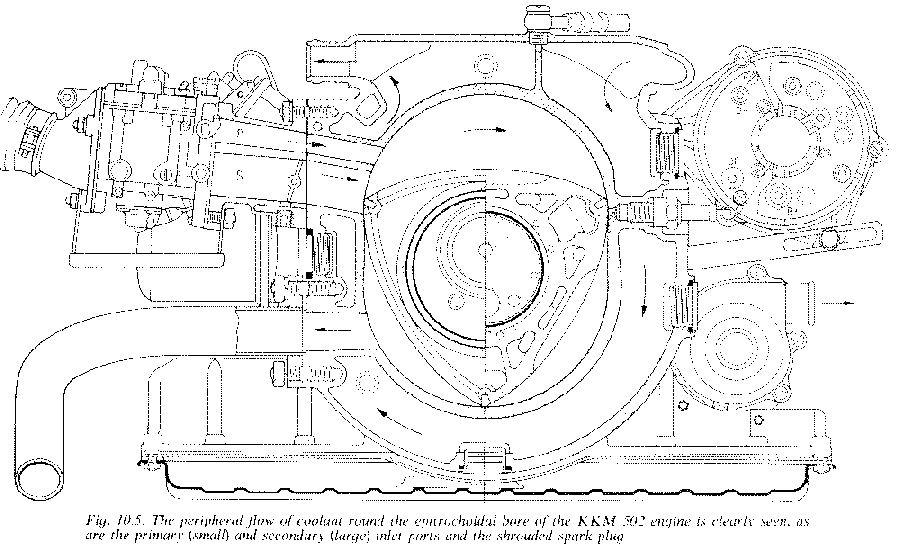
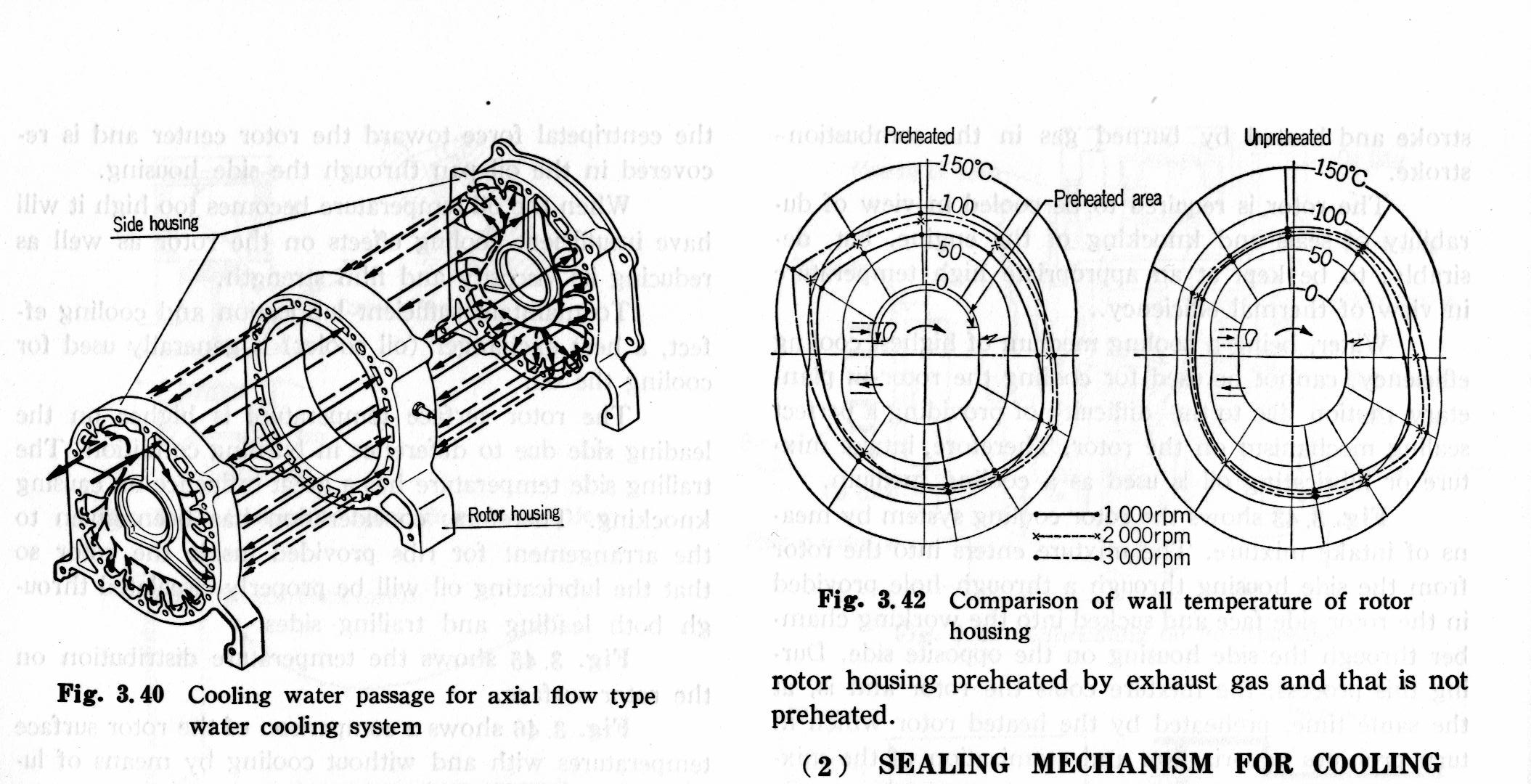
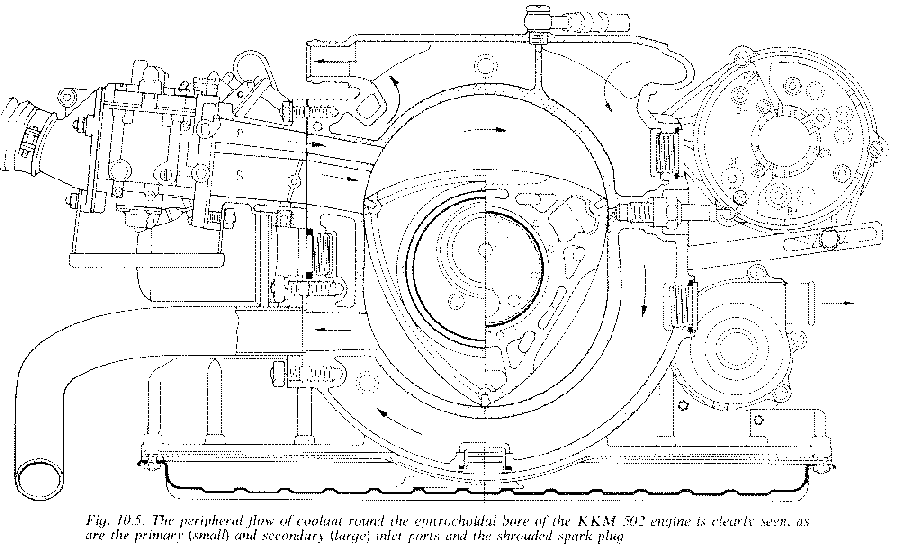
It was the axial flow cooling where cold water goes down
the hot side of the engine is warmed and returns on the
cool side. Here is a better jpg of the situation.
The bad part about this is the rear rotor housing runs hotter
than the front rotor housing. Prior to that NSU
used circumferential coolant flow which in theory was better
but required an external water manifold for multi rotor
engines.
Paul Lamar ...No rotor no motor.
The Rotary Engine NewsLetter. Powered by Linux.
ACRE NL web site.
http://www.rotaryeng.net
Copyright 1998-2006 All world wide rights reserved.