George,
I love the idea of a "pretend-jet" as you put it, but not for the
boy-wow factor -- I actually think there could be a way to make such an
airplane work quite well -- even for bigger-than-sport plane size.
Here's my idea. Please feel free to poke holes in it: (Paul I know you
don't need an invitation to fire away).
An airplane like the Diamond D-jet or Excel Sport jet weights about 5000
pounds gross, will go about 350 mph at 25,000 feet, stall at not much
more than a high-performance piston single and have a range of about
1000 miles, roughly.
These planes, although not yet certified, are a very exciting
development. I've seen the D-jet take off and climb out and it is
actually much quieter than a Cirrus, displaying the kind civilized,
confident deportment that only a jet plane can. Flying in one would be
very very comfortable, I'm sure -- what without the piston vibration,
prop blast against the windshield, etc. After seeing this baby at a
local field, I thought, "man, this is a nice way to fly." And that
"whoosh" sound...who could go back to propellers?
Call me crazy, but I think that there exists the potential to make this
concept even better using rotary power and a ducted fan. Or at least as
good, but much less expensive.
Now I'm not talking about the big ducts that we see on ducted fan small
planes, like that Optica or even Perry Mick's Long-EZ, or that nice
little Legati triangular wing job. I'm talking about a 24-inch diameter
duct at most, contained within the fuselage, as in the D-Jet and Sport
jet, and with two intake scoops on the sides.
The problem with the big ducts is not just the added drag of the extra
wetted area, but also that these huge surfaces can act like a big sail
and cause stability problems and all kinds of aerodynamic grief.
George mentioned the misconception that rotary or piston engines can
drive a duct as good as a turbine. This is indeed a misconception
because, generally this is an impossible dream. For one thing, a rotary
or piston engine is much bigger in diameter than a turbine, which can be
quite a small round cylinder making a huge amount of power for its
size.
This is important because you have the engine in the center of the duct
and if your engine is big around the middle, you have to have a big
duct. You also have a lot of blockage to the air stream in the
middle of
the duct where the engine is sitting. Of course the engine is
streamlined with a fairing, but even so that fairing adds quite a bit of
wetted area against which the high-speed air stream has to work.
My idea is eliminate the engine in the middle of the duct. In fact the
engine will not be in the duct at all. The duct would be incorporated
into the fuselage as on the D-jet and Sport jet, as mentioned. But the
rotary engine would be sitting ahead of the duct, inside the fuselage
proper. A short drive shaft would poke from this engine compartment into
the center of the duct and drive the single-stage fan.
All you would have inside this duct is the fan itself. There would be no
blockage whatsoever. In this regard, it is even better than a turbofan.
You would not have any of the drag of the air stream against the engine
fairing. And since the air stream is moving quite fast, this drag is not
insignificant, even with the small diameter of a turbine engine.
Also, since the duct is completely within the fuselage you have no
additional outside wetted area, no sail effect, no aerodynamic issues of
any kind.
So what about efficiency? I think it could be quite good, even compared
to a propeller plane. Don't forget that with a prop plane you have the
high-speed prop slipstream causing friction against the surface of the
plane. This causes higher drag than the parasite drag from the
undisturbed air, because the prop slipstream air is moving much faster.
This also causes some aerodynamic issues, such as the left-turning
tendency from the prop slipstream pushing against the rudder, etc.
A 24 -inch fan would result in a fan speed of about mach .75 at 7500
engine rpm, direct drive. If you wanted to use a higher rpm P-ported
engine, you could move the rpm range up a bit and use an even smaller
fan diameter. This small diameter duct would present a relatively small
wetted area inside the duct and would decrease friction drag and help
efficiency. And with no engine in the duct -- and no blockage of airflow
-- efficiency would also be improved considerably. In fact, if you
wanted to use an even smaller duct and a higher speed jet effect, you
could gear up the engine to turn the fan faster than engine speed.
Ideally, the engine would be turbo compounded for great specific fuel
consumption, as well as maintaining high power at altitude. This is in
fact something that even turbines can't do -- their power drops with
altitude.
The fuel load would therefore be considerably smaller as a ratio of
total airplane weight. The 5000 pound jets we're talking about here
carry about one third of that weight as fuel (1700 pounds or so). A
turbo compound rotary with a SFC of under .4 could do the same on little
more than half the fuel, assuming equal power. You could count on
saving
at least 700 to 800 pounds of fuel weight.
Yes the engine will be a little heavier, but maybe 200 pounds at most.
The 1300 pound thrust Williams FJ33 in the D-jet weighs 300 pounds. You
could probably build a very powerful 3-rotor engine for under 500
pounds
I'm sure -- less if aluminum castings are available. So you would still
be able to have a gross weight 500 pounds lighter.
There is no reason why you could not scale this idea down to say a
four-seater with a smaller engine, or even a two-seater with a 2-rotor.
Regards,
Gordon.
This idea has some merit.
The 1300 pound thrust at sea level Williams engine is probably
developing one third of that at 30,000 feet or about 430 pounds.
TSFC (pounds burned per pound of thrust) for a small turbo fan
might be as low as 1.3 at this altitude so fuel burn would be
about 560 pounds an hour or 93 gallons
an hour. With 1120 pounds of fuel or 186 gallons on board
range at 450 MPH would be 900 miles. 4.8 MPG. Every year
at OSH I would stop by the Williams booth and ask about
the TSFC every year they would not tell me :)
At 400 MPH or 586 FPS that would be 459 equivalent thrust HP.
At 450 MPH if it will go that fast 660 FPS or about Mach .5 In
that case the equivalent thrust HP would be 516 HP net.
Rotary engine power required with a .6 eff. duct would be 860 HP.
Fuel burn at .4 BSFC (TC) would be 344 pounds per hour or 57 gallons
an hour or 8 MPG. Range would be about 900 miles with 120 gallons.
Cooling required would be a major design effort. Some of the
boost pressure would be diverted to pressurize the
cabin.
Its been done and I will upload some pictures shortly.
Paul Lamar
I don't think we are at the peak of propeller design efficiency yet. If
you have heard a dash8 400Q flying, you know that they have more going
on with their prop designs than what we get on direct drive LyCont
engines. Since the rotary really needs a gear reduction unit anyway, we
have flexibility in choosing a prop RPM that's much quieter. The
airframe obviously needs room to have a large diameter prop..
Regards,
Matt-
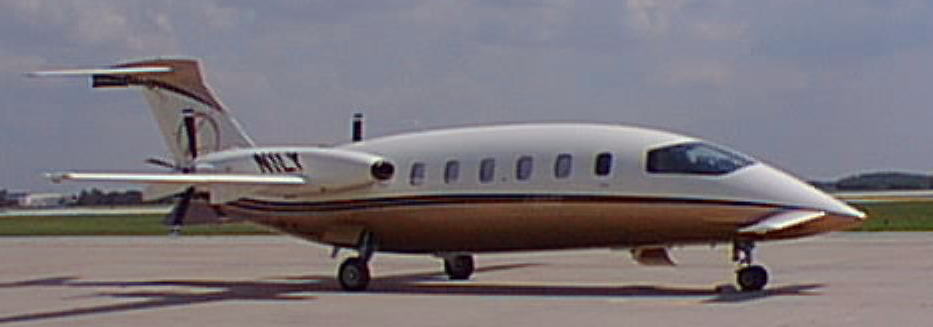
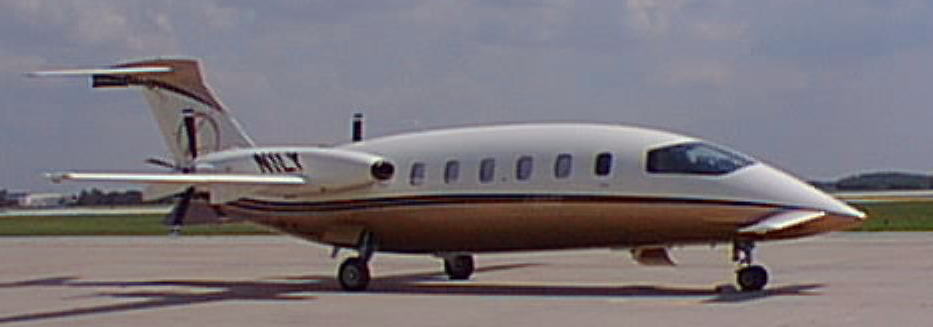
That is why the turbo prop verses biz jet argument is still
going on. Piaggio Avanti in particular is at the forefront of that
argument.
http://www.artdisk.it/proposta_piaggio/htm/piaggioaero.htm
Paul Lamar ...No rotor no motor.
The Rotary Engine NewsLetter. Powered by Linux.
ACRE NL web site.
http://www.rotaryeng.net
Copyright 1998-2006 All world wide rights reserved.