George,
I love the idea of a "pretend-jet" as you put it, but not for the
boy-wow factor -- I actually think there could be a way to make such an
airplane work quite well -- even for bigger-than-sport plane size.
Here's my idea. Please feel free to poke holes in it: (Paul I know you
don't need an invitation to fire away).
An airplane like the Diamond D-jet or Excel Sport jet weights about 5000
pounds gross, will go about 350 mph at 25,000 feet, stall at not much
more than a high-performance piston single and have a range of about
1000 miles, roughly.
These planes, although not yet certified, are a very exciting
development. I've seen the D-jet take off and climb out and it is
actually much quieter than a Cirrus, displaying the kind civilized,
confident deportment that only a jet plane can. Flying in one would be
very very comfortable, I'm sure -- what without the piston vibration,
prop blast against the windshield, etc. After seeing this baby at a
local field, I thought, "man, this is a nice way to fly." And that
"whoosh" sound...who could go back to propellers?
Call me crazy, but I think that there exists the potential to make this
concept even better using rotary power and a ducted fan. Or at least as
good, but much less expensive.
Now I'm not talking about the big ducts that we see on ducted fan small
planes, like that Optica or even Perry Mick's Long-EZ, or that nice
little Legati triangular wing job. I'm talking about a 24-inch diameter
duct at most, contained within the fuselage, as in the D-Jet and Sport
jet, and with two intake scoops on the sides.
The problem with the big ducts is not just the added drag of the extra
wetted area, but also that these huge surfaces can act like a big sail
and cause stability problems and all kinds of aerodynamic grief.
George mentioned the misconception that rotary or piston engines can
drive a duct as good as a turbine. This is indeed a misconception
because, generally this is an impossible dream. For one thing, a rotary
or piston engine is much bigger in diameter than a turbine, which can be
quite a small round cylinder making a huge amount of power for its size.
This is important because you have the engine in the center of the duct
and if your engine is big around the middle, you have to have a big
duct. You also have a lot of blockage to the air stream in the middle of
the duct where the engine is sitting. Of course the engine is
streamlined with a fairing, but even so that fairing adds quite a bit of
wetted area against which the high-speed air stream has to work.
My idea is eliminate the engine in the middle of the duct. In fact the
engine will not be in the duct at all. The duct would be incorporated
into the fuselage as on the D-jet and Sport jet, as mentioned. But the
rotary engine would be sitting ahead of the duct, inside the fuselage
proper. A short drive shaft would poke from this engine compartment into
the center of the duct and drive the single-stage fan.
All you would have inside this duct is the fan itself. There would be no
blockage whatsoever. In this regard, it is even better than a turbofan.
You would not have any of the drag of the air stream against the engine
fairing. And since the air stream is moving quite fast, this drag is not
insignificant, even with the small diameter of a turbine engine.
Also, since the duct is completely within the fuselage you have no
additional outside wetted area, no sail effect, no aerodynamic issues of
any kind.
So what about efficiency? I think it could be quite good, even compared
to a propeller plane. Don't forget that with a prop plane you have the
high-speed prop slipstream causing friction against the surface of the
plane. This causes higher drag than the parasite drag from the
undisturbed air, because the prop slipstream air is moving much faster.
This also causes some aerodynamic issues, such as the left-turning
tendency from the prop slipstream pushing against the rudder, etc.
A 24 -inch fan would result in a fan speed of about mach .75 at 7500
engine rpm, direct drive. If you wanted to use a higher rpm P-ported
engine, you could move the rpm range up a bit and use an even smaller
fan diameter. This small diameter duct would present a relatively small
wetted area inside the duct and would decrease friction drag and help
efficiency. And with no engine in the duct -- and no blockage of airflow
-- efficiency would also be improved considerably. In fact, if you
wanted to use an even smaller duct and a higher speed jet effect, you
could gear up the engine to turn the fan faster than engine speed.
Ideally, the engine would be turbo compounded for great specific fuel
consumption, as well as maintaining high power at altitude. This is in
fact something that even turbines can't do -- their power drops with
altitude.
The fuel load would therefore be considerably smaller as a ratio of
total airplane weight. The 5000 pound jets we're talking about here
carry about one third of that weight as fuel (1700 pounds or so). A
turbo compound rotary with a SFC of under .4 could do the same on little
more than half the fuel, assuming equal power. You could count on saving
at least 700 to 800 pounds of fuel weight.
Yes the engine will be a little heavier, but maybe 200 pounds at most.
The 1300 pound thrust Williams FJ33 in the D-jet weighs 300 pounds. You
could probably build a very powerful 3-rotor engine for under 500 pounds
I'm sure -- less if aluminum castings are available. So you would still
be able to have a gross weight 500 pounds lighter.
There is no reason why you could not scale this idea down to say a
four-seater with a smaller engine, or even a two-seater with a 2-rotor.
Regards,
Gordon.
This idea has some merit.
The 1300 pound thrust at sea level Williams engine is probably
developing one third of that at 30,000 feet or about 430 pounds.
TSFC (pounds burned per pound of thrust) for a small turbo fan
might be as low as 1.3 at this altitude so fuel burn would be
about 560 pounds an hour or 93 gallons
an hour. With 1120 pounds of fuel or 186 gallons on board
range at 450 MPH would be 900 miles. 4.8 MPG. Every year
at OSH I would stop by the Williams booth and ask about
the TSFC every year they would not tell me :)
At 400 MPH or 586 FPS that would be 459 equivalent thrust HP.
At 450 MPH if it will go that fast 660 FPS or about Mach .5 In
that case the equivalent thrust HP would be 516 HP net.
Rotary engine power required with a .6 eff. duct would be 860 HP.
Fuel burn at .4 BSFC (TC) would be 344 pounds per hour or 57 gallons
an hour or 8 MPG. Range would be about 900 miles with 120 gallons.
Cooling required would be a major design effort. Some of the
boost pressure would be diverted to pressurize the
cabin.
Its been done and I will upload some pictures shortly.
Paul Lamar
OK here are the pictures.
http://www.rotaryeng.net/prescot.jpg
http://www.rotaryeng.net/prescotf.jpg
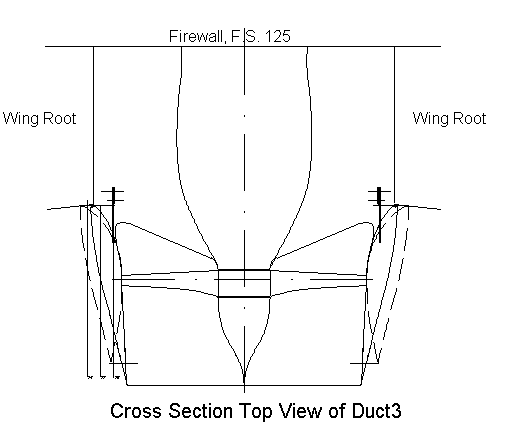
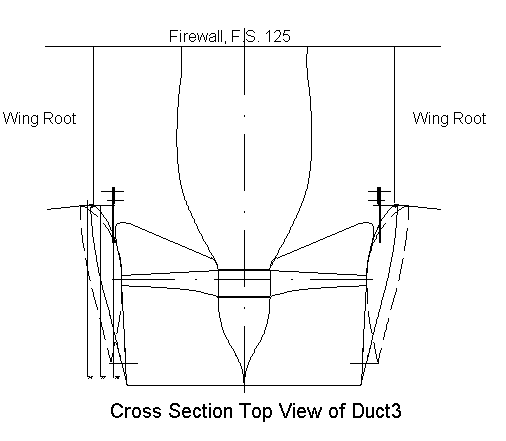
http://www.rotaryeng.net/ductfan3.gif
http://www.rotaryeng.net/Vances-Wnkpln.gif
http://www.rotaryeng.net/Vances-4p-side-v.gif
Gordon, Have you been reading my web site again? :)
--
Paul Lamar ...No rotor no motor.
Paul,
Thanks for the pictures. I have seen those on your website. The prescot
plane is similar to my concept in that the fan appears to be driven by a
drive shaft from a forward-mounted engine that's not in the slipstream.
That drive shaft housing seems rather fat, though. I would try to keep
that diameter to a minimum.
The other pictures show an engine mounted in the center of the duct as
in a conventional bypass turbofan. This is not what I have in mind. The
key to my idea is not having the engine in the fan slipstream. I believe
this will greatly improve efficiency.
You are assuming an efficiency of only .6, based on prior experience
with piston and rotary ducted fans, but these have all had the engine in
the slipstream and a much bigger duct. The engine-less duct and a small
duct diameter would reduce wetted area to a small fraction of this setup
and would give much better efficiency, since most of the lost efficiency
can be attributed to surface drag on that big wetted area.
Also we eliminate the extra surface drag on the outside of the fuselage
that we get from a propeller slipstream. With the fuselage-buried ducted
fan, the fuselage is seeing only undisturbed free stream air. So even if
our duct is not quite as efficient as a prop, we are taking a little bit
back from the decreased airframe drag.
I accept your numbers for the most part, but my figuring is based on
slightly different assumptions. For example, the turbofan in our example
will not be cruising at takeoff power setting. It will be throttled
back, especially for long-range cruise.
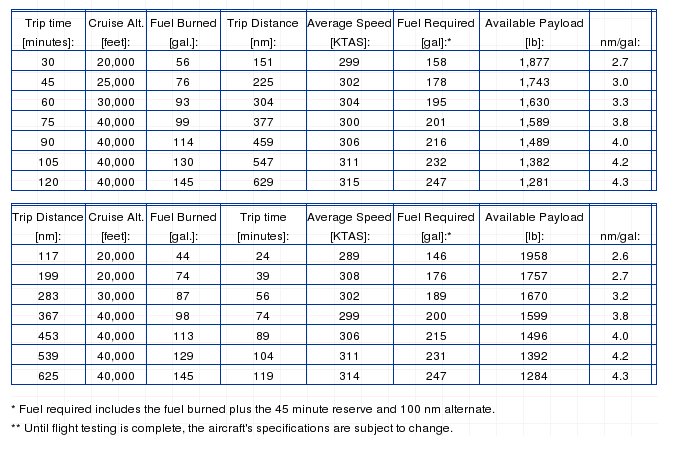
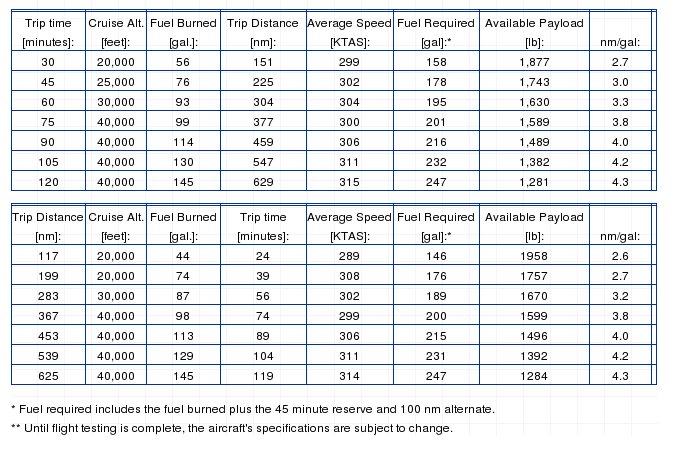
For example the D-jet specs give a maximum range of 1350 nm at a
long-range cruise of 240 knots, flying at at FL250. This gives 5.6 hours
in the air, plus the standard 45 minute NBAA reserve, presumably. With
1700 pounds of fuel on board, this translates to fuel flow of just 267
pounds per hour, or 38 gph of Jet A, which weighs about 7 pounds per gallon.
If we assume that the little Williams is getting a SFC of .7, which is
pretty much the state of art right now, that 266 pounds of fuel per hour
means the engine is making the equivalent of only about 186 thrust
horsepower.
This does sound a little low, but these are the specs that Diamond is
giving now. They are probably a bit optimistic and the plane will
probably end up with a bit shorter range, at a little higher fuel burn,
etc. Still it gives us a rough idea that it does not take a whole lot of
power to push this airplane through the air at 240 knots, or about 275
mph. At higher speeds of course, we will need more power and burn more
fuel. (The D-jet maximum cruise speed is given as 315 knots, or 362 mph.)
Still this back of napkin calculation tells me that performance like
this is probably within reach for a rotary-fan airplane of this size and
configuration -- but with better fuel burn. If we accept the figure of
200 thrust horsepower to cruise at 275 mph, and assuming a fan
efficiency of say .7, we would need 285 engine horsepower. This is at
long-range cruise power. If we assume this is about 60 percent of full
power, then our full power would be about 475 hp.
Again, I don't dispute your numbers, but you are talking about much
higher speeds.
Someone mentioned the engine-out factor and the drag of the fan in this
situation. With small diameter fan and duct, this would be minimal. With
just an overriding clutch on the fan and engine out situation, the fan
would see an air stream equal to the airspeed of the aircraft through the
air. The drag produced by the small fan would be minimal.
Regards,
Gordon.
I will play devils advocate here.
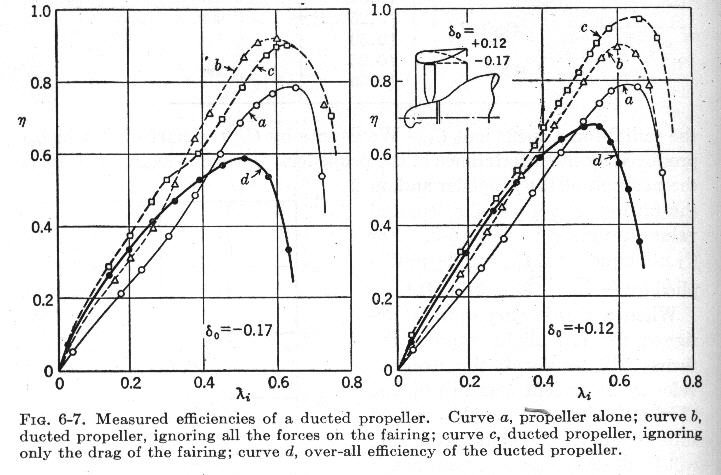
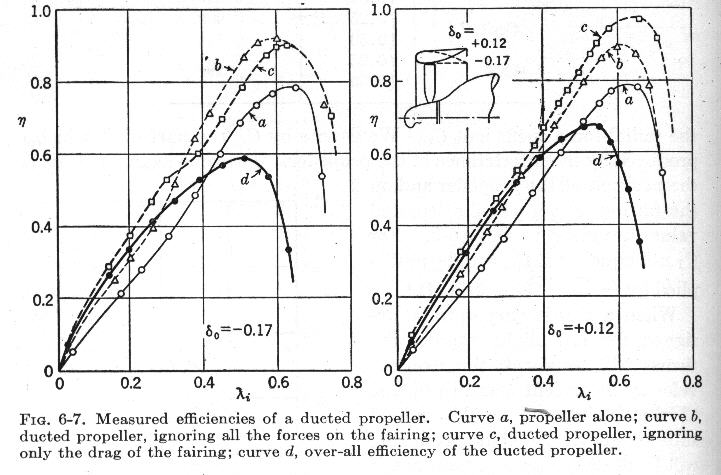
I am basing my duct eff. on Kucheman and Webers book, Aerodynamics of
Propulsion real data. Last chart.
I got bad news for you Gordon. The smaller the duct dia. the worse
the efficiency. That is the rational behind the high by pass turbo fan.
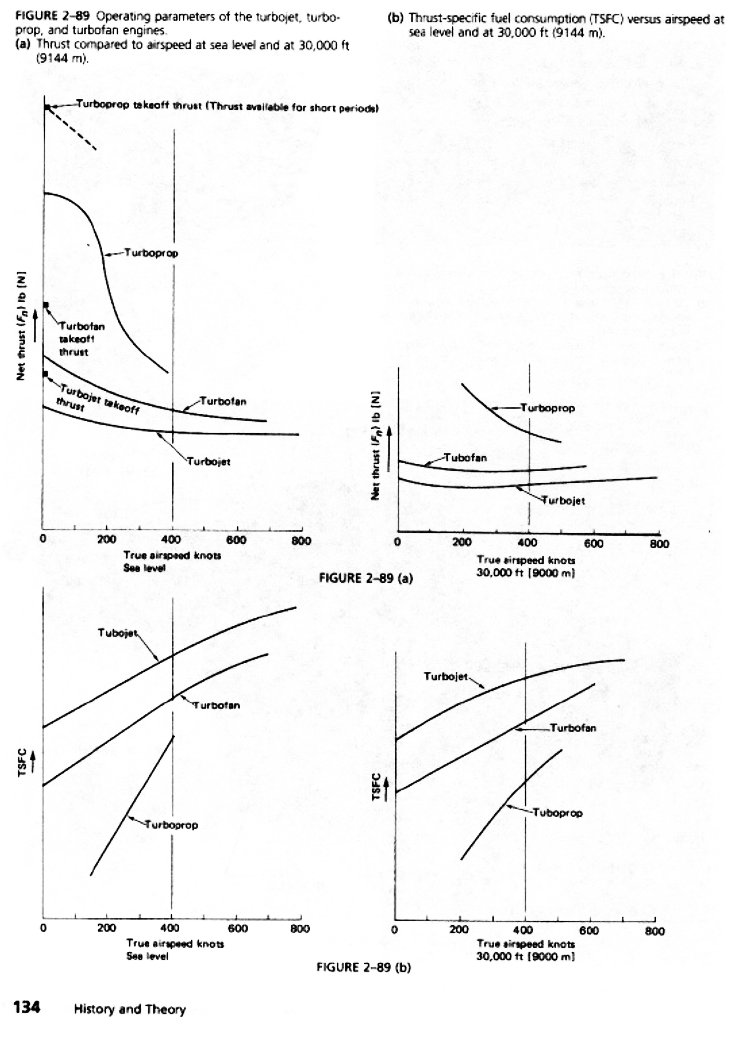
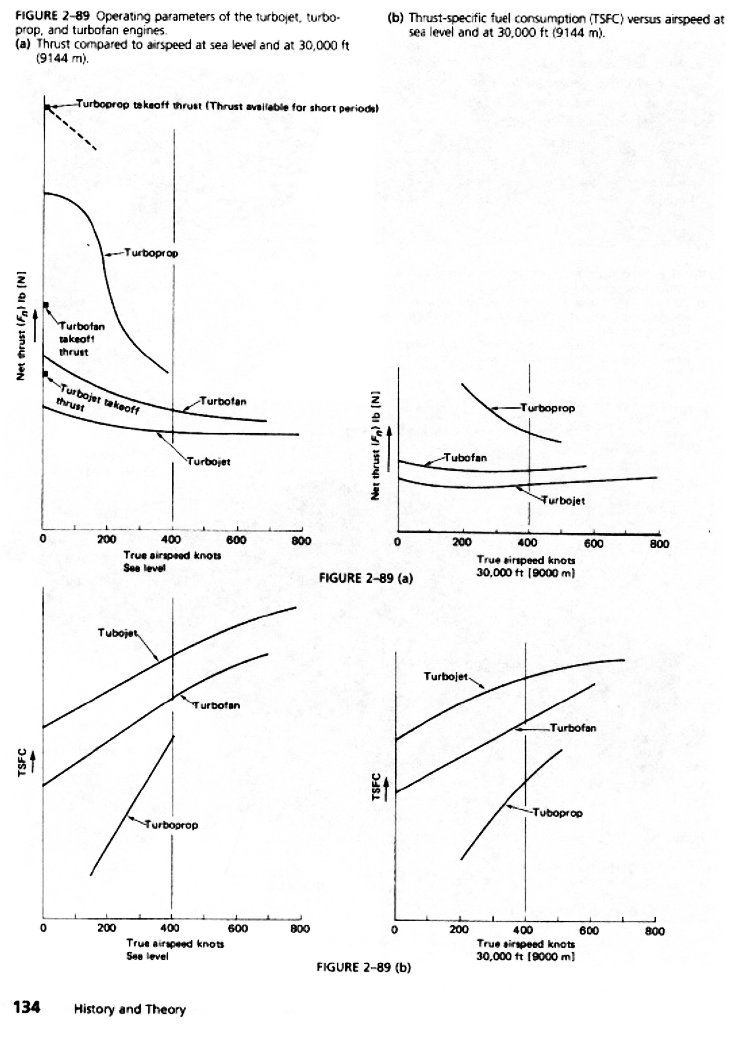
Take a look at this thrust chart. Notice the high by pass turbo fan is more efficient
through out the speed range than the pure jet. In fact the big debate now in air
liner engine design is to use and even larger fan and gear it to save fuel. The core
engines are still in the duct. Perry Mick's engine was largely out side the duct with
a long e-shaft extension. See the gif.
http://www.bridgingworlds.com/duckt.htm
The most efficient propulsion system is to accelerate the largest mass of
air possible only a little faster than the aircraft speed.
Your assumption of the .7 TSFC of the Williams is unfounded and undocumented
so far. The last chart is closer to the real world. Do you mean BSFC for the
Williams based on equivalent thrust HP? Show us your source.
One last thing. Most biz jets will fly at 40,000 feet no problem. Huge advantage when
it comes to weather and MPG. The turbo compound rotary has years to go
before it can fly at 30,000 feet.
My having said all that does not mean nobody should try it. IMHO it is a real
engineering challenge and beyond almost everyone except perhaps a large aero space
firm. Now a days the big engine manufacturers are still making significant
changes in turbo ducted fans due to the pressure to reduce air liner fuel consumption.
It is close but so is the turbo prop. People like jets for different reasons.
One is the smoothness. Two is the long TBO. Three is above the weather. Four
is the status. If you have money to buy the biz jet the cost of fuel is
inconsequential.
Paul Lamar
The Rotary Engine NewsLetter. Powered by Linux.
ACRE NL web site.
http://www.rotaryeng.net
Copyright 1998-2006 All world wide rights reserved.