Didn't the Italians fly one of those, inside the plane ducts, back
around 1938???? Karibian
You're talking about the Caproni-Stirpa. Sort of the Edsel of Italian
aircraft. It actually would fly, but the performance was pretty lame. A
few years ago people even crazier than us actually built a scaled manned
replica and flew it. Powered it with an Italian racing motorcycle
engine.
It is now retired to a Museum, much to the relief of all. Whenever I
see a
picture of this thing I keep imagining that someone offered a prize
for the
design with the least potential for development that would still fly.
Other
than that I'm completely neutral.
George W
> You're talking about the Caproni-Stirpa. Sort of the Edsel of Italian
> aircraft. It actually would fly, but the performance was pretty lame.
> A
> few years ago people even crazier than us actually built a scaled manned
> replica and flew it. Powered it with an Italian racing motorcycle
> engine.
> It is now retired to a Museum, much to the relief of all. Whenever I
> see a
> picture of this thing I keep imagining that someone offered a prize for
> the
> design with the least potential for development that would still fly.
> Other
> than that I'm completely neutral.
>
> George W
>
Had to look up that one...
thought I'd share one of the photos I found...
Harley
Looks perfectly logical to me.
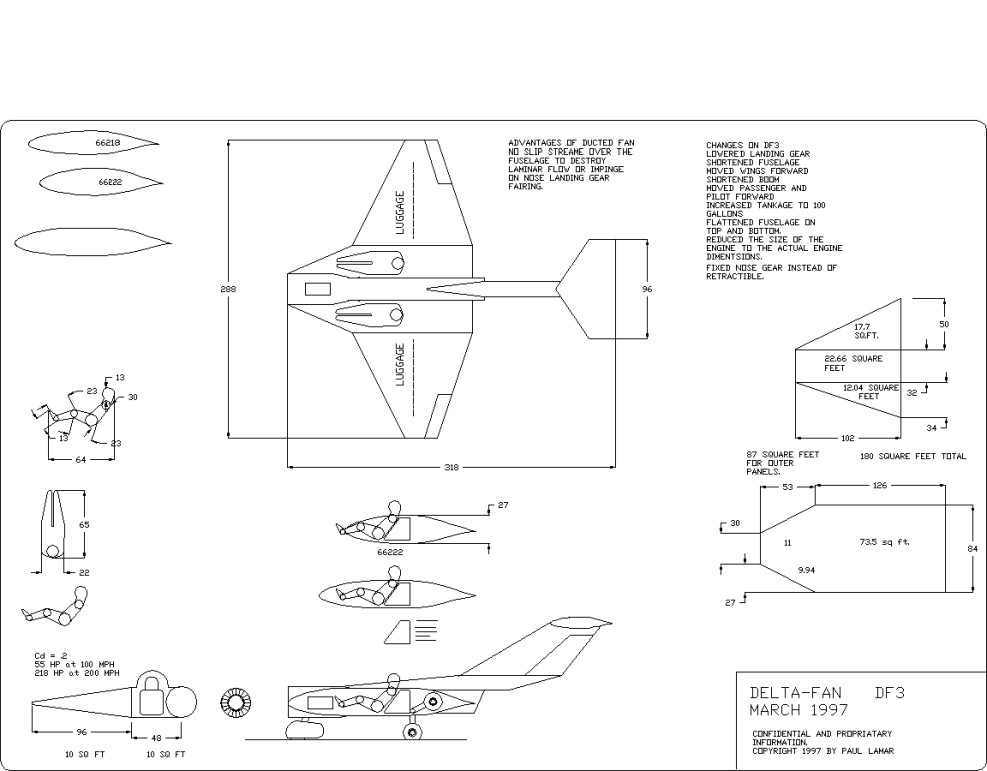
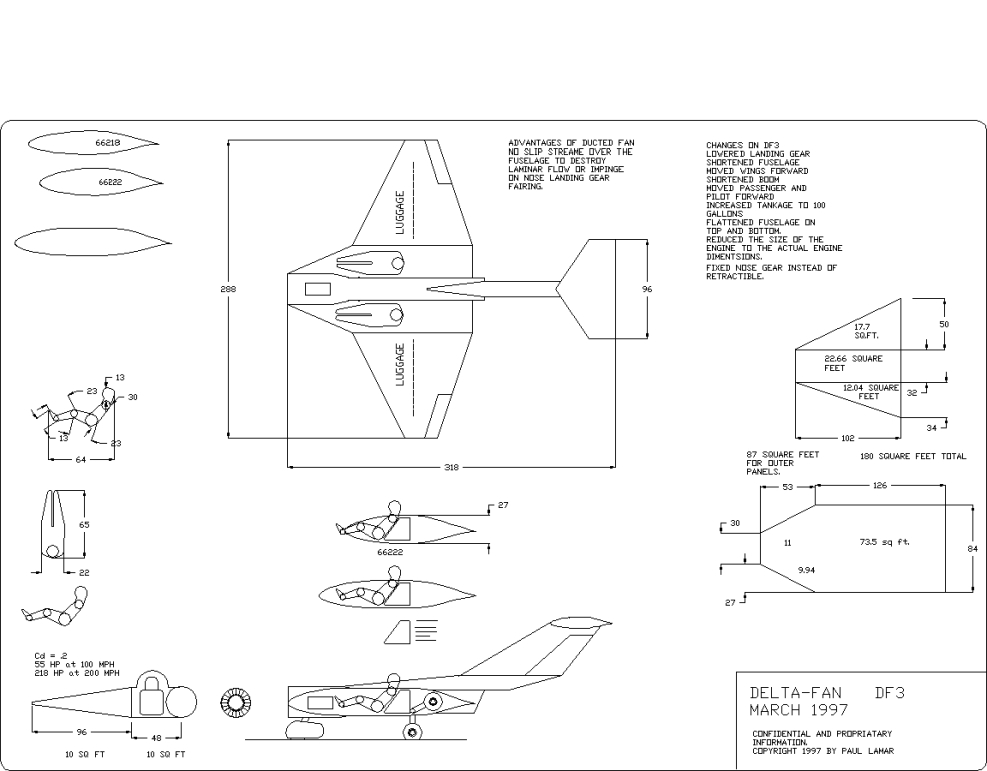
Here is one I designed that looks just like it.
It is turbo compound because the exhaust drives another
auxiliary fan in the duct.
What is wrong with this design George?
Paul Lamar ...No rotor no motor.
Paul:
Is there an easy way to get my laser printer to put out the entire width of
the drawings?
In general, I think its an interesting layout. You might get a kick out of
going to
www.luft46.com on the right menu hit "heinkel", then go down to
the project labeled He P. 1078B. You have some high powered people who
definitely wouldn't have a problem with your intake solution.
I spotted something on one of your drawings that may create a conflict of
interest, can I side bar with you in a private e-mail first? I don't think
there's a real problem, but I signed a non-disclosure with someone we both
know in 96 and I don't want to violate it. what private e-mail address can
I use? Otherwise, we can try a telecon tomorrow evening. If we don't have
a problem, I'd be delighted to go on record for my opinions (whatever
they're worth).
George W
No problem with the private email. Just put private in the subject
box. Fire away I would like your opinion. I proposed this to
Southwest Research Institute (SwRI) and they declined to help
develop it.
Send me the dwg that is causing problems to be sure I have
the right one as I can easily scale it. Here is DELTA4 scaled
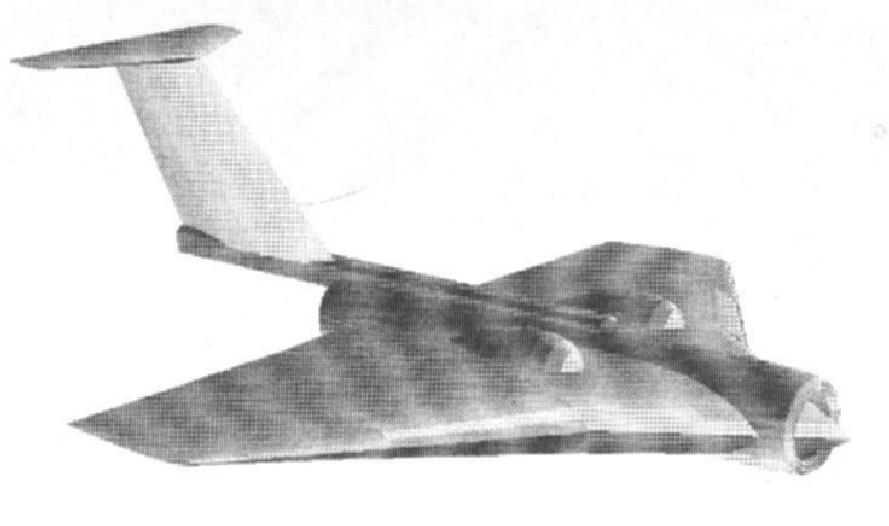
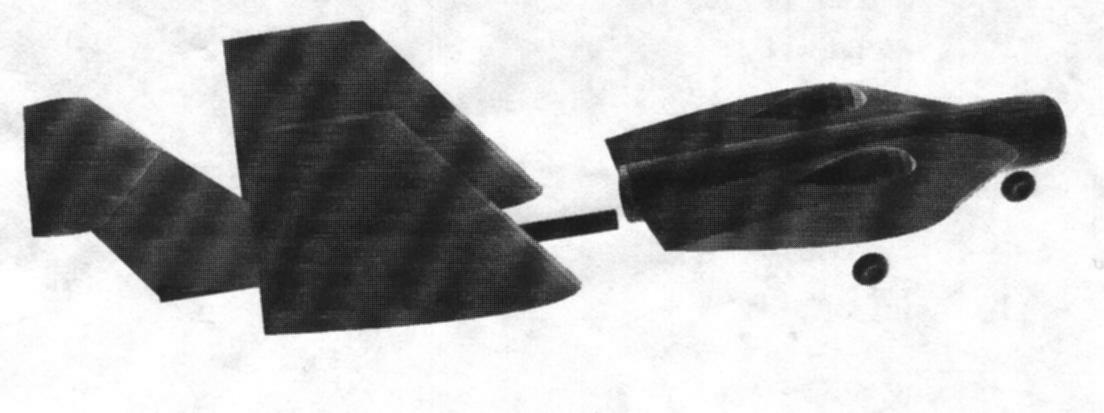
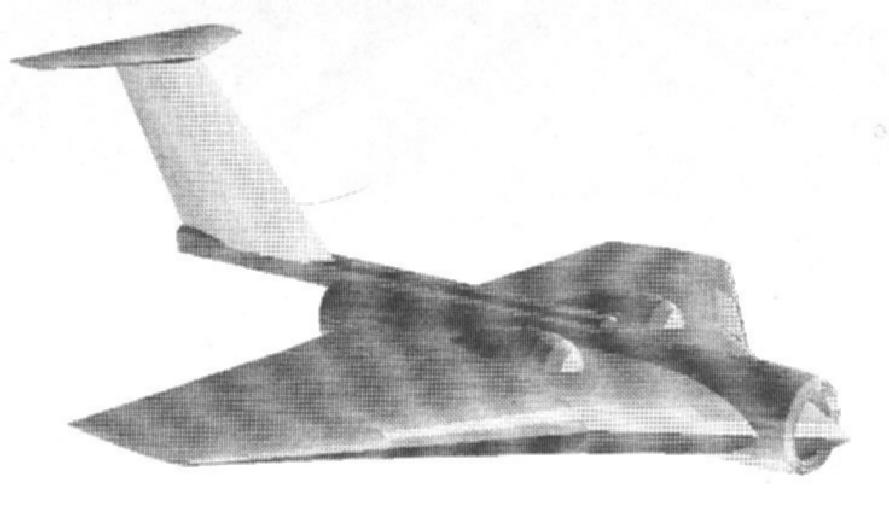
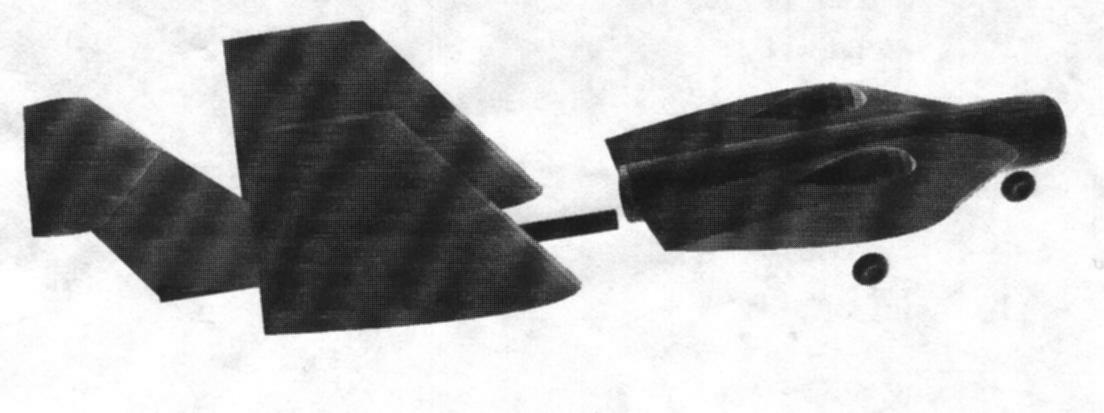
down a bit. Here too are some crude early 3D's. I can redo these
if you wish in Rhino. These were pre Rhino.
Here is the proposal text.
LIGHT AIRCRAFT IN THE NEXT MILLENNIUM Copyright 1997 Paul Lamar
Revision 6 June 29, 1997
INTRODUCTION
I have always wondered why light airplanes stopped selling in the
early eighties. The highly publicized reason is product liability.
That certainly is a factor but I think there are other factors as
well. Another reason cited is; "The price is too high!". Actually
the price is too high partly because too few light airplanes are
sold. The price of a luxury car can be as much as $100,000. Why
don't more people who live in small towns and own expensive cars
also own airplanes? They think nothing of driving a couple of
hundred miles to go shopping.
Another factor is the de-regulation of the airline industry has
drastically lowered the cost of air travel. It is now more expensive
to fly your own airplane than it is to take a commercial flight.
One on going problem in general aviation is and has been ironically
ground transportation. After someone flies a light plane to their
destination airport, there is no way to get around. Not all
airports, catering to light airplanes, have rental cars or taxis.
Rental cars or taxis at small airports can be expensive and time
consuming to arrange as well.
This situation limits the usefulness of the light plane. The utility
of the light aircraft needs to be drastically improved if they are
to become attractive in today's competitive transportation
marketplace.
A second problem is bad weather. People do not want to be stuck
somewhere because of adverse weather. There is nothing more boring
than staying in some motel room out in the middle of nowhere waiting
for the weather to get better so one can fly home or on to their
destination. People need to be somewhere at a specific time no
matter what. Perhaps it is simply to be at work on Monday morning.
I can't remember the number of times I have flown back from a
vacation and was unable to enter the Los Angeles basin. Many times I
had to park the airplane 50 miles away and rent a car to drive home.
The airplane was retrieved as soon as possible with no small
inconvenience or expense.
An IFR rating could help but not all pilots want to obtain or
maintain an IFR rating. It is difficult for non-professional pilots
to stay IFR current. Sometimes the weather is so bad even IFR is out
of the question.
We believe the local transportation issue, adverse weather factors
and the low price of reliable air travel on commercial airlines
has discouraged the use of light planes for medium distance
transportation and hence their sales.
Another need in the light plane industry is some exciting looking
new airplanes. We don't want to design something that looks just
like our grandfather's airplane. We need a radical looking aircraft
that engenders, interest, excitement and a desire to own. That is
why people spend large amounts of money on exotic cars.
OVERALL CONCEPT
In what ways can the light plane industry address these problems?
The local transportation issue has been addressed in the past by
several attempts at designing and manufacturing flying cars. All
attempts have failed. We believe the advent of carbon fiber
composites and other technical advances, with the help of clever
innovative design could make this dream achievable. The reality
is; new technology sometimes make old ideas possible, however one
must be careful when marketing these ideas least one be labeled
eccentric because of past failures.
Past attempts at flying cars have either used a heavy and costly
separate engine or heavy transmission components to power the
wheels. These are some of the reasons flying cars have failed in the
past. An overall systems approach is called for. Fundamental to our
systems approach is do away with these drive methods which will save
weight and cost. Instead we will use the aircraft's primary
propulsion system to power the ground vehicle mode.
By the way it is important to understand that it is not intended
that this device takeoff from roads or streets. This would create
legal and safety problems. All takeoffs and landings are intended to
be made from existing airports. This vehicle is designed to be
ninety percent aircraft and ten percent car. It is not intended to
be driven hundreds of miles at a time on the freeway.
Obviously an aircraft propeller in an environment where pedestrians
could be found is out of the question for safety reasons. That
leaves either the turbo jet or the ducted fan. The turbo jet is
also out of the question because of noise and hot jet blast. It is
the ducted fan that makes this concept possible and unique.
THE AIRCRAFT SYSTEM
What we suggest is a low aspect ratio, thick, wing/fuselage with
central ducted fan. See figure one. Thick wing/fuselage's do not
make the most efficient light aircraft however they can look more
like a car with their wings removed. They have high internal volume
and low bending and torsional stresses. Bubble cockpits for pilot
and passenger can be located on either side of the central duct.
The overall look when the wings are removed for ground transport
mode will be of a personal flying saucer or magic carpet that is
low and wide.
A more conventional looking four passenger design would use twin
engines and twin ducts on either side of a conventional cabin. It
would be safer than conventional twins as the thrust lines from each
engine would be closer together then if propellers were used.
THE ROAD VEHICLE CONFIGURATION
The road configuration is a three wheel car because the conventional
aircraft tricycle landing gear does double duty. Fortunately three
wheel vehicles are considered motorcycles by the Department of Motor
Vehicles. As such it has certain crash worthiness and emissions
dispensations not accorded four wheel automobiles.
Obviously the wing span would have to be limited to a legal eight
feet unless the wings are made removable. I suggest an overall span
of twenty four feet using eight foot span outer wing panels.
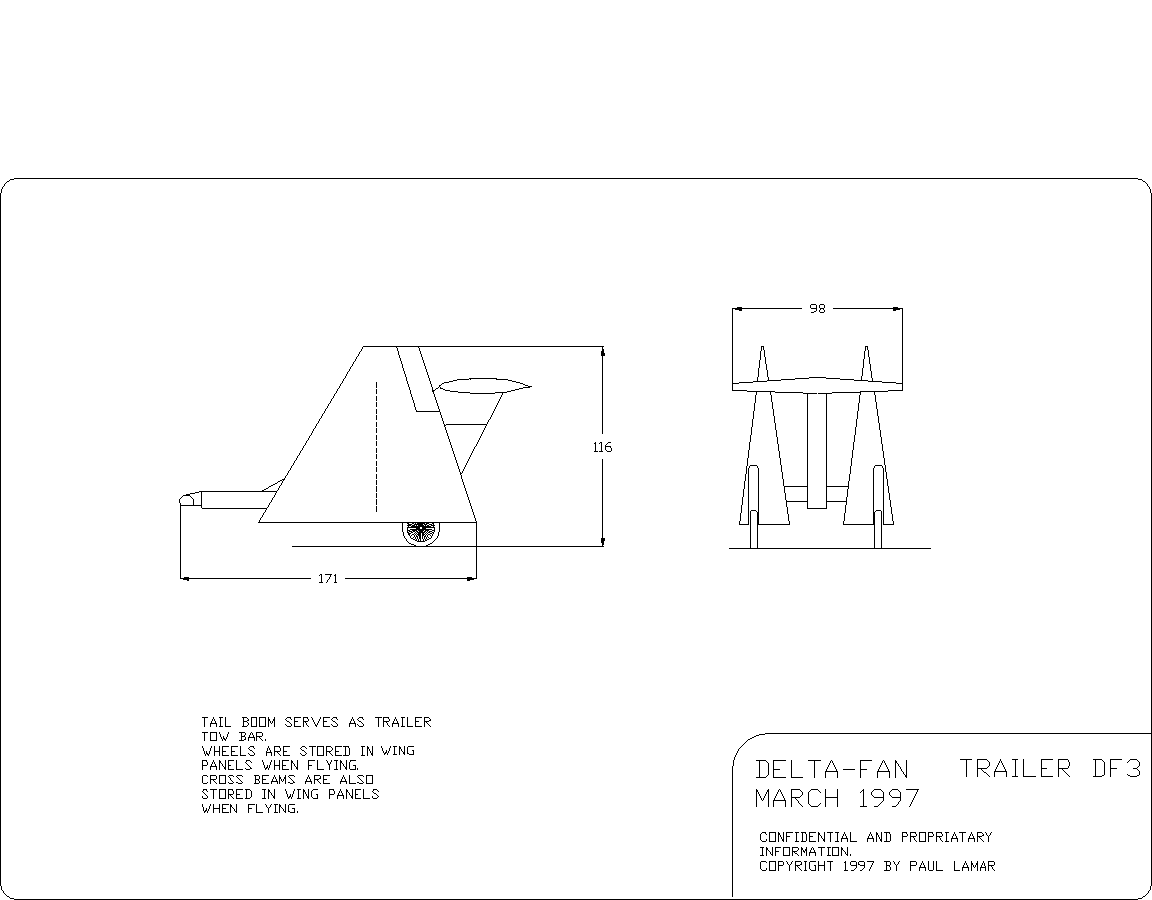
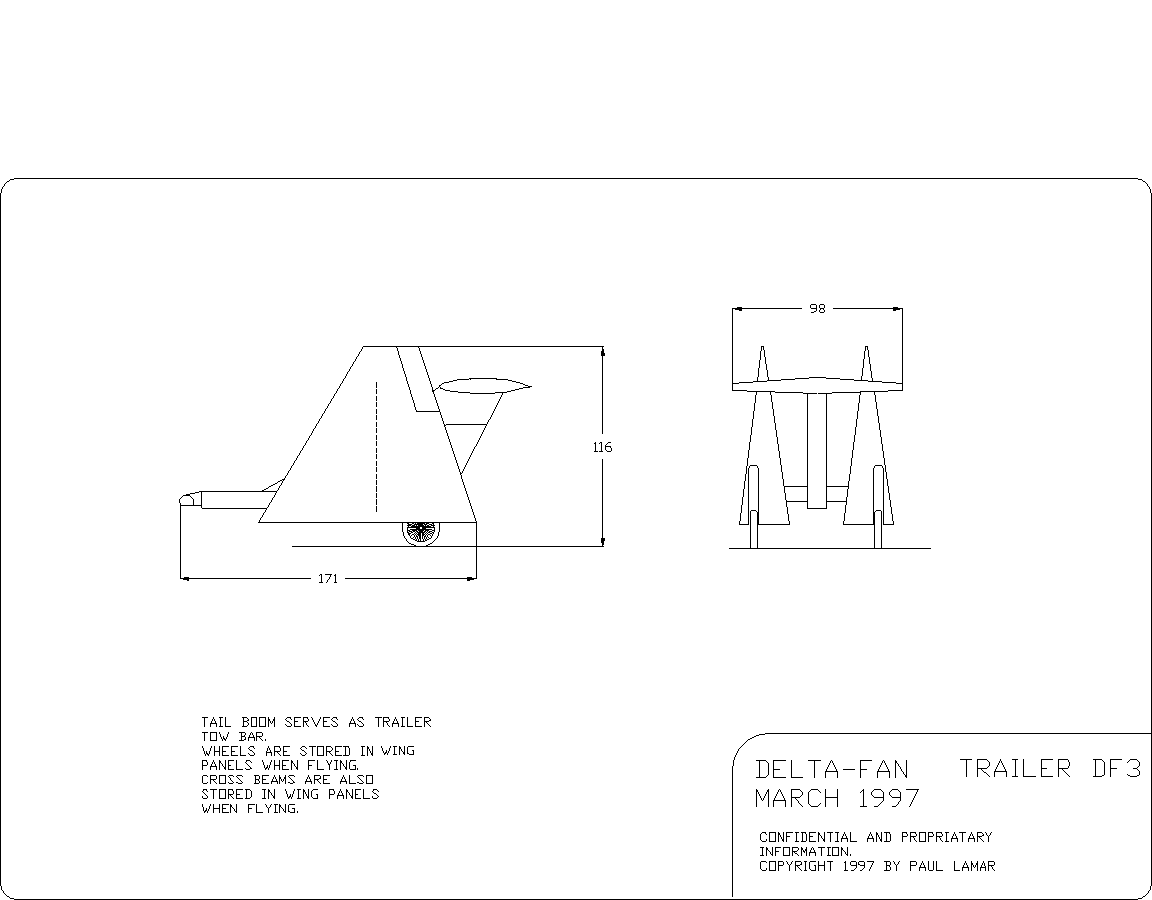
These can be removed quickly along with the tail boom and tail and
either left at the airport or towed to the new destination airport
with built-in trailer wheels.
With the wings removed the width of the resulting three wheel
"motorcycle" would be seven and a half feet. This width for a ground
vehicle is not that unusual as the AM General Hummer sport utility
vehicle is eighty seven inch's wide. Many motor homes and trailers
are also eight feet wide.
Since the rudder and elevator are attached to the tail boom they
will normally be left at the airport and the resulting vehicle will
look more car like than if it had a large rudder and elevator. The
landing gear will be designed to lower the motorcycle in road going
mode. The expensive part of the airplane can be stored at home in
the garage lowering the cost of owning an airplane and enhancing its
life compared to an airplane tied down outside.
This last transport mode can also be used to avoid inclement weather
along the desired route of flight. This advantage cannot be
overestimated as many pilots and passengers have become very
discouraged with private flying after having experienced severe
inclement weather conditions. Weather fronts are seldom more than
one hundred miles wide. The wings and tail boom can be removed and
the vehicle driven through the front. On the other side of the front
the parts are attached at the nearest suitable airport and the
vehicle is flown on to its ultimate destination. Thereby this
feature will remove the weather anxiety factor. This airplane will
be safer overall than other light aircraft configurations with its
capability to avoid severe weather and still get there in a timely
manner.
THE DUCTED FAN
An advantage of the ducted fan is; low cost mass produced high speed
auto engines can be used without heavy and costly prop speed
reduction gear boxes.
The on going problems with the ducted fan has been efficiency. The
overall efficiency of the ducted fan propulsion system can be
improved by recovering some of the waste heat in the exhaust of the
IC engine. No breakthroughs in aerodynamic efficiency of the fan
itself are required. As much as fifty percent of the total energy in
the IC engine's fuel is normally wasted in the exhaust. If the
ducted fan system is configured properly, with the right engine, we
believe overall propulsive efficiency can be improved.
The key to recovering the waste cooling energy and exhaust energy is
place a small frontal area engine in the duct behind the fan and use
a fan/turbine to recover some of the waste heat energy. See figure
two.
Air blown over the engine will help cool the engine. Coolant
radiators partially placed in the long duct will cool the engine
better at low speed high power conditions such as found in the climb
phase of flight. The duct walls could also be configured as surface
radiators.
Air intake for the fuel injected engine can face the back of the fan
thereby developing a mild super charge effect.
The largest energy recovery will come from the waste heat in the
exhaust directed through a fan/turbine. Approximately as much as
fifty percent of the energy in the fuel is lost in the exhaust.
Hopefully the overall thrust efficiency will be as good as a
conventional reciprocating engine and propeller combination.
THE ENGINE
The engine of choice is the Wankel type rotary.
The over riding advantage of a Wankel type rotary in this
application is it's small frontal area. See figure three.
The Mazda rotary engine is also the only automotive engine with a
power to weight ratio comparable to that of a real aircraft engine.
The engine is robust and very simple with no camshafts to wear or
valves to burn and leak. It is also low cost compared to a real
aircraft engine. It burns no-lead auto fuel and leaded 100LL
aviation fuel equally well with no problems because it has no poppet
valves. This of course is necessary in both road and flying mode.
The ability to remove the wings and drive into town to refuel also
means low cost auto fuel is more practical to burn as many gas
stations are always open and readily available.
This engine is not the most efficient IC engine at the moment but it
can be improved if converted to a high speed diesel configuration.
Some work along these lines has already been done by the John Deere
company. The advantage of a diesel are of course its ability to burn
Jet A.
Ironically the inefficiency of the gasoline fueled Wankel could be
an asset in this configuration as this very inefficiency is manifest
as extra heat in the exhaust. Wankel's are also known for high
levels of un-burned fuel in the exhaust. Additional fresh air from
the duct could be introduced into the exhaust pipe to recover this
potential heat and lower emissions by burning the normally wasted
fuel.
A variable area duct nozzle should be investigated.
This system arguably could be called a marriage of the turbofan
and internal combustion engine. Turbo-combustion-fan? Or,"TICEF"
Turbo Internal Combustion Engine Fan?
If an air-cooled dedicated Wankel rotary engine is designed the
system can be further simplified.
A scaled down twin duct, single pilot version could be built around
air-cooled two cycle ultralight engines.
SUMMARY
All of these ideas are mechanically simple, low cost, low technical
risk and light weight. Never have all these ideas been combined in
an car/airplane before.
This transportation system will not be the most efficient airplane
nor the most efficient road vehicle but it will be the only and most
efficient flying road vehicle.
Paul Lamar ...No rotor no motor.
The Rotary Engine NewsLetter. Powered by Linux.
ACRE NL web site.
http://www.rotaryeng.net
Copyright 1998-2006 All world wide rights reserved.