Paul,
Ive given the question of ducted fan efficiency a little more thought
and have come up with a rough cut of what kind of efficiency we might
reasonably hope to achieve from a personal jet type airplane
comparable to the Diamond D-jet, but powered by a rotary engine and
buried ducted fan instead of a turbofan engine.
It is a simple fact of physics that a small ducted fan cannot hope to be
as efficient as a large fan or propeller: In order to get the same force
(thrust) from a small diameter stream tube (small ducted fan) as a large
diameter stream tube (large fan or propeller), the small stream tube has
to be accelerated to a greater speed. This principle was first
articulated in Newtons Second Law of Motion, which tells us that force
is the change of momentum of an object in time. (See attached graphic.)
Since momentum is mass times acceleration, and acceleration is
difference of velocity over time, we find that a smaller mass needs
exponentially more acceleration to produce the same amount of force. In
order to produce this increase in acceleration we have to expend more
energy or power.
We are all in agreement on this. The big question is: How much more
power? In other words, how much extra engine power does it take to make
the same amount of thrust with a smaller stream tube? If it takes twice
as much power, then our efficiency with the smaller stream tube is going
to be at a huge disadvantage. Even if it takes 30 percent more power, it
could be unworkable. But if it takes only 10 to 20 percent more power,
then it is not so bad.
What were going to do is figure out just how much efficiency we are
losing by comparing a 72 inch stream tube to a 24 inch stream tube. We
will calculate the efficiency of each making the same amount of thrust.
We are using the D-jet as a benchmark, so we will use its cruise speed
of 240 knots at 25,000 feet and cruise thrust of 330 pounds, which we
calculated earlier based on its fuel burn and thrust-specific fuel
consumption.
We will leave aside for the moment the fact that the small stream tube
will be enclosed in a duct or shroud in the actual airplane. We will see
later that an enclosed propeller or fan is actually more efficient than
an open prop of the same size, but for now lets compare apples to
apples, since all we want to do is find the difference in efficiency
caused by the smaller stream tube diameter. I should note that the actual
fan diameter of the D-jet is 17.3 inches, but we are using nice round
numbers that make the comparison easier.
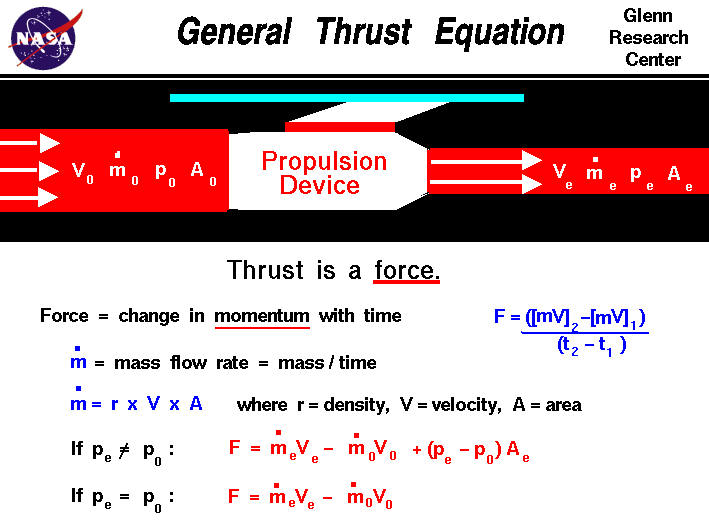
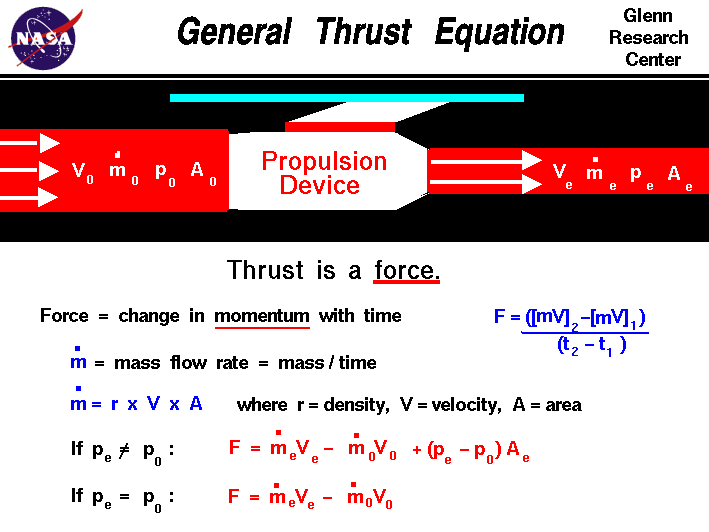
We start with simple momentum theory, which tells us that the amount of
thrust depends on the mass of air flowing through the propeller and the
change in velocity of that air mass imparted by the propulsion system.
From this we get the general thrust equation seen in the attached graphic:
Thrust = (mass flow * exit velocity) (mass flow * free stream velocity)
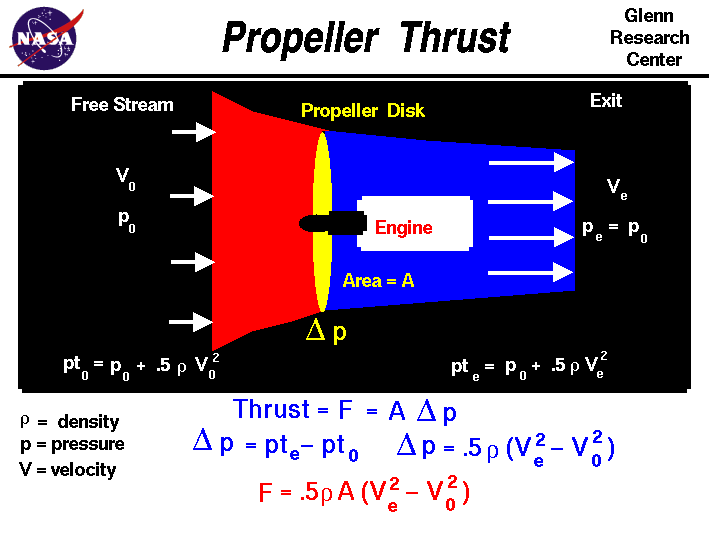
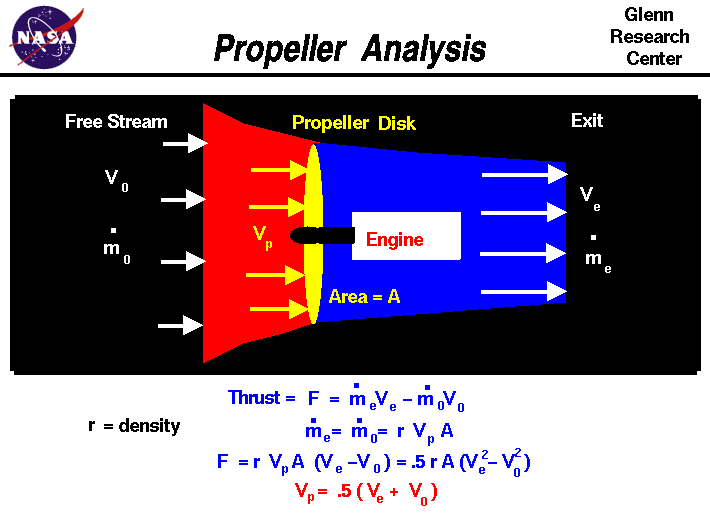
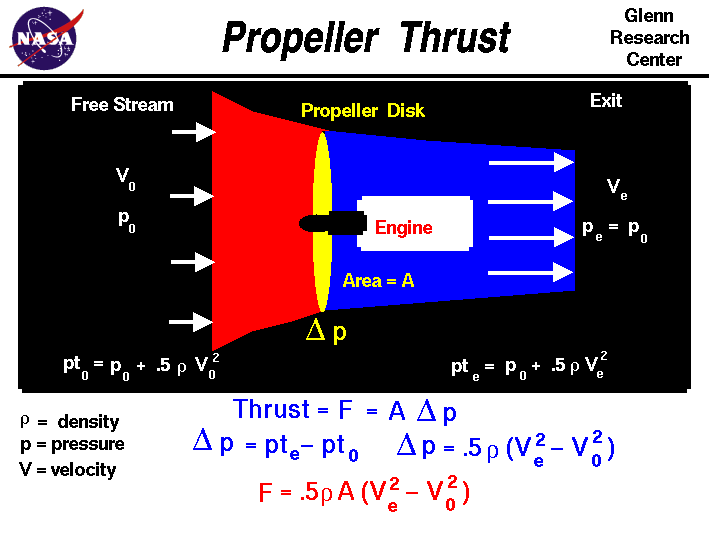
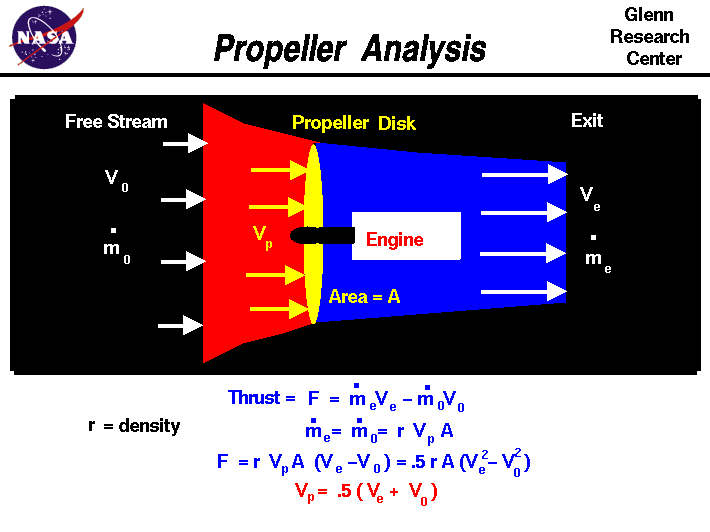
In order to relate this equation to a spinning propeller, which moves
air on the basis of differential pressure created by its airfoil blades,
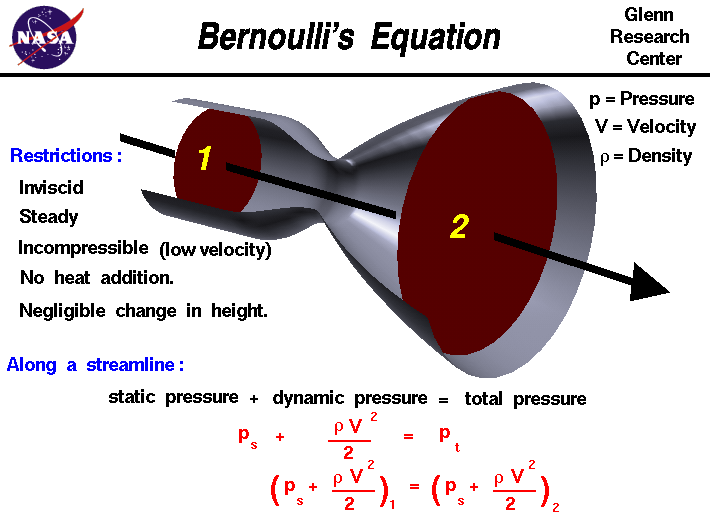
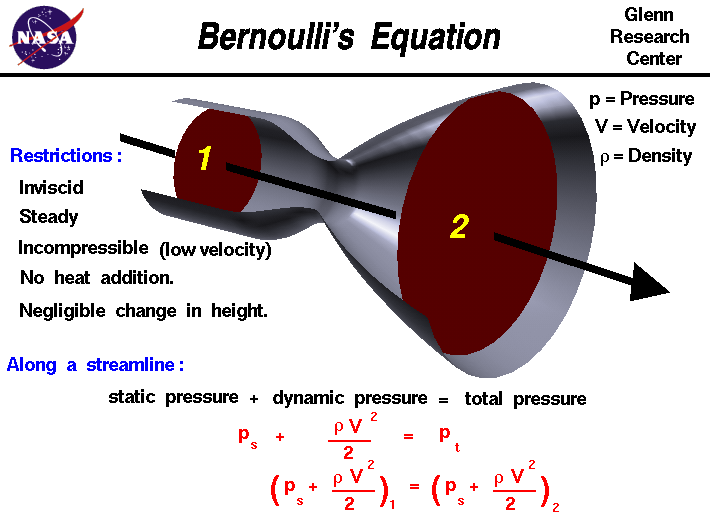
we need to bring in Bernoullis theorem, which we can apply to the air
in front of the prop and the air behind the prop. See attached graphics
on propeller thrust. Our thrust equation then becomes:
Thrust = 0.5 * air density * disk area * [exit velocity squared
free stream velocity squared]
By looking at this equation we quickly see that if we know the thrust
and the free stream velocity (aircraft speed), we can solve for the exit
velocity. Since we know the D-jet is flying at 240 knots, or 405 feet
per second and making 330 pounds of thrust, we have everything we need
to solve for exit velocity. Once we know exit velocity, we will know how
much the air has been accelerated to create the given thrust and we can
then calculate our propeller induced efficiency, which, like induced
drag, is a measure of how much efficiency we are losing in order to move
the air.
So using the above equation for our 24 inch prop, with V = 405 fps, F =
330 lb, r = air density of 0.00105slugs/cu-ft :
F = 0.5 * r * A * [e^2 Von^2]
We get:
330 = 0.5 * .00105 * 3.14 * [e^2 164025]
330 = 0.001649 * [e^2 164025]
200080 = e^2 - 164025
e^2 = 364105
So e = sqrt (364105) = 603 fps
The exit velocity of the stream tube on our 24 inch prop is 603 fps, at
our aircraft speed of 240 knots at FL250 and 330 pounds of thrust. We
are leaving aside practical considerations like where we would mount
such a small propeller such that the airframe would not block its
operation on the roof perhaps?
For our 72 inch prop, with V = 405 fps, F = 330 lb, r = air density
0.00105, exit velocity is calculated:
330 = 0.5 * .00105 * 28.27 * [e^2 164025]
330 = 0.0148 * [e^2 - 16405]
22234.5 = e^2 - 164025
e^2 = 186259.5
e = 431.5 fps
So our 24 inch prop needs to be accelerate its stream tube to 603 fps,
while the 72 inch prop needs to speed up the air flowing past by just a
very small amount above free stream speed: 431 fps.
Now that we know how much more the small stream tube is being accelerated
to make the same 330 pounds of thrust, we can compare the two in terms
of induced efficiency. The energy required to accelerate the stream tube
is the mass flow rate times the square of the velocity in the
stream tube, which is the rate of kinetic energy increase:
With the airplane flying at 405 fps, the stream tube increase
for our two props is:
1. v = 198 fps
2. v = 26 fps
The increase in momentum is:
1. V * v = 405 * 198 = 80190
2. V * v = 405 * 26 = 10530
The increase in kinetic energy is:
1. [(V + v)^2 V^2] * 0.5 = [(405 + 198)^2 405^2] * 0.5 = 99792
2. [(V + v)^2 V^2] * 0.5 = [(405 + 26)^2 405^2] * 0.5 = 10868
To get induced efficiency we simply divide the increase in momentum by
the increase in kinetic energy:
1. 80190 / 99792 = 0.80
2. 10530 / 10868 = 0.96
So we see that our big prop has an induced efficiency of 96 percent,
while our small prop has an efficiency of just 80 percent. It should be
noted that this result is an upper limit; actual induced efficiency will
always be less due to aerodynamic losses from the prop blade and other
factors we are not taking into consideration here.
But this does show clearly what the difference in efficiency is between
a six foot disk and a 24 inch disk making the same amount of thrust
about 16 percent. Stated another way, our 24 inch prop is about 83
percent as efficient as the 72 inch prop (80 / 96 = 0.83). This is not
bad. Yes, the small stream tube is always going to be at something of an
efficiency disadvantage, but it is not as bad as we might at first imagine.
And remember this is at 25,000 feet at a very low air density. At lower
altitudes and greater air density, the difference between the two
converges. At sea level density, the efficiency of the small prop is
less then 10 percent behind the big prop. (No need to go through the
arithmetic again here, but I have calculated it, using sea level density
of 0.00237 slugs/cu-ft.)
So what does this mean in the real world? We know that overall prop
efficiency for a good constant speed prop is about 85 percent. That
means our small fan could achieve an overall efficiency of 85 * 0.83 =
70 percent.
This is much higher than the 60 percent figure at all altitudes that I
used in my earlier analysis. This kind of efficiency would change the
entire performance envelope of this airplane. To cruise at 240 knots at
FL250 would require just 340 hp, compared to 415 at the lower fan
efficiency of 60 percent. This is a huge difference. It means we could
use a 3-rotor engine, instead of a 4-rotor and save 100 pounds of engine
weight, maybe more.
Our fuel burn would decrease significantly too -- by about 25 percent at
sea level and lower altitudes. At our cruise altitude of FL250 and speed
of 240 knots, our 70 percent fan efficiency would give us a fuel burn
of just over 130 pf, well below the 160 pf it would take at 60
percent fan efficiency. Our fuel load could be reduced by a like amount,
reducing our gross weight by about 200 pounds, plus the 100 pound
lighter engine for a net weight drop of about 300 pounds.
We can quickly see that a plane like this could be a very efficient and
viable performer in all respects: range, cruise, climb, comfort, etc.
There is actually much more ground to cover in this discussion of ducted
fan efficiency that I will get to in a later post. I will just say that
the 70 percent figure arrived at here can actually improve considerably,
when we take some other factors into account.
Regards,
Gordon.
The Rotary Engine NewsLetter. Powered by Linux.
ACRE NL web site.
http://www.rotaryeng.net
Copyright 1998-2006 All world wide rights reserved.