Gordon, take a look at this.
http://www.connel.com/freeware/airduct.shtml
This is what you input
Flow Rate 20000 CFM
Velocity 12000 FPM
Pressure 14.7 PSI
Temperature 75 F
Duct length 4 FT
Duct Roughness 0.0001 FT
These are the results
The duct diameter is: 17.48 inches
The air density is: 0.0742 pounds per cubic feet
Reynolds Number = 1779111.80
Friction Factor fa = 0.01235369
Friction Factor f = 0.01231736
loss PSI = 0.01082625
loss inches of H2O = 0.29997373
Paul Lamar ...No rotor no motor.
That's an HVAC (low velocity) calc--are you sure it's accurate at higher
flow/velocities?
Donald Willard Garrett
No I am not sure as the equations are not shown.
I did enter 12000 FPM which is 200 FPS or 136 MPH.
It calculated the duct size rather than inputing
the duct size which is rather strange.
--
Paul Lamar ...No rotor no motor.
Paul,
My comparison of efficiency of a 24 inch prop and a 72 inch prop is
comparing a freestream prop to a freestream prop, not a duct.
I explained that this was so we could compare just one factor, the
induced efficiency. In other words, we are concerned for the purpose of
that exercise only with how efficient, in terms of kinetic energy, a
small prop is versus a big prop.
I will get to the issue of duct efficiency and drag in my next post.
There is some very interesting stuff there. It's not just a matter of
the duct having a downside because of drag.
Also, your formatting scrambled all my math, taking out all the minus
signs and some other stuff as well. Anyone trying to work through it
will get nonsense results. Can we put up the math in proper form, in
case someone wants to do their own calculations?
Regards,
Gordon.
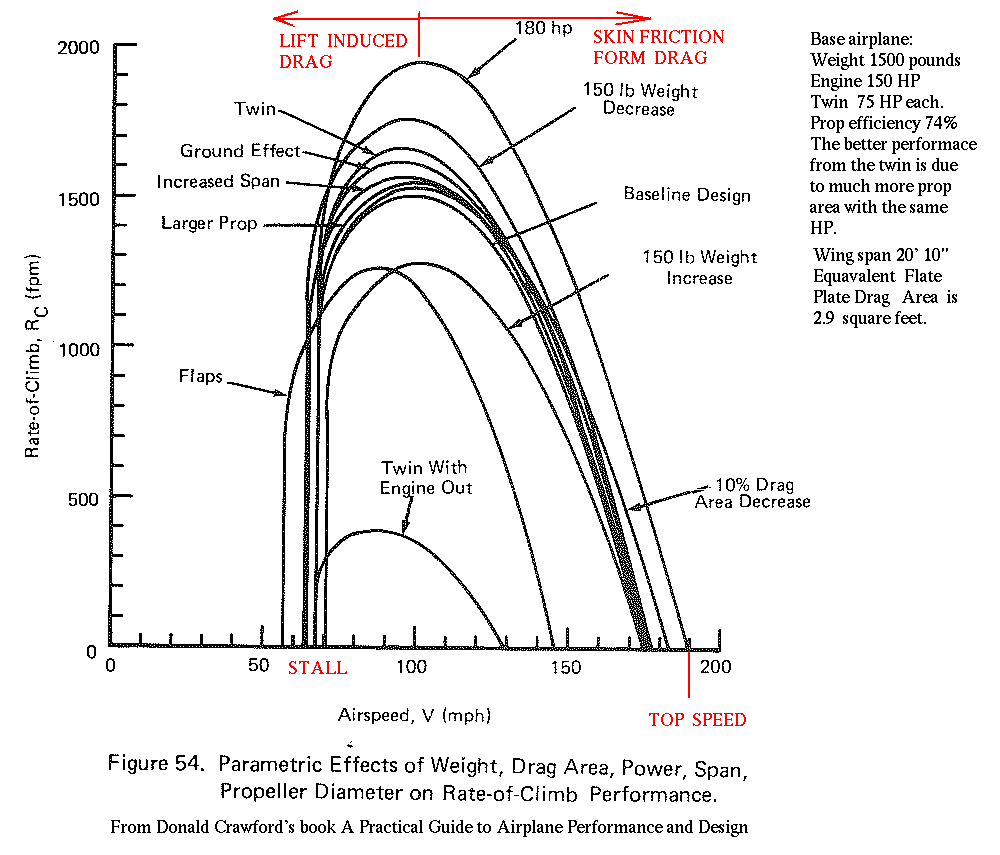
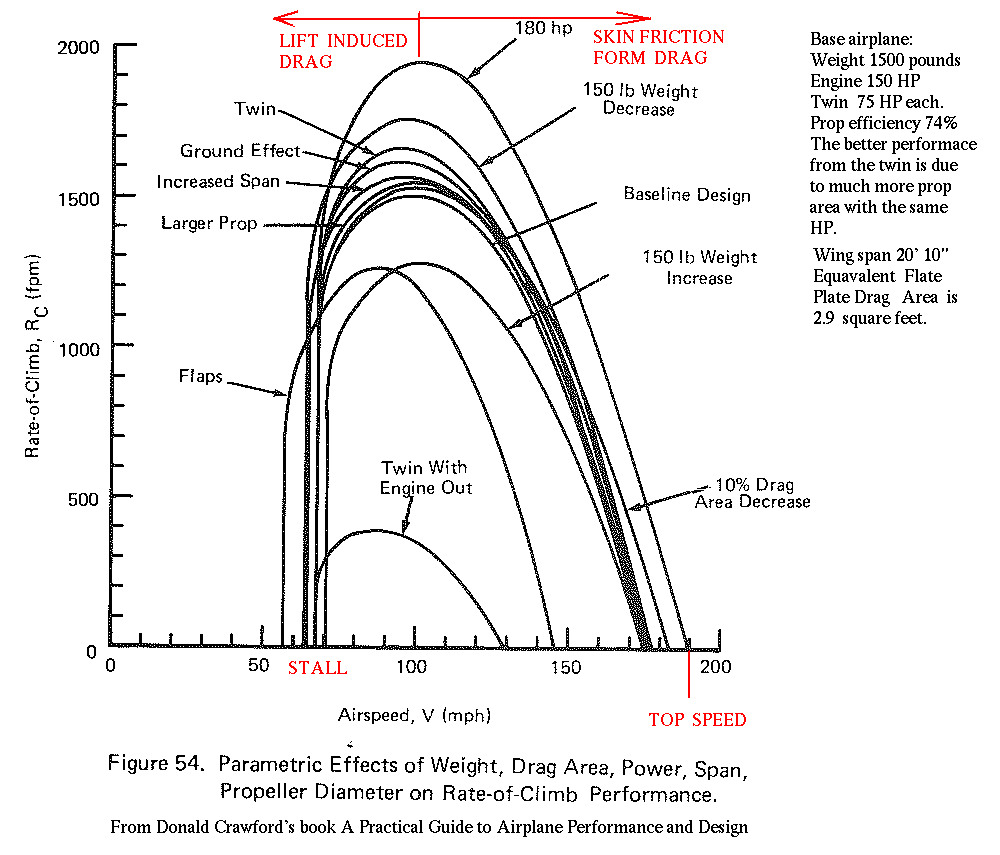
You can double check your calculations with the
single verses the twin with this chart as the twin has
more prop area. Note it only helps the climb.
The duct is the problem with its internal skin friction
drag. It is also a 3D problem as the air is whirling
around inside the duct. The density of the air on
the outer inner wall is higher than the density of
the air near the core.
Paul Lamar ...No rotor no motor.
The Rotary Engine NewsLetter. Powered by Linux.
ACRE NL web site.
http://www.rotaryeng.net
Copyright 1998-2006 All world wide rights reserved.