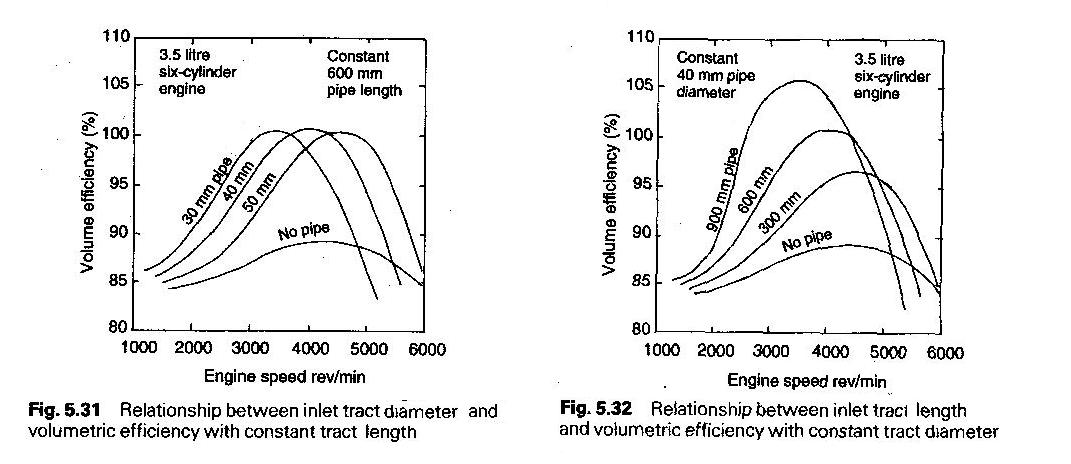
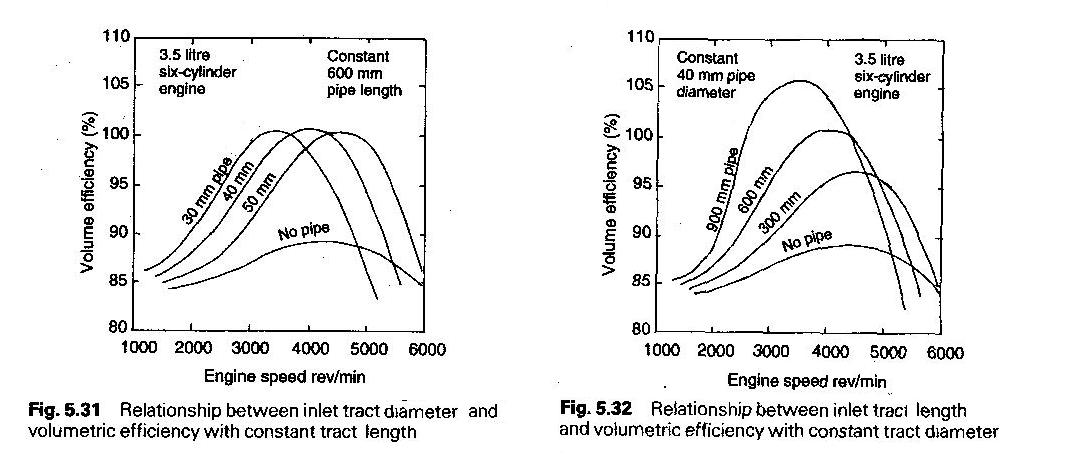
This 1984 info is obsolete of course as the 1991 Lemans
engine was entirely different. The next three charts are
for the Lemans engine config. The pipe lengths shown here
are in addition to the fixed length of around 17 inches.
The diameters of the pipe are around two inches.
We came pretty close to duplicating the Lemans p-port engine
results with a Weber carb on the Mazdatrix dyno.
Torque peak is not only a function of pipe length
but also a function of diameter as shown in the least chart.
Perhaps something to due with Helmholtz theory.
Paul Lamar ...No rotor no motor.
Paul,
Can you explain the short intake runner length numbers here with the
dyno data you provided earlier concerning the Weber 58mm carburetor-
they seemed to imply that longer runners, between 24" and 28", are
preferred for operations near 6000 rpm, not the 14" used here?
One more question: Im leaning towards using a throttle body, but,
assuming 4 long runner tubes, as for a 4-port Renesis intake design, do
you feel your slide throttle still a viable option or will it be too
long physically? Any thoughts to an engine-perpendicular moving slide
orientation instead of parallel to the engine?
Mike Parker
My best guess is it was a much smaller engine (2 L) than the 13B
(2.6 L) so the runner diameter was probably much smaller. According
to this chart the smaller the runner the lower the torque peak so
to move the torque peak back up one must shorten the runner.
This is not to say the torque is optimized. If the torque is
NOT optimized at a given RPM then so too is the HP NOT optimized.
Small pipes have higher skin friction drag than large pipes
for a given volume flow rate.
I have always considered that chart apparently contradictory and I
rarely upload it for that reasons. I am impressed you noticed the
difference :) I would not be a bit surprised if the engineers at
Mazda in 1984 were unaware of the runner diameter effects on the
torque peak RPM. I could be wrong. This chart was published in 1995
in Advanced Engine Technology by H. Heisler. In the classic
book Scientific Design of Exhaust & Intake Systems by P.H. Smith
& J.C. Morrison, first published in 1961, third edition 1971,
IMHO this effect was not noted. Only length was considered.
However by 1991 and the Lemans engine with 13B width rotors
Mazda engineers had finally gone to about as large a pipe diameter
they could given the width of the rotor housings and the need for
support for the apex seal as it passed over the p-port hole. No
one to my knowledge every got more NA HP at any given RPM than the
Lemans engines. Perhaps Racing Beat or Guru but Jim never published
any HP curves for his NA p-port engines that I could find.
The 16b p-port engine will be a sight to behold with 2.5 inch
runners possible with 50% more port area than the 13B's two inch.
My guess max NA HP for a p-port 16B two rotor will be in the
range of 375 to 400 HP at 9000 RPM with an unprecedented
power to weight ratio.
With four runners, say 2 inches in diameter, a slide throttle
will be much longer.
Slide throttles work best with a p-port. Since there
apparently is a huge penalty for making the air turn 90
degrees through side ports I would not bother with side
ports for an aircraft engine. Everett Hatch and Allan Tolle
proved that ten years ago with 238 MPH in the Sun 100 race
and the all time fastest time to climb from a dead stop
on the runway to 3000 feet including jet fighter planes.
Unfortunately the spur gear box was not up to it and failed.
Intake systems are aerodynamic devices. The lower the aero drag
the lower the pumping losses, the higher the HP and the better
the BSFC in our RPM ranges. Lower RPM ranges (less than about
3500 RPM) misfiring occurs due to high passage area overlap in
P-ports destroying the BSFC, average torque and HP. That is the
reason the RX8 engine has both side intake and side exhaust. It
cuts the over lap passage area.
Paul Lamar ...No rotor no motor.
Ops forgot to attach the chart.
Paul Lamar ...No rotor no motor.
The Rotary Engine NewsLetter. Powered by Linux.
ACRE NL web site.
http://www.rotaryeng.net
Copyright 1998-2006 All world wide rights reserved.