> P-ports misfire at low RPM because good mixture gets
> contaminated by exhaust gases due to the high overlap
> between the exhaust and intake ports.
>
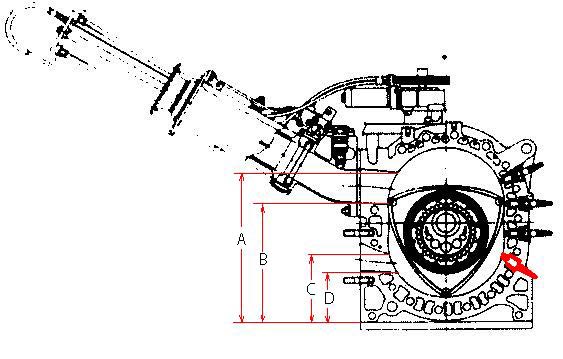
> There fore it helps to keep the throttle plates close
> to the rotor housing to minimize the volume of
> contaminated gases.
> --
> Paul Lamar ...No rotor no motor.
>
> Does a p-port have to be straight in? What would it do if you
came in from
a
> higher angle giving more separation from exhaust and a more
oblong intake,
> thereby basically hopefully giving you more intake without extending
> overlap?
> jofarr, soddy tn
>
> ----------------------------------------------------
>
> Might help. Lots of sizes and a few different angles have been tried.
> I can't say if there is an optimum angle.
> --
> Paul Lamar ...No rotor no motor.
-----------------------------------------------------------------------
Having given this plenty of thought and asked many questions of so
called
experts, I've come to the conclusion that the early post opening is
as Paul
suggested. That is overlap which contaminates the inlet charge. This
is only
a problem at idle, as the exhaust evacuation speed ( reaching supersonic
speeds) is more likely to suck inlet charge through the rotor
depression and
into the exhaust at higher rpm.
A much later opening subjects the inlet to increasing pressure (start of
compression cycle), which is even more likely to push inlet the fuel
air mix
back into the inlet manifold and may well reduce volumetric efficiency.
There is a suggestion that this back pressure can cause the fuel
droplets to
drop out of suspension and cause alternating rich, starved running.
The best solution ( at present) is Tracy Crooks method of early air
inlet
with a slightly delayed fuel injection.
Future direct injection will eliminate overlap and increase
atomization by
reducing fuel droplet sizes, as part of the DI process.
George (down under)
--------------------------------------------------------------------
The port timing has little to do with the overlap. The two ports are
ALWAYS
connected together in a P-port engine by the depression in the
rotor. In that regard
a P-port rotary engine is somewhat like a gas turbine engine. The
flow of
exhaust and intake gases, one way or the other, depends on the
instantaneous
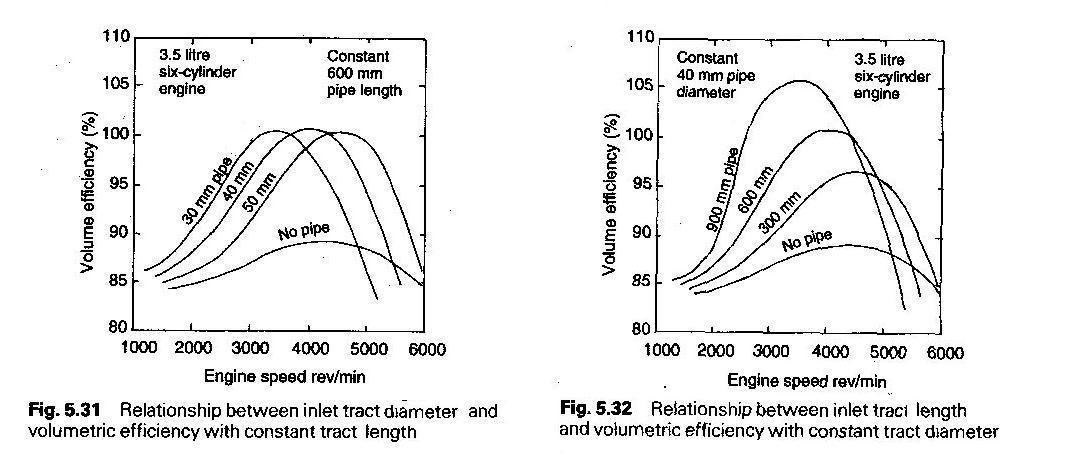
pressure differences in intake and exhaust. Pipe tuning has a large
effect. Everett Hatch found that 32 inch exhaust pipes worked
the best for 6000 RPM on a dyno. A muffler can greatly change the
balance.
A turbo charger will make a huge difference in the balance.
Anybody wishing to really see what is going on needs to instrument
the intake and exhaust port with high speed pressure sensors.
Unless this is done everything else is speculation.
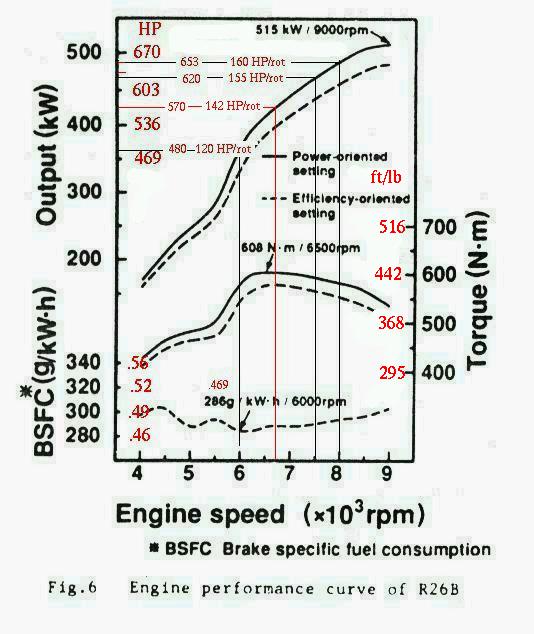
Here are some charts from Mazda that used such instrumentation.
So far DI has been unsuccessful in doing anything but perhaps make
the BSFC worse.
Super high pressure DI (20,000 psi and above) has not been tried to my
knowledge.
Placing the injectors way up stream giving the fuel more time to mix
works the best with p-ports. Racing Beat has done extensive dyno testing
with this configuration and confirmed the effect. A turbo p-port in
theory
is slightly better in this regard as the air intake temperature is
higher
vaporizing the fuel better. NA the intake pipes are very cold at
high power.
Almost freezing.
Passing the intake tubes through the oil pan on the Lycoming engines
to warm them aid in fuel vaporization but hurt max HP.
BTW Francois mentioned to me at OSH that injection timing is
critical with
his (Mistral) NA intake manifold that shoots directly into the side
port.
As far as I know Tracy has done no experiments with p-ports and as far
as Francois is concerned he does not think injector timing is as
critical
with p-ports.
Paul Lamar
I've found the intake and exhaust pressure curves that you attached to
this message to be very interesting. Do you know the lengths and
diameters of the intake and exhaust runners? Did the exhaust runners go
to a collector?
What carburation/fuel injection was used?
Philip
It came from SAE paper 841017 recent Tech Develop of High Power
Rotary Engine at Mazda.
Exhaust pipe length was 300 mm or 11.81 mm
P-port intake opened at 100 degrees before top dead center and
closed closed 70 degrees after bottom dead center.
RPM was in the ranges of 5000 to 6000 RPM.
The test engine was a 500 cc one rotor. Equivalent to
a 1000 cc 2 cylinder four cycle piston engine.
No idea if this was carb or EFI.
The intake pipe length and diameter was not specified but
they went on to present this chart of BMEP verse pipe
length. No mention of a collector.
This 1984 info is obsolete of course as the 1991 Lemans
engine was entirely different. The next three charts are
for the Lemans engine config. The pipe lengths shown here
are in addition to the fixed length of around 17 inches.
The diameters of the pipe are around two inches.
We came pretty close to duplicating the Lemans p-port engine
results with a Weber carb on the Mazdatrix dyno.
Torque peak is not only a function of pipe length
but also a function of diameter as shown in the least chart.
Perhaps something to due with Helmholtz theory.
Paul Lamar ...No rotor no motor.
George,
What is Tracy's method of early air inlet.
Geir
The Rotary Engine NewsLetter. Powered by Linux.
ACRE NL web site.
http://www.rotaryeng.net
Copyright 1998-2006 All world wide rights reserved.