Mistral?s 300 engine is 375 pounds. Why so much?
I thought a 20b was 266 out of the box. PRSU bulk? Takeoff
RPM at 2200?
Rick Irwin
Francois?
Paul Lamar ...No rotor no motor.
I think Francois is sleeping (midnight in Geneva) so probably
what he means is firewall forward the weight is 375 pounds.
That is about right perhaps just a little on the high side.
The bare weight is about 266 pounds.
Paul Lamar ...No rotor no motor.
The weight of a TOTALLY BARE 3-rotor 20B block is 233 lbs. That does not
even include the oil pump or the spark plugs! I do not know to what precise
engine configuration the number of 266 lbs corresponds. I suppose it must
be the automotive 20B with VERY FEW IF ANY accessories included and
CERTAINLY it is no aircraft engines.
To make it an airworthy aircraft engine you have to add some relatively
heavy modules: a PSRU capable of passing 300 HP, a backplate capable of
passing the engine/prop weight as well as the prop traction and gyroscopic
loads to the engine mount and ultimately to the airframe. You also have to
add plenty of other not so heavy components which add up.
I think there is a misconception on weight. Yes indeed, the rotary engine
is unbeatable on power to weight ratio by any other IC engine technology,
especially a 3-rotor! However, I believe it is impossible to build an
airworthy 3-rotor engine with an acceptable lifetime that will weigh less
than approximately 340 lbs... unless you have a lot of development money and
start becoming very sophisticated (Al side-housings, Ti through-bolts, etc).
The Mistral engines are designed and manufactured for a 3000-hour TBO.
Believe me, that adds weight relative to any minimal-weight solution. For
example, a transmission expert recently ran some sophisticated lifetime
calculations on our PSRU. He confirmed (while suggesting a few minor
improvements) this lifetime of 3000 hours on our top-of-the-line 360HP
engine, but our design doesn't have any unnecessary "fat" (read steel) at
that power! So, any significantly lighter transmission will fail well short
of a thousand hours... BTW, there are some people on this very newsletter
who painfully experienced precisely such a failure after only a few tens of
hours! After all, mechanics is an old engineering science... there aren't
too many "miracles" anymore.
Having said this, I do not mean that we do not have some opportunities to
save weight... as a matter of fact, we have precisely such a project
ongoing. I am open to suggestions.
Francois
What is the weight of your psru Francois?
Tracy's box weighs about 45 pounds as I recall.
The psru failures I am aware of are mostly due to the late
Ross being improperly machined or missing a helical gear thrust
bearing. A very common problem. As I recall Tom Parkes's Ross failed using
with his turbo 3 rotor. All Ross boxes used the four pinion
version of the Ford auto TX gear set. As I recall Tom replaced it
with one of Tracy's six pinion version. Al Gietzen is now
flying a three rotor with Tracy's six pinion boxes. Not many
hours yet.
Dave Leonard had one of Tracy's psru fail because the method
of attaching the sun gear to the input shaft failed on his
turbo 13B as I recall. See the attached picture. This is the
method I suggested for fixing the problem. A minor change.
Since that time Tracy has changed the
method of attaching the sun gear to the input shaft. Also Tracy
has gone to the much stronger six pinion version of the Ford auto
TX gear set.
Are these the failures you are referring to Francois or are
there other ones I am not aware of or I have forgotten about?
Paul Lamar ...No rotor no motor.
----------------------------------------
Paul, I was indeed referring to the two cases of transmission failures you
mentioned. I am glad Tracy switched to the much stronger 6-pinion
transmission.
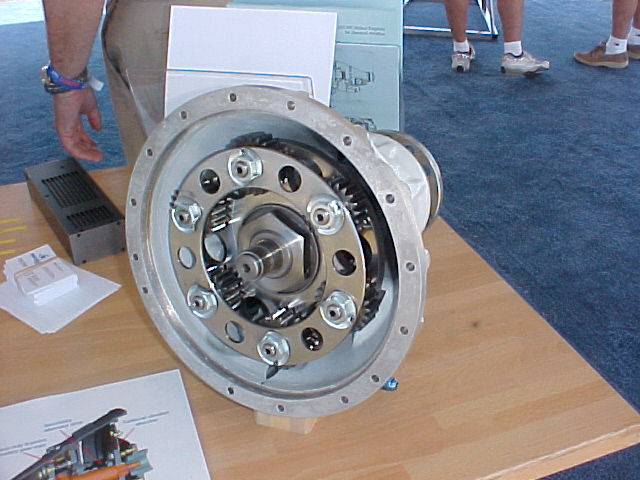
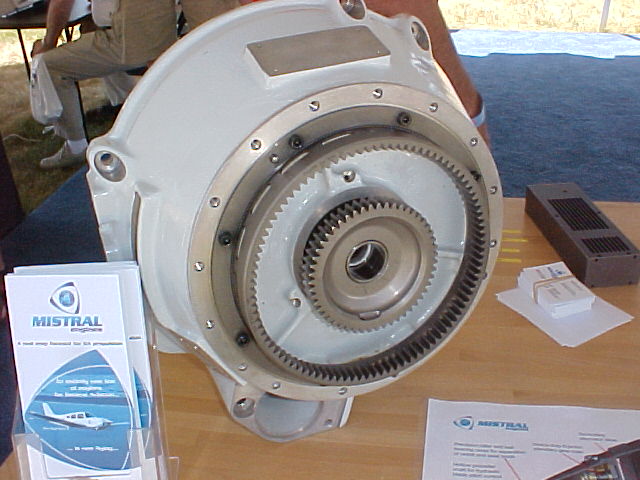
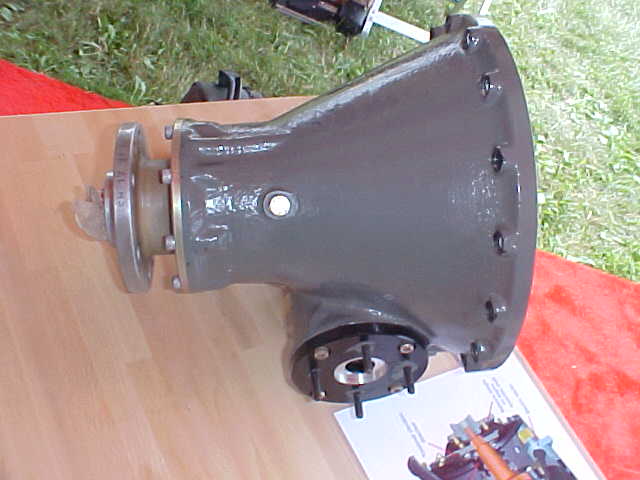
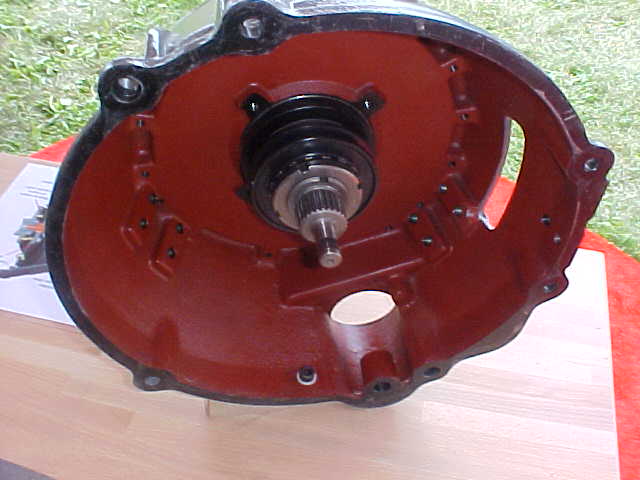
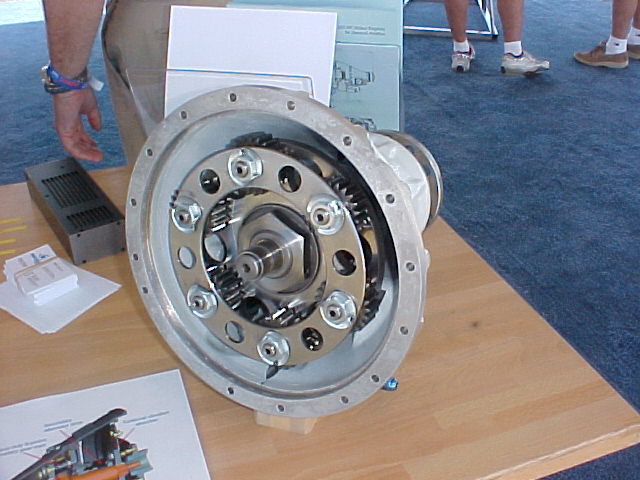
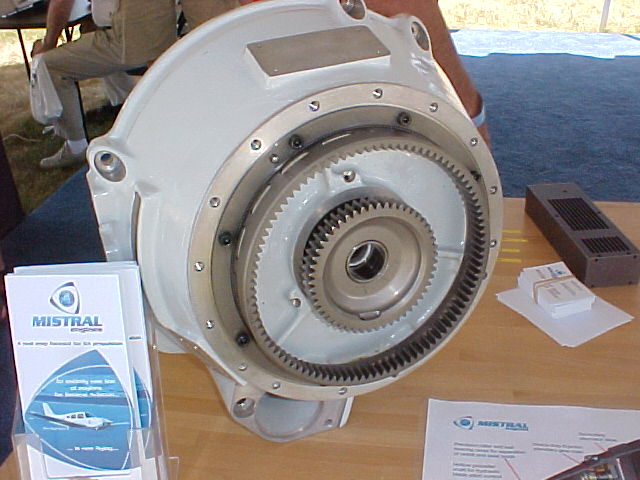
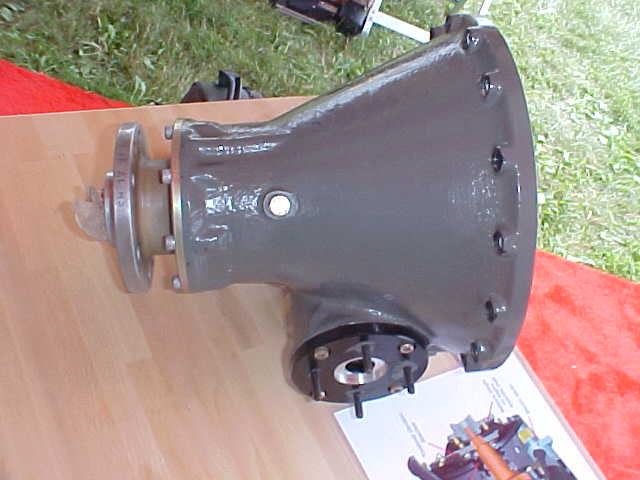
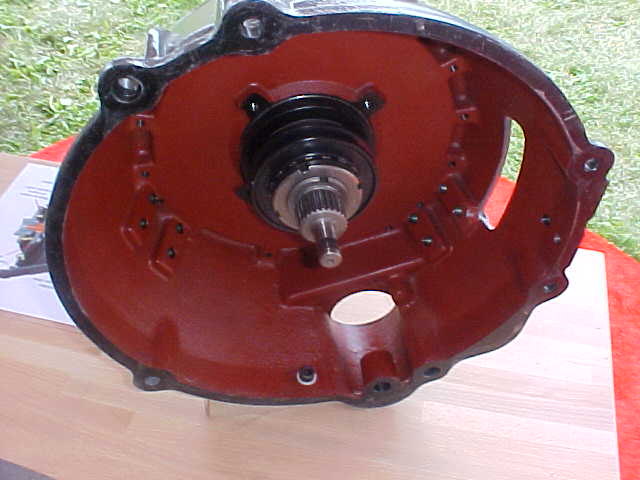
For comparison purposes, the weight of our PSRU can be detailed as follows:
- Steel (shafts, gears, satellite carrier and bearings) 35.5 lb (of which
1.2 lb is for the prop governor shaft which does not exist in most other
PSRUs)
- Magnesium transmission housing: 5.65 lb
- Magnesium dry- or bell-housing: 7.85 lb
Total transmission weight (including bellhousing): 49.0 lb (of which 1.2 lb
is optional)
- Miscellaneous (included within bellhousing but not belonging to PSRU per
se): drive pulley for secondary alternator 0.45 lb, vibration dampener 3.9
lb, flexplate and starter ring gear 4.1 lb)
I hope this information is useful.
Best regards, Francois
Here are some pics I took of Francois gear box at OSH
--
Paul Lamar ...No rotor no motor.
The Rotary Engine NewsLetter. Powered by Linux.
ACRE NL web site.
http://www.rotaryeng.net
Copyright 1998-2006 All world wide rights reserved.