You will not necessarily get more boost with a larger compressor.
What it does is load the turbine down so it does not spin
as fast. The high speed spin is the main reason they fail.
Temperature has a lot to do with it as well but in our
case it is mostly spin IMHO.
By all means cutting the turbine blades
sounds like a workable plan. Let us know how it goes.
Would be nice if you added a turbine tachometer
so we could get a better handle on the problem.
Paul Lamar ...No rotor no motor.
Paul,
I have a fuel injected, single turbo 13b sitting in my hanger (`86-`89
model with intercooler). I have heard from several sources that the stock
turbo is not the best to use in aircraft application because of blade
disintegration, over speeding, etc.
What turbo should I use? Exact name and part number, please, so I can go
to the turbo shop and ask for it by name. I do not know yet into what
plane the motor will go into, but a 2.17:1 reduction will be used.
Probably Tracy`s with his ignition and engine controller.
Thank you and regards,
Erik Snyman
Messina
South Africa.
I don't know. We have not had enough guys run other than stock
turbo's to really know what lives. We do know the stock turbo
will live if a larger compressor is fitted. Tom Parkes has run
an old aircraft turbo on a 3 rotor for awhile and that seems to
work. Unfortunately it is out of production as I recall.
Tracy's EFI will still have to be individually tuned for your
specific airplane and engine. Also I would suggest an intake
manifold air temperature alarm or sensor that detected intake
manifold temperatures over 140 F. It would be ideal if
it richened the mixture or retarded the ignition slightly
in that case to avoid detonation.
Paul Lamar ...No rotor no motor.
Paul,
I still feel (especially in stock turbo use), the bypass idea is the best
way to reduce heat and overspinning of the turbo. My new Suzuki motorcycle
has a butterfly valve to vary back pressure ( at different RPM's) for
exhaust tuning - the same principle can be used for the bypass to the turbo.
Claiming original idea and patent rights.
George (down under)
The stock 2nd gen turbo already has a waste gate bypass valve.
Nobody (other than a car racer wall grind jpgs), to my
knowledge, has effectively ported it to increase
its effectiveness so far. In theory it should work.
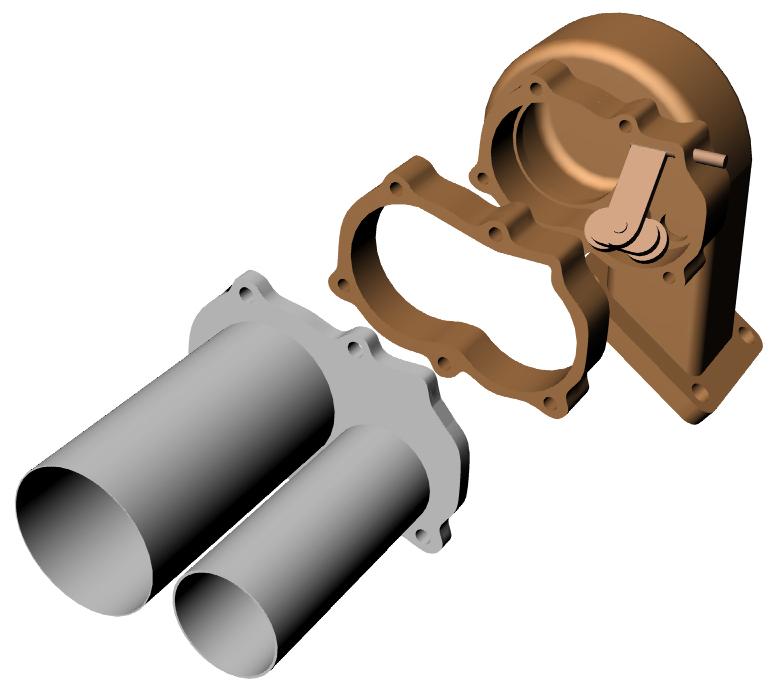
As I recall Dave Leonard removed the flapper entirely
but that did not seem to work well enough. Apparently the
hole must be greatly enlarged. The flapper is also
restricted from opening 90 degrees by the back cover without
modification. Some of those mods are shown here
Are you advocating adding a restrictor after the turbine?
If so that in effect is what happens with the stock exhaust
system in the 2nd gen RX7s. As soon as you remove the stock
exhaust system the boost jumps up several psi.
Paul Lamar ...No rotor no motor.
The Rotary Engine NewsLetter. Powered by Linux.
ACRE NL web site.
http://www.rotaryeng.net
Copyright 1998-2006 All world wide rights reserved.