Paul,
What would be the sea level exhaust pressure just before the turbine
inlet in a turbocharged engine?
I'm guessing maybe 18 psi to account for a little bit of back
pressure
due to the turbine?
Regards,
Gordon.
I don't have any data on that. I wish I did.
Paul Lamar ...No rotor no motor.
(Snip from my comments October '04... since I never received any
feedback on these comments, I always assumed no one understood the
real kernel of turbo wisdom here. This is how 1500 bhp/liter is
done. So, I'll put it out there again:)
I have seen no mention of this technique in the newsletter, so I
thought I would contribute some thoughts on turbocharger selection.
One of the damnable aspects of turbo sizing is trying to come up with
the best compromise for the dynamics of manifold pressure
generation: how much, how quickly, how efficiently, and how costly.
Automotive turbo applications are driven by a much different set of
goals, primarily their wide-range dynamic response issues. The
aircraft turbo application is a much happier equation to solve,
whether it be for all out power, or altitude compensation. In fact,
there is an opportunity to closely optimize the performance of all
the components so that some real magic begins to happen.
It's possible to size a turbocharger so that the engine, and its
forced induction, as a complete system, operates in 'crossover',
that is, when intake manifold pressure exceeds the exhaust manifold
back pressure driving the turbine. The result is a net positive
scavenge flow through the cycle and the result is significant gains
in power. Combined with the right intake/ exhaust event timing, BSFC
benefits as well. This crossover condition can only be achieved in a
narrow band of operation, but it happens to be the same band that
aircraft engines are looking for: Part throttle, medium load, and
medium rpm ( as a % of max rpm)
A program goes something like this:
Select the 'frame' size, or family of turbocharger so that there is a
good selection of turbine wheels, turbine houngs, trims and
compressors available in the range of mass flows necessary. The
Garrett T04 is such a family. Then, generally on the dyno, the
turbine side of the turbocharger is selected for its swallowing
capacity, resulting in larger than normal A/Rs. The objective is to
use all the gas flow to drive the turbine, not bypass continuously
through a waste gate. (The waste gate and its sizing still must
function as a safety/ control device, and for temporary demands for
higher manifold pressure)
The compressor selection can now be optimized for its output mass
flow and tailored for its best efficiency. The simplest way to
verify the component selection is to monitor the exhaust manifold
pressure just ahead of the turbine inlet, in fact the port can
sometimes be coincident with the EGT probe location. A small damping
orifice, around .020 seems to work well, will give steady readings at
the gage. A similar set up on the intake side, both before and
after the inter cooler. Then you can go to work mapping the relative
pressure results vs. a whole range of operating parameters, load,
speed, temps et al. When you home in on crossover, even if its only
a .5 psi differential, watch what happens to all the other numbers.
If you can achieve a 2, 3 or 5 psi lower turbine inlet pressure
relative to intake manifold pressure, then you've really done a good
job. You'll see directionally correct moves in the power, temps,
the bsfc, the ignition timing, et al.
The resulting turbo configuration will be a hybrid: an unusual
combination of turbine and compressor, most likely much bigger on
both sides than the automotive application. And operating in speed
and temperature ranges that are comfortable, safe and unstressed. My
guess is that none of the stock automotive turbo components will be
there in the end. The material specs are just not high enough
( anyone who flies without an Inconel wheel is asking for it...) The
power and efficiency numbers will be dramatic, the turbo application
is truly in its element once this balance has been achieved, and the
near steady state operation of the IC engine is one of the few times
we as engine development engineers can come close to this near
perfect condition.
Reeves Callaway
Thanks Reeves. So re wording this a bit a good system has
2 to 5 psi lower exhaust manifold pressure than intake manifold
pressure. I'll do an example. Lets say we have 10 psi boost
above atmospheric. Then the exhaust manifold will show
5 to 8 psi above atmospheric. Did I get it right?
--
Paul Lamar ...No rotor no motor.
Now we're 'cooking with gas, as it were, Paul. Your example is correct.
And just to emphasize, even the smallest differential between
turbine inlet pressure and compressor outlet pressure is the goal.
( As pilots , we really refer to all pressures in inches of Hg
Absolute. So running 40" of intake manifold pressure using only
39.5" (or less) driving the turbine is the goal.
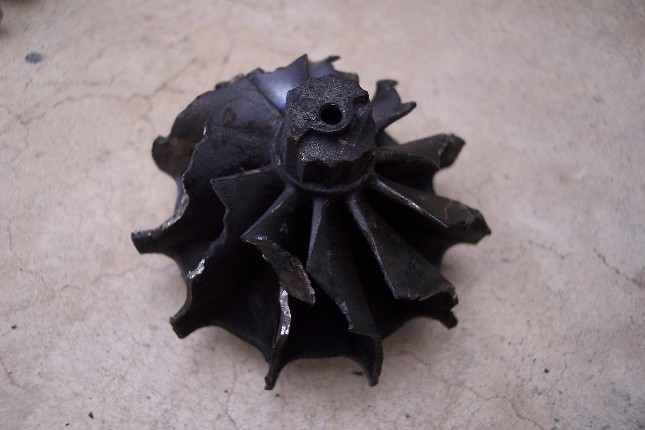
What scares me most about the turbo discussion on this list are the
signs of impending disaster... tips of turbine wheels eroding, or
gone missing! I can't tell you how wildly over-stressed the
components have to be to do that. In the horsepower and duty cycle
ranges that you are shooting for, the 200-300 hp area, there is no
question that you should all be in the T04b Garrett frame size. I
know nothing about the std Mazda turbo other than it has to be
selected by cost factors, not metallurgy. It certainly was when we
did the turbocharger design/build MazdaSpeed Protege for MNAO
( BTW, we were on the hook for sharing the warranty on those units.
4 years and 6000 vehicles later, I can report that the warranty
incident on the Mazdaspeed/Callaway turbo version was significantly
less than the norm.
In the car biz, a turbo failure is a 'walk home incident'. You know
what it is here...
Reeves Callaway
The standard RX7 Turbo II is about a TO3 size. Other than that we know
little about it. We have had several turbine failures. I suspect
mostly due to over speed. All rather benign without a
total loss of power. I suspect they are running well over 100,000
RPM at 12,000 feet and higher. I have not been able to talk
anybody into installing a turbo tach so far unfortunately.
--
Paul Lamar ...No rotor no motor.
The Rotary Engine NewsLetter. Powered by Linux.
ACRE NL web site.
http://www.rotaryeng.net
Copyright 1998-2006 All world wide rights reserved.