From all this talk about about the Bell planetary and other
planetary designs one might get the false impression there
is something wrong with the Ford planetary used in Tracy Crooks
PSRU. Nothing could be further from the truth. It has been used
for the past 30 years as the core of several PSRU's. The most famous
being the Ross. Unfortunately towards the end of the Ross company
they shipped a few that were improperly machined.
The latest Ford's (actually manufactured by Toyota) have been
ungraded with 6 pinions and are now used in the F250 Power Stroke
diesel pickup truck with 650 foot pounds of torque. That pales into
insignificance the puny 160 foot pounds from the Mazda 13B rotary.
The three rotor is only about 240 foot pounds.
Dozens of airplanes with Ford planetary have been flying for
years, some decades, with no trouble. One I know about had
over 2400 hours in a two place rotary powered gyro copter
used for training.
As far as I know no one has worn one out yet when properly
installed. The best part is the gear set cost less than a $100.
Paul Lamar
Agreed Paul - just looking at this for those with much higher HP
requirements. Also it is a special interest of mine, brought to life by
Doug's research.
George (down under)
Well lets see 650 ft pounds of torque for the Ford at 5000 RPM is
5000 X 650 / 5252 = 618 HP.
Paul Lamar ...No rotor no motor.
The Power Stroke is diesel Paul so the rpm's would probably 2000-3000 giving
247-371 hp. Tracy rates his for 300 hp which would seem to fit well.
John
Tracy is being a bit conservative IMHO.
Gear boxes are usually rated on torque and not HP.
Increasing the RPM and the HP in to such a gear box
assumes you are going to keep the oil cool.
IMHO the real limit is the RPM AND bearing load of the needle
bearing inside the planet gears. Needle bearings don't
like high RPM. This is a pretty good web site on the subject.
http://www.machinedesign.com/ASP/strArticleID/59055/strSite/MDSite/viewSelecte
dArticle.asp
Timken also publishes life factors as a function of load and RPM.
I think the Bell is going to have a needle bearing life problem
if run at 6000 RPM input for long.
The centrifugal load on the needles forces them out of contact
with the inner race at high RPM. The needles start to skid.
Silicone nitride rollers can up the RPM limit due to lower density.
BTW One of the reasons the Norton/Midwest/Diamond rotary engine
is limited to 7000 RPM is because of the needle bearings
in the rotor. A rotary engine this small should rev at 11,000
or more with at least 30% more HP.
Paul Lamar ...No rotor no motor.
Paul.
We are back from Kyoto now. It was a nice autumn this year.
Say I have heard about the Ford PSRU and its ability to handle 650 ft.lbs
of torque many times now. No doubt the gear sets are robust but with all
due respect is that statement 100% accurate? Perhaps the Ford set that
Ross and Tracy selected doesn't see all of that torque but just part of it
since it is embedded in a power train with loads in series and in parallel.
The trucks' rear end would be series while some load paths in the
transmission appear to function in parallel.
About the bearing and planetary speeds of the Bell, I agree with you 100%.
Gear line speeds seem to be within the realm of possibility but centrifugal
loading is a challenge. Obviously Mistral came up a bearing solution.
Both Bell and Mistral are well engineered products, with each component
selected for use using proven aviation tough components and developed with
extensive. For the majority of the people on this newsletter though Tracy's
unit appears to be sized just fine. It is a quality item but is limited to
fixed wood props. I happen to personally think a 3:1 or a slightly higher
ratio has some advantageous for my particular application. Still because
Bell's design point was originally focused on helicopters I look at the
design as a good starting point, not the finished product.
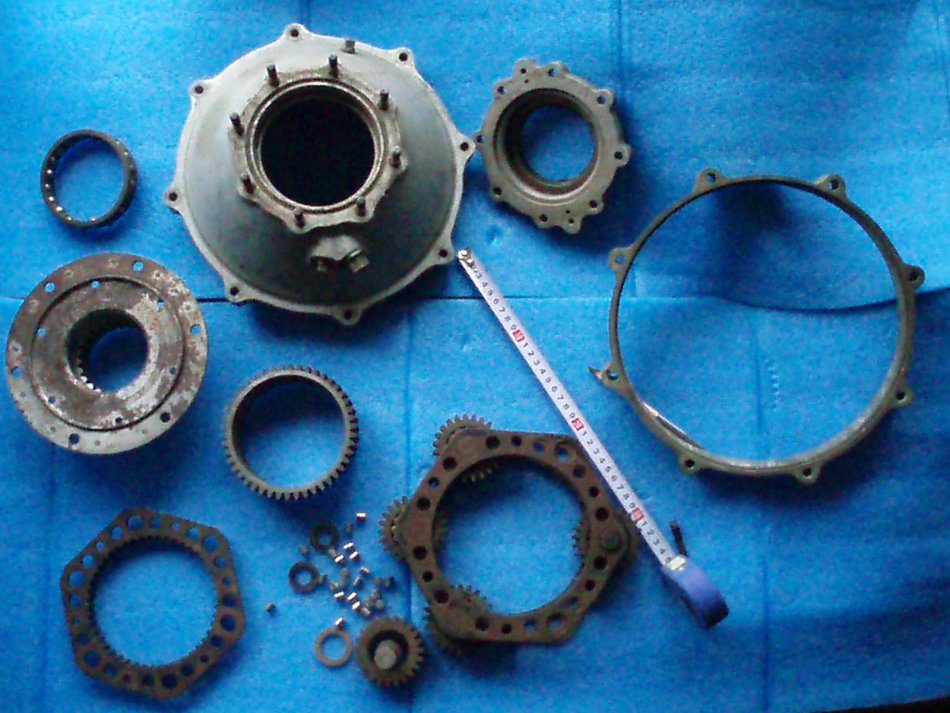
Here are a few pictures of all of the components shot from both sides.
Only the inner race of the TRW thrust and support bearing is shown in the
upper left. No prop shaft is made yet.
Note the planetary gear shaft has a hard bearing sleeve that slips over it
and then the bearings ride between this sleeve and the inner part of the
gear. This set-up lowers the rpms the roller bearings actually see because
the sleeve is also moving in relationship to the shaft.
Is that analogous to your stacking thrust bearings?
George
The 'one inch' referred to the thickness of the gears. Yes gear line
contact would be less than the Ford helical gears and spurs are noisier but
I don't want to have to deal with thrusting issues. I doubt noise will be a
concern though as it will be masked by greater engine noises.
I haven't seen the gear sizes of the primary planetary that feeds into the
one I have. You can see a cut off plate of the primary planet set on the
left in the picture. Its' shafts are 14.5 mm in diameter and the planetary
set diameter is about 144.5mm + 0.2 - 0 on shaft center.
Doug Fir
That pretty lady is with a strange looking Japanese gentleman :)
Paul Lamar
The Rotary Engine NewsLetter. Powered by Linux.
ACRE NL web site.
http://www.rotaryeng.net
Copyright 1998-2006 All world wide rights reserved.